Showing posts with label wake up call. Show all posts

The War in Libya and the War on Logic

One of the most strategically important aspects of the war in Libya is the parallel war on logic.  According to the Obama administration, the ongoing war in Libya is neither illegal nor unconstitutional because it is not a war.  From The Atlantic:
"We are in no way putting into question the constitutionality of the War Powers Resolution," one senior administration official explained to reporters on a conference call. "We are not engaged in any of the activities that typically over the years in War Powers analysis has considered to constitute hostilities within the meaning of the statute. We're not engaged in sustained fighting, there's been no exchange of fire with hostile forces, we don't have troops on the ground, we don't risk casualties to those troops." And here is Obama in his letter to Boehner:
The initial phase of U.S. military involvement in Libya was conducted under the command of the U.S. Africa Command. By April 4, however, the United States had transferred responsibility for the military operations in Libya to NATO and the U.S. involvement has assumed a supporting role in the coalition's efforts. Since April 4, U.S. participation has consisted of: (1) non-kinetic support to the NATO-led operation, including intelligence, logistical support, and search and rescue assistance; (2) aircraft that have assisted in the suppression and destruction of air defenses in support of the no-fly zone; and (3) since April 23, precision strikes by unmanned aerial vehicles against a limited set of clearly defined targets in support of the NATO-led coalition's efforts.
So, as the Obama administration would have it,  the president does not need a declaration of war from the Congress or even Congressional approval of the war in Libya because we're not involved in a war in Libya: we're just providing material support for allies engaged in combat, neutralizing air defenses, maintaining a no fly zone, and waging an extensive bombing campaign with unmanned drones.  Ron Paul writes at the Daily Caller:
Our Founders understood that waging war is not something that should be taken lightly, which is why Article 1, Section 8 of the United States Constitution gives Congress — not the president — the authority to declare war. This was meant to be an important check on presidential power. The last thing the Founders wanted was an out-of-control executive branch engaging in unnecessary and unpopular wars without so much as a Congressional debate.

Unfortunately, that’s exactly the situation we have today in Libya. That’s why I’ve joined several other members of Congress in a lawsuit against President Obama for engaging in military action in Libya without seeking the approval of Congress . . . the War Powers Act is hardly an improvement on the U.S. Constitution because it does allow the president to go to war without the approval of Congress.  But President Obama refuses to follow this law.
It is time to begin holding our presidents accountable for their crimes. 

Land of the Free, Home of the Incarcerated

From Daniel D'Amico at the Mises Institute:
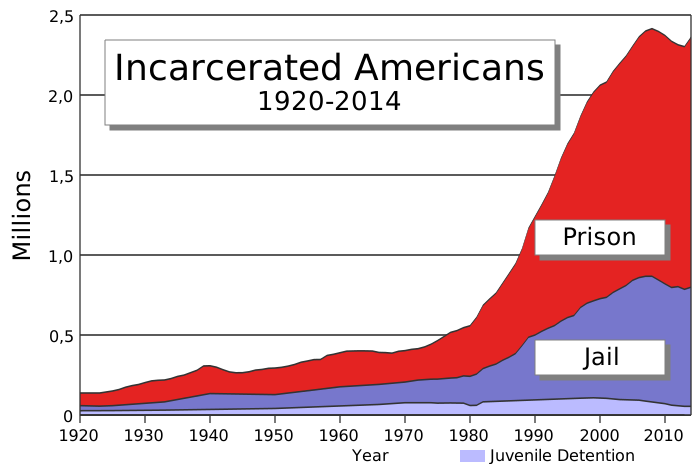
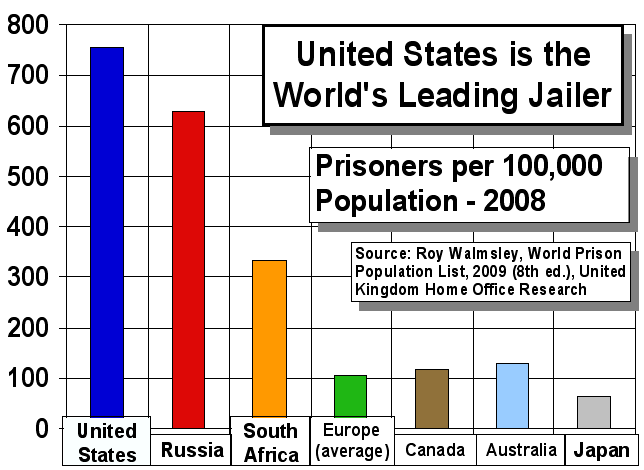
It is time to take prisons seriously. The United States incarcerates more people than any country in the world today and throughout history. The financial costs are tremendous and rising. One in every one hundred Americans is jailed within this so-called land of the free. Many have committed no violent crimes. Not a few are in for supposed political crimes. Some are wholly innocent of both yet languish in captivity. What are the sociological, political, economic, cultural, and historical consequences of incarceration?

The prison is a unique technology of enforcement. One could say it is the ultimate embodiment of institutionalized coercion. Its essential architectural features — individualized cells and controlled living environments — minimize the opportunities for social interaction among inmates and maximize their perception of total observation and control by guards. Both features were designed and implemented to accomplish particular purposes.

Since the 1970s, the American system has been said to operate according to a retributive paradigm of criminal justice, wherein criminals are thought to deserve punishment. Prisons are believed to be an efficient retributive technique and deterrence is their convenient consequence.

Originally, penitentiaries were designed and built with grander intentions: to induce penitence at the individual level and to make for a better community at the societal level. Prisons were both a micro and macro tool of social engineering . . . 
This summer, D'Amico will be holding an online course at the Mises Academy on the prison state that has been constructed by the Democratic and Republican parties over the course of the last four decades:
In my upcoming Mises Academy course, The American Prison State, I will use readings and lectures to outline the long and varied history of incarceration and criminal law in the United States. All the readings for this course will be free and online. The online video lectures will use Webex, the industry standard for web conferencing. Lectures will be Tuesday evenings, 7:00–8:30 EDT, and they will be recorded and available for enrolled students to download. The first class will be on June 7.
Some basic facts and figures to consider:

File:US incarceration timeline-clean.svg


Please Refer All Complaints to Your Local Emergency Dictator

As I've written, again and again, there are three basic steps in the formula for Republican-Democrat party government in the United States: 1) if there is no crisis at hand, manufacture one; 2) utilize this crisis to justify the implementation of emergency measures which would ostensibly address the crisis; 3) under the cover of those emergency measures, stage attacks on fundamental rights and liberties while securing and consolidating the base of power for the dictatorship of the two-party state.  The practice is so common and so widespread, it really should have a name, if it doesn't already.  Any suggestions?

Another recent example of the practice comes to us from Michigan, where legislation allowing for the declaration of "financial martial law" empowers the governor to dissolve elected local governing bodies and replace them with "emergency financial managers."  The new law has received relatively little attention in the corporate media, but a number of bloggers at Forbes have been following the story rather closely.  From Rick Ungar, just over a month ago:
This week, the Michigan legislature passed – and the governor signed into law – a bill that would permit Governor Rick Snyder to push aside elected city officials and replace them with emergency financial managers in any municipality or school district facing financial difficulties. . . .

Whatever the reason, one of the most shocking, Draconian, democracy-destroying measures in the history of this country has became law – and the nation has seemingly slept through it.  Should you think I am somehow overstating the issue – which would certainly be understandable given how difficult all of this is to believe – let’s do a quick review of what has happened in Wolverine State.

The new law, described by one of the GOP legislators sponsoring the bill as “financial martial law”, empowers the governor’s appointees (referred to as ‘Emergency Financial Managers’ but more aptly termed viceroys appointed by the king) allows the EFR to fire duly elected local officials, cancel labor contracts and even dissolve entire communities and school districts. . . .

This law gives an appointee of the governor – which, by the way, may be a corporation – the authority to dismiss any or all of a municipality’s elected government officials. How does this not anoint Michigan’s governor as King Richard the First? Let that sink in for a moment and then explain to me how any citizen of this country can avoid outrage?
In Detriot, the actions of "Emergency Financial Manager" Robert Bobb stoked actions that resulted in the arrests of numerous protesters who opposed the unilateral closure of a highly successful school for pregnant teens.  From E.D. Kain at Forbes, last week:
Detroit Emergency Financial Manager Robert Bobb announced last month that he was closing eight schools, and selling up to 45 more to charter companies. Among those slated for clsoure was the Catherine Ferguson Academy, a school designed for pregnant teens and the only one of its kind in the nation. One reason the announcement came as such a surprise to students and teachers there is that Catherine Ferguson has a stellar track record, boasting 90% graduation rates and 100% college acceptance rates.
A local media account of the protest action against the closure of the school:
Protesters gathered outside the Catherine Ferguson Academy Friday afternoon chanting, picketing and holding signs -- a show of solidarity against the proposed closing of the school, which caters to pregnant and parenting teenage girls. While they were outside, about a dozen others were inside holed up in the library. When they wouldn't come out, Detroit police went inside.

"Police came and they're like, 'You've got to go. You've got to go,' said Tiffany Baldwin. "We just stood there and they just arrested us one by one."

"Officers advised them that the building was closed and that they did need to leave or they would be considered trespassers. After several warnings, they refused to comply. Once we were able to make entry into the room where they were, we arrested several for trespass," said Chief Roderick Grimes with Detroit Public Schools.

As the chants grew louder, students, former students and even a teacher were led out in handcuffs . . . Some struggled, some screamed, all were put in squad cars and hauled away. "To go in like storm troopers to arrest people who were carrying on a peaceful protest during spring break to preserve their school was just absolutely outrageous," Driver said . . .

There was a DPS spokesperson on the scene. He said they understand that a school can mean so much to students, parents and teachers, but that a protest is not the way to go about trying to get your message heard. Instead, they are encouraged to talk to Robert Bobb and show that their school needs to stay open.  [Emphasis added.]
Under the rule of the Republican-Democrat party, a peaceful protest is no longer the way to go about trying to get your message heard.  Such tactics, one assumes, are better suited to a situation in which government officials are democratically elected by the public.  Instead, you are encouraged to grovel at the feet of your local emergency financial dictator.

Breaking: Democratic and Republican Parties to Merge, "Super Party" in Works

A release from Starshine Media, a political watchdog group, sent via email:
Washington, D.C., March 31 (Rush Copy) – In recent weeks, leaders of both the Democratic and Republican parties have quietly held a series of confidential meetings at the Washington Hilton aimed at forging consensus on a wide range of divisive political issues that have divided the nation.  Lawmakers have brainstormed new legislation, party leaders have swapped ideas on strategy, and all have attempted to woo long-time donors to win their support for the efforts of the group, according to staffers familiar with the events.

An analysis of roll call records reveals that dozens of lawmakers, party leaders and even private donors have filtered in and out of the weekly sessions over the last two and a half months.  "This is not your stereotypical meeting of well-heeled party leaders in a smoke-filled backroom," said one wizened aide who attended a number of the meetings.  "You're not allowed to smoke at the Hilton," he quipped.

The closed meetings have been something of an open secret among Washington's chattering class.  Media executives have been in attendance to coordinate messaging ahead of the group's official launch, which is tentatively scheduled for late spring or early summer.  Word of the discussions first leaked to outside sources following an electronic snafu in which a number of internal documents from the group were forwarded to an independent researcher in northern Virginia.

"I don't think it was an accident," said Richard Folley, who received the documents earlier this week.  "I was bcc'd on an internal email that had a bunch of attachments," he explained.  A 'bcc,' or blind carbon copy, refers to the practice of sending a message to multiple recipients while concealing the fact that there may be additional addressees from the complete list of recipients.  Folley shared the documents with this organization.

Among the most startling proposals floated by the working group is a plan to merge the Republican and Democratic parties into what would be, for all intents and purposes, a single entity.  Proponents of the idea cite the danger posed to the traditional political order by the tea party and anti-war movements, and a number of independent citizens' groups aimed at countering corporate influence in the major parties. 

The plan calls for cross-endorsements of individual candidates from both major parties, agreements to cease running challengers in non-competitive districts, and the passage of legislation to tighten up ballot access law to prevent independent and third party candidates from spoiling "choreographed contests," as one document puts it.

A parallel outreach effort would seek to ensure that private donations from individuals and corporations flow into the apparatus of the new "super party" rather than toward traditional partisan fundraising operations and outside groups.

Another document proposes new strategies for keeping the media on message and restricting access to decision-making positions from the public at large.  

"Democracy is messy, we just want to clean things up a bit," said one participant in the negotiations who would only speak on condition of anonymity due to the sensitive nature of the talks.

Some observers have questioned the necessity of such an effort.  "Under the two-party system, Democrats and Republicans have already achieved the wide majority of these goals," said Douglas Layman, a political scientist and researcher at George Washington University.  "Party leadership is clearly concerned that they inhabit an increasingly precarious position in an increasingly unstable political order," he continued.

Others, however, welcomed news of the group's activities.  "For too long, the parties have turned a blind eye toward the political implications of the growing disconnect between the people and their representatives," said Bill Warrens, a veteran political consultant and strategist who has worked on numerous high profile campaigns for Democrats and Republicans alike.  "Without such actions, there will soon come a time when voters are no longer willing to support the lesser of two evils," he stated.

Contacted by phone, Democratic and Republican party officials declined to comment for this story.

News Anchor: "The change we really need is to somehow dump these two parties."

Via Rise of the Center comes a link to a video from 2008 in which influential Detriot news anchor Bill Bonds signs off from his final broadcast with a commentary stating that "we need to dump these two parties."  A partial transcript, video below:
Like you I love America . . . but more and more frequently I don't trust my government, I don't believe what some of our elected leaders are telling us . . . this America is in deep, deep crisis . . . if we're going to successfully maneuver our way through these nightmares, I think we're gonna have to play a little hardball with these two political parties of ours and the people who control them . . .

we have to find a way to tell these Democrats and these Republicans, these liberals and these conservatives that, "before you were a Democrat or a Republican, you were first an American." I believe there are a lot of Americans who are now convinced that you've forgotten that. I think a lot of Americans believe that maybe you're just more loyal to your parties than you are to your country and your fellow citizens. And maybe the change we really need is to somehow dump these two parties and form a new one, because whatever it is you guys and gals are doing just ain't working anymore. And that's kinda scary.

Nader: Prosecute Bush and Obama for War Crimes

In an interview with Democracy Now, Ralph Nader calls for the impeachment of President Obama:

Will Social Media Kill the Two-Party System?

Joe Trippi seems to think so, and he predicts it will happen within the next two presidential election cycles.  From Politico:
Democratic political consultant Joe Trippi said Sunday that it’s just a matter of time before a third-party candidate comes out of nowhere to upend a presidential front-runner . . . Speaking at the South by Southwest Interactive conference about how social media continues to transform politics and campaigns . . . He said some underdog candidate is going to seize on social media tools in ways that no one has even thought of. . . .

Trippi went on to predict that a third-party candidate will soon raise so much money through the Web that Obama’s 2008 haul will look modest by comparison.

“There's going to be a moment, and it could be in 2012 – you know for my party’s sake, I hope it's in 2016 – but some independent candidate is gonna just come out of nowhere and raise a billion dollars on the Internet, saying ‘screw both these parties, it's you and me baby, let's go change this thing.’”
Trippi predicted this would have a radical impact on politics, as we know it. “It will be the end of the two parties,” Trippi said.
It can't happen soon enough. 

Acts of Speech and Acts of War: Wikileaks and Information Warfare

Has the most recent Wikileaks diplomatic document dump sparked a worldwide information war?  The political establishment in the US was quick to frame the Cablegate release as an act of war.  The incoming chairman of the House Homeland Security Committee, Republican Peter King, has stated, “This is worse even than a physical attack on Americans, it’s worse than a military attack,” and promptly called for Wikileaks to be designated a foreign terrorist organization.  Secretary of State Hillary Clinton called the disclosures "an attack on America's foreign policy interests," as well as "an attack on the international community."  Such rhetoric has undoubtedly figured in the decisions of corporations such as Amazon, PayPal and Mastercard to cut all ties with the controversial organization, and inspired distributed attacks against the Wikileaks website, prompting Sam Wilson at Think 3 to wonder whether we are in the midst of "an internet civil war."  But this "war" is not confined by any single nation's borders, rather, it spans the globe.  Dave Bonta writes at Via Negativa:
It doesn’t seem that long ago — around 2000, maybe? — that I first heard someone say “TMI” and had to ask what it meant. This morning, as news breaks that the anarchistic, world-wide non-organization of geeks known as Anonymous have launched DDoS attacks against the websites of MasterCard, Swedish prosecutors, and others they consider to be unfairly targeting WikiLeaks and Julian Assange, it occurs to me that the problem or scandal of “too much information” is very much at the heart of what’s shaping up to be the first global information war — call it WIW I, or perhaps WWWW I (World Wide Web War I).  
Many advocates of transparency in government and internet freedom, however, have begun to argue that employing even the metaphorical language of war and warfare to describe the ongoing fallout from and response to the most recent mega-leak, represents a serious strategic blunder, as it allows opponents of transparency in government and internet freedom to control the terms of the debate.  At Polizeros, Josh Mull argues that "journalism is not an attack and Wikileaks is not warfare."  He writes in response to a post by Bob Morris:
Asymmetrical warfare, anarchist bomb-throwing, and “digital vandalism” are all forms of attack. But dissent is not an attack. Activism is not an attack. And most importantly, journalism is not an attack . . .

The act of publishing information is not warfare. Wikileaks is not warfare. Just because Julian Assange thinks of himself as a freedom fighter, and just because Wikileaks’ supporters like to imagine themselves fighting an “Infowar”, doesn’t make it true.  If we allow our definitions of war and conflict to blur, then we bring the government’s aggressive response on ourselves . . .

If you support Wikileaks, if you support transparency, accountability, or even just basic free speech, you should not be playing into the government’s semantic game that presents itself as a victim, and Wikileaks as an attacker. As someone who engages in journalism, as someone who engages in activism and dissent, I don’t want these things re-defined as an attack on the state.
The problem, however, is that the state has already prepared the conceptual groundwork to promulgate a redefinition of such acts and actions as part and parcel of an ongoing information war.  Morris writes in response: "It’s not asymmetrical armed warfare, to be sure, but the tactics are the same, so perhaps we should call it asymmetrical info warfare."  In fact, Cablegate – understanding that term in the widest sense, to include the actions of Wikileaks as well as the response by agents of the state, individual citizens and other non-state actors – has virtually all the markings of an information war as that term has been re-defined and re-conceptualized by the state.

Over the last ten years, the Department of Defense has quietly been developing the conceptual and operational framework for what it calls "information operations," or "info-ops" for short.  An Information Operations Primer published by the Army War College in 2006 (see the relevant document at IWS) delineates five core capabilities that constitute information operations: 1) psychological operations, 2) military deception, 3) operations security, 4) electronic warfare, and 5) computer network operations.
• The concept behind Wikileaks is almost indistinguishable from that of psychological operations (PSYOPS), here defined as "planned operations to convey selected information and indicators to foreign audiences to influence their emotions, motives, objective reasoning, and ultimately the behavior of foreign governments, organizations, groups, and individuals."

• The immediate response to the latest megaleak on the party of the Department of Defense was aimed at ensuring operations security (OPSEC) by taking actions to defend against any future such leaks from protected information networks.  As noted at Wikipedia, OPSEC is "a process that identifies critical information to determine if friendly actions can be observed by adversary intelligence systems, determines if information obtained by adversaries could be interpreted to be useful to them, and then executes selected measures that eliminate or reduce adversary exploitation of friendly critical information."

• The distributed denial of service attacks against Wikileaks and those against the websites of corporations such as PayPal and Mastercard might easily be construed as a form of electronic warfare (EW) or as computer network attacks, in which latter case they would fall under the rubric of computer network operations (CNO).  A computer network attack "includes actions taken through the use of computer networks to disrupt, deny, degrade, or destroy the information resident in in computers and computer networks and/or the computers/networks themselves."  In response, all parties involved here have all very likely engaged in computer network defense, understood as "actions taken through the use of computer networks to protect, monitor, analyze, detect and respond to unauthorized activity within information systems and computer networks." 

• Finally, some conspiratorially minded observers and commentators have begun to wonder whether the Cablegate mega-leak is itself an act of military deception, and have asserted that Wikileaks was always or has become a front for state-actors engaging in "false flag operations." 
Among those speculating whether Wikileaks has effectively ignited an information war, the question has been raised as to what or where precisely the battlefield of this conflict is.  If one assumes that we are indeed in the midst of an information war, then the answer to this question is disturbingly simple: there is no space, whether physical, virtual or even mental, that is not a part of the battlefield.  Consider the following graphic conceptualization of information operations from the document mentioned above:


The "information environment" – the abstract space in which information warfare and information operations are carried out – has physical, informational, perceptual, cognitive and social dimensions.  Thus the potential informational battlefield stretches from the tangible real world, to cyberspace, to the individual human mind, to society as a whole.  As such, information warfare allows for a form of total war the likes of which were literally impossible before the dawn of the information age.

One of the primary characteristics of total war is the erosion of the distinction between civilians and combatants.  The complete collapse of this distinction is axiomatic for radical terrorist groups such as Al Qaeda.  The maintenance of this distinction represents a primary difference between civilization and barbarism.  For this reason, if for no other, it is imperative to defend the freedom of speech and of the press against any and all who would seek to argue that any such act of speech or press constitutes an act of war.

A Government that Cannot Secure Its Own Data Cannot be Trusted with Ours

Among the hundreds of thousands of State Department diplomatic cables that have been, or are soon to be released into the public domain via the Wikileaks "Cablegate" database, I happened to stumble across a noteworthy document that might go some way toward explaining how such a massive leak is possible in the first place.  As reported yesterday at Third Party and Independent Daily, in the run-up to Germany's 2009 general elections, American diplomats in Berlin worried that a strong showing by the Free Democratic Party might complicate US national security strategy and specific trans-national counter-terrorism efforts because the libertarian-leaning party is a strong defender of civil liberties and the individual right to data privacy.  From TPID:
The cable frames the FDP's support for citizens' privacy rights and individual liberties as a hindrance to US security strategy, and states that, if it were to join a ruling coalition in Germany, the party would scrutinize any proposals that would require sharing or accessing of information concerning private individuals.  The cable faults the party's "limited government viewpoint" for its opposition to data-sharing measures that would infringe on the privacy rights of individuals. 

In a most ironic turn, the leaked cable scoffs at FDP Parliamentarian Gisela Piltz, who cautioned against data-sharing operations with the US government on the grounds that the US government as a whole lacks effective data protection measures even as it accumulates massive amounts of data on innocent citizens. 
The author of the cable dismisses the parliamentarian's concerns that the United States lacks sufficient  data protection measures, and implies that German officials simply do not understand how effective US data protection policy really is.  Needless to say, the fact that this confidential cable is now in the public domain along with hundreds of thousands of documents just like it demonstrates how ineffective US data protection policy really is.  And Democrats and Republicans want us to believe that they can be trusted to collect and safeguard reams of data on us?   

The greater irony, however, is that this massive breach of information security was likely facilitated by efforts to increase information sharing between federal, state, and local government agencies and competing bureaucracies in the wake of the 2001 terrorist attacks.  In other words, Democratic-Republican party policy consensus is ultimately responsible for this leak and data dump.  An article at the Guardian provides a fascinating look at SIPRNET, the supposedly secure network from which the hundreds of thousands of leaked diplomatic cables were likely accessed and relayed to the public domain:
Siprnet is itself an acronym, for Secret Internet Protocol Router Network. Siprnet was designed to solve the chronic problem of big bureaucracies – how to share information easily and confidentially among large numbers of people spread around the world. Siprnet is a worldwide US military internet system, kept separate from the ordinary civilian internet and run by the defence department in Washington.  Since the terrorist attacks of September 2001, there has been a move in the US to link up separate archives of government information, in the hope that key intelligence no longer gets trapped in information silos . . . 
Siprnet does not appear especially secure, given that millions of individuals worldwide may well have access to it.  In 1993 over 3 million people had clearances that would theoretically have allowed them to view its contents:
An increasing number of US embassies were plugged into Siprnet in the last decade, so that military and diplomatic information can be shared. In 2002, 125 embassies were on Siprnet; by 2005, there were 180. . . . From there it can be accessed not only by anyone in the state department, but also by anyone in the US military who has a computer connected to Siprnet. Millions of US soldiers and officials have "secret" security clearance. The US general accounting office identified 3,067,000 people cleared to "secret" and above in a 1993 study.
According to a CBS News report on Siprnet and information sharing from this past summer, "hundreds of thousands of people" have access to Siprnet.  (A columnist at Town Hall relates his own experience with the network, which he terms "the secret internet.")  Despite concerns about potential leaks, demands for access to Siprnet have only grown.  Last May, Next Gov reported that language buried in the 2011 Defense Authorization bill would require that every single committee in the US Congress have access to Siprnet.

Given the fact that one of the core functions of the Department of Homeland Security is to "foster information sharing," we should not be surprised if this non-transparent, sprawling and unaccountable bureaucracy is at least partially to blame for the massive holes in US data security measures.  We will wait in vain for any form of intellectually honest self-criticism from Democrats and Republicans on this issue. However, on the other side of the coin, the hysterical reaction to the most recent Wikileaks data dump on the part of Rep. Peter King, incoming chairman of the House Homeland Security Committee, demonstrates the extent to which the DHS bureaucracy represents a threat to fundamental liberties.  King wants Wikileaks to be labeled a "terrorist organization."  From CBS News:
Long Island Rep. Peter King told 1010 WINS the release of the information put “American lives at risk all over the world.”

“This is worse even than a physical attack on Americans, it’s worse than a military attack,” King said. King has written letters to both U.S. Attorney General Eric Holder and Secretary of State Hillary Clinton asking for swift action to be taken against WikiLeaks and its founder Julian Assange.

King wants Holder to prosecute Assange under the Espionage Act and has also called on Clinton to determine whether WikiLeaks could be designated as a Foreign Terrorist Organization.
Since Wikileaks does nothing more than publish information that is supplied to it by others, as I understand it, what King wants is the criminalization of liberties guaranteed under the First Amendment to the Constitution, namely, the freedom of speech and of the press.  Perhaps this is only to be expected from a "warmongering fascist," as David Kramer describes King at Lew Rockwell.  But King is not alone among Republicans and Democrats in his contempt for rights, liberties and the rule of law.  We can save ourselves over $50 billion dollars a year by dissolving the Department of Homeland Security, depriving petty totalitarians in the Congress of yet another pedestal from which they can terrorize the people of the United States, and safeguard liberty in the process.  It would be a bargain.

Opt Out of the Two-Party Charade, Declare Your Independence

The forced choice between strip search and sexual assault that is being foisted upon American air travelers by the DHS/TSA resembles nothing so much as the false choice between the Republican and Democratic parties forced upon the American people by the structure of the reigning two-party state.  The supposed competition and opposition between the Republican and Democratic parties is as much a political charade as the DHS/TSA's new protocols are little more than security theater.  It is time to opt out of the imaginary double binds with which our political system confronts us on a daily basis.

Is there a better metaphor for the choice between the Democratic and Republican parties than that between invasive strip search and public sexual assault conducted by the agents of Democrat-Republican party government?  It might even go some way toward explaining the pervasiveness of ideological and political Stockholm Syndrome among American voters, not to mention the rapidly-cycling bipolar disorder of the American electorate.  Opt out of the two-party charade.  Declare your political independence from the two-party state and duopoly system of government.

South Dakota's Independent Candidate for US House: "The parties are part of the problem, not the solution."

B. Thomas Marking is running as an independent candidate for the US House of Representatives in South Dakota. On the front page of his website, Marking writes: "South Dakota has but one voice in the U. S. House of Representatives. It should therefore be a truly Independent voice." Marking explicitly describes his party affiliation as "None of the Above," and explains:
In the current proclamations of both the G.O.P. and the Democrats, I find no coherent philosophy; other than whatever one is for, the other is most surely against. This relationship is as irrational and destructive as the famous feud between the Hatfield and McCoy families. For many, it seems the feud has become more important than doing the people's business, sometimes more important than the objective truth.

Our major political parties are now more a part of the problem than of the solution. They routinely act irresponsibly, and consistently produce bad answers to the wrong questions. In addition, both parties have acted to further centralize power in Washington, one just a bit faster than the other. I have therefore sworn my fervent independence from both.
Over the weekend, South Dakota's Press and Dakotan published a lengthy profile of the independent following a meeting and interview with the outlet's editorial board on Friday. Randy Dockendorf reported:
U.S. House candidate B. Thomas Marking wants his fellow South Dakotans’ vote — not only in the November election but on issues after he would take office. The Custer man, who has retired from a career in federal and state service, is running as an independent candidate. He faces Democratic incumbent Stephanie Herseth Sandlin and Republican challenger Kristi Noem.

During Friday’s interview at the Press & Dakotan, Marking explained his proposal for allowing citizens to register their opinions on major policy areas. Marking said he would provide the quarterly surveys as a way for citizens to give input on issues.
Judging from the paper's description, Marking's proposal actually sounds quite similar to the "Open Office" concept developed by Jake Towne, an independent libertarian candidate for Congress in Pennsylvania. Dockendorf's article goes on to describe Marking's career and background, while elaborating his positions on a number of high-profile issues, including the wars, immigration, tax policy and even cyber-security. Marking states that he is running for the office as an independent because the major parties have become part of the problem:
Marking is running for Congress as an independent to avoid partisan labels and separate himself from the party machinery. “You saw the two parties in the past, and they were more the problem than the solution,” he said. “It seems like a matter of divide and conquer. They slap a label on the other side and describe them as evil. I didn’t want to be a part of it.”
The interview with Marking clearly left a strong impression with the folks at the paper. In a reflective editorial published today, the Press and Dakotan urges readers to consider the perspectives and positions of those who do not speak from within the framework of Democrat-Republican party government and asks: "Independent Voices: Will we ever listen?" From the editorial:
An independent candidate for South Dakota’s lone U.S. House seat stopped by the Press & Dakotan last Friday. The interview had been arranged a couple of days before that, and so we prepared to meet him for the very first time. But in the back of our minds, we couldn’t help but think that he already had two strikes against him . . .

The aforementioned two strikes arise from the deeply ingrained two-party mentality that dominates our political culture. We have become so conditioned to choose one or the other that most of us give little thought to considering any variations . . .


It’s odd to consider that when the American electorate decides it needs a change, it simply turns back to the party from which we made the change in the first place. With such a peculiar dynamic in place, the two parties often seem more interested in working to pry the other from power, as opposed to working to solve the laundry list of problems this nation always faces . . .

This is not an endorsement of Marking or any other independent candidate. Instead, we’re merely pointing out that the two major political parties do not have a monopoly on ideas and solutions for this nation. There are other ideas that lurk outside the two-party mainstream who have a few ideas, too. Listening to them does not mean you embrace them or endorse them. They won’t infect you or destroy you. But they just may make you think about other answers to the questions we face and about just how limiting and self-serving our two-party institution seems to have become. [Emphases added.]
Of course, there is no question as to just how limiting and self-serving our two-party institution has in fact become, except, perhaps, for the most ardent partisans of the ruling political class. The American declaration of independence from Democrat-Republican party government is long overdue.

Environmental Catastrophe and Democratic-Republican Party Government: the Global Warfare and Coporate Welfare State vs. the People of Earth

The environmental catastrophe in the Gulf of Mexico perfectly demonstrates the abject failure of Democratic-Republican party government to represent and defend the interests of the people of the United States, and, indeed, the people of earth, over and against the interests of well-connected multinational corporations. This, of course, is not surprising, as the apparent moral, political and intellectual bankruptcy of the response to this catastrophe by the nation's ruling criminal-political class is, sadly, just one more piece of evidence documenting the moral, political and intellectual degeneracy of the Democratic-Republican global warfare and corporate welfare state. The rot begins at the very top. Naturally, the president is the single greatest recipient of campaign contributions from British Petroleum. Reuters reports:
BP and its employees have given more than $3.5 million to federal candidates over the past 20 years, with the largest chunk of their money going to Obama, according to the Center for Responsive Politics. Donations come from a mix of employees and the company's political action committees - $2.89 million flowed to campaigns from BP-related PACs and about $638,000 came from individuals.
Sarah Palin recently attempted to score political points against Obama by suggesting his financial dependency on the oil giant has compromised his ability to confront the crisis, which is not an unreasonable suspicion. As the Wall Street Journal documents, however, Republicans are in no position to criticize Democrats on this matter:
Former Alaska Republican Gov. Sarah Palin stirred up more controversy over the oil spewing into the Gulf of Mexico Sunday when she suggested that the administration’s response was linked to “the oil companies who have so supported President Obama in his campaign.” . . .

According to the nonpartisan Center for Responsive Politics, Republicans receive far more campaign money from the oil and gas industry than do Democrats. So far in 2010, the oil and gas industries have contributed $12.8 million to all candidates, with 71% of that money going to Republicans. During the 2008 election cycle, 77% of the industry’s $35.6 million in contributions went to Republicans, and in the 2008 presidential contest, Republican candidate Sen. John McCain received more than twice as much money from the oil and gas industries as Obama: McCain collected $2.4 million; Obama, $898,000. This is a decades-long trend, the center says.

The criminal collusion of big government and big business was unwittingly documented by a CBS News crew on site at the Gulf coast early last week. As reported by Raw Story:

As BP withholds information on impact of massive oil spill, Coast Guard says that 'embedded' media have been allowed to cover response effort. As oil from the massive BP spill in the Gulf of Mexico approached the US coastline, a CBS News crew was threatened by the US Coast Guard with arrest if they attempted to film a beach in South Pass, Louisiana.

"When we tried to reach the beach ... a boat of BP contractors with two Coast Guard officers on board told us to turn around under threat of arrest," CBS's Kelly Cobiella reported on Tuesday. "This is BP's rules, it's not ours," an officer can be seen calling from the other boat in the CBS video . . . Since this initial brief report, the CBS video clip has been widely re-posted, but there has apparently been no followup from either CBS or BP.

The true nature of the global warfare and corporate welfare state is perfectly revealed by this small incident, in which a news crew is threatened by military officials acting under orders of a multi-national corporation: "This is BP's rules, it's not ours." Unsurprisingly, CBS has apparently opted not to follow-up on this story. Even columnists in the New York Times have become cognizant of the crisis that is corporatist government. Bob Herbert writes:

This is the bitter reality of the American present, a period in which big business has cemented an unholy alliance with big government against the interests of ordinary Americans, who, of course, are the great majority of Americans. The great majority of Americans no longer matter.

It is long past time that we bring back the corporate death penalty.

Tea Party Protesters Confronted By Riot Police, the True Face of Democratic-Republican Party Government

Numerous commentators are shocked today that riot police would be called in to confront a large group of protesters outside an event where the president was slated to speak. Via Memeorandum, Jim Hoft writes at Big Government: "Unreal . . . Unbelievable . . ." Of course, anyone who finds it "unreal" and "unbelievable" that peaceful protesters would be confronted by riot police is seriously out of touch with the realities of the surveillance society and national security police state that has been constructed in the United States over the course of recent decades. Militarized police units are the very face of Democratic-Republican Party government. Left Coast Rebel writes:
I wonder if we will be seeing more of this kind crackdown on Tea Party events? After scanning several stories, I sure as hell could not find an 'incident' that provoked authorities to the point of calling in riot police.
If there is any question here, it is the following: why hadn't we already seen such shows of force by the police at tea party protests? As I wrote last July in a post on a tea party protest that drew unwanted attention from local police:
Since many Tea Party organizers admit that they are new to the forms of protest they have begun to employ, it was only a matter of time before they realized that protesters are often not looked upon kindly by members of the law enforcement community, to put it mildly.
At political protests in the United States, the deployment of riot police to confront people exercising their constitutional rights is the rule rather than the exception. At future events, keep an ear out for the following announcement regarding your freedom of speech and assembly:
To those who remain, by order of the chief of police, I hereby declare this to be an unlawful assembly. I order all those assembled to immediately disperse, you must leave the immediate vicinity. If you do not disperse you may be arrested and/or subject to other police action.
In practice, such declarations are followed by the deployment of tear gas, flash grenades and rubber bullets, all on the tax payer's dime, of course.

Wake Up Call: Third Party Now

At Georgia's Barrow Journal, Chris Bridges calls on Americans to "wake up from their political slumber" and makes the case against reproducing the Democratic-Republican two-party state:
Change for change’s sake is not getting us anywhere. We can elect Republicans to replace Democrats and nothing is going to change. We can elect Democrats to replace Republicans and nothing is going to change. Until voters wake up from their political slumber and realize a third party is needed, we will continue to be in the same sinking boat we are going under in . . . Time to quit trying to bail out and get into another boat.

Whether it is the Libertarian Party (my choice), the Constitution Party, the Tea Party or even supporting an independent candidate, it’s time to start thinking outside the box. We can’t expect solutions when we continue to give the wrong answers.

In 2008, it was the Republican Party which fell victim to the tidal wave of voter revolt. Right now, it appears the tide is sweeping the other direction. But what good is that going to do? Candidates elected on single issues aren’t set up to be effective for the long haul.

Until we realize that they all need to be thrown out, along with this broken two-party system, we will continue to have the same problems, with no viable solution in sight. It’s time to wake up people. Shed the broken system of the two parties which, in reality, don’t have enough difference between them to amount to anything. If you truly value change, then look beyond the same slate of candidates. At the very least, look beyond candidates who simply used one office to seek a higher one. Our state and our country depend on it.
 
http://www.wikio.com