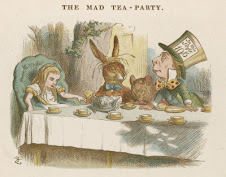
'It wasn't very civil of you to sit down without being invited,' said the March Hare. 'I didn't know it was your table,' said Alice, 'it's laid for a great many more than three.'
At the Patriot Post, Mark Alexander asks whether third party conservatives are "fixers or spoilers," and considers the dilemma between "purism and pragmatism" felt by so many voters. He writes:
Many Patriot readers have asked: "How should one vote when a third-party candidate is more conservative than the Republican offering? Should one vote for the lesser of two evils on the major party tickets? Is a vote for a third-party conservative a wasted vote or, worse, one that takes votes from a moderate on the ticket, and seats a Leftist?"
The answers, of course, depend on one's affinity for purism versus pragmatism, and the particular circumstances and consequences of each political contest. Purists are those who rigorously and steadfastly adhere to established traditions and principles in the conduct of their affairs, in application both to individual and societal matters. Pragmatists, on the other hand, are those who take a practical approach to arriving at solutions, even if that means supporting the lesser of two evils. They thus try to strike a balance between principles and practicality rather than take a strict ideological line.
He concludes:
in the opinion of this humble purist, who knows when to exercise some pragmatism, I suggest you vote early, and make your vote count! If you are faced with a choice between a third-party conservative and a Republican moderate, and you can vote for the most conservative candidate without seating a Leftist as a consequence, do so. If not, hold your nose and vote for the most electable conservative on the ticket.
By coincidence, the Wading Across blog also addressed this very same issue in a lengthy post today, but argues that the two-party system has become so dysfunctional that the so-called pragmatic option of working with and within the major parties is no longer viable:
The two party system is flawed, and yet we are yearly told we should prop it up because it’s the only way. Perhaps the real answer is to let the Republican party flop and create a new party. Or, conversely to watch the Democrat party implode and see all of the moderates (RINOs and DINOs) coalesce. The two-party system in this nation has seen such things occur before, though it’s been over 150 years. Maybe it’s time for that again. Maybe it’s time for people to vote for the individual, and not the party – and to not just pay lip service to that statement as many often do.
It will not be the end of the world or this nation if the Republican party does not regain control next month or in 2012. Fight for this country with conviction and principles, not pragmatism and compromise. Fear not. Too many people give in to pragmatism over conviction out of fear for the future. If our founders had been pragmatic, we would never have become a nation.
Among the greatest paradoxes to result from the ideology that sustains the two-party state is the fact that though a majority of the public reject both the Democratic and Republican Parties, refusing to identify themselves with the aims and ends of either, only a small fraction of that same public support third party and independent alternatives to the representatives of the ruling Democratic-Republican political establishment. While browsing the news yesterday for reports on the recent LibDem surge in the UK, I came across a video of John Cleese's "party political broadcast for the Liberal Democrats" from 1997 (via Robert Mackey). In the video, Cleese hones in on this precise paradox, effectively framing it as a constitutive but completely irrational element of the viability hurdle faced by all third party and independent candidates for political office. The comedian states:
People like our policies, so what's the problem? The problem comes because you like our policies. The polls show that half of you prefer LibDem policies and would vote for the Liberal Democrats if you thought we could win. Do you see the problem? Half of you prefer LibDem policies and would vote for the Liberal Democrats if you thought we could win.
That means if you did vote for us, we would win. Right? I mean, not just do well, but actually win. In fact, half the votes would give us the biggest landslide this century. We should be so lucky. So look, when you say that you would vote for us if we could win, I'm not being rude, but what do you mean, exactly?
Allegory of the Cave: 'many cities nowadays are governed by men who fight with one another over shadows and form factions for the sake of ruling, as though it were some great good.'
 Via RSS
 Via Twitter