 Via RSS
 Via Twitter

On December 29th, the Arizona Green and Libertarian parties filed a lawsuit in the US District Court of Arizona charging that the state’s new voter registration forms violate their First Amendment right to freedom of association and their Fourteenth Amendment right of equal protection under the law.
The state’s former voter registration forms included a box prompting registrants to specify their party preference by writing that name in the space provided. In the most recent session of Arizona’s legislature, however, lawmakers changed the design. In the party preference section on the new form, voters are prompted to check one of three boxes: the first is labeled Republican, the second is labeled Democrat and the third is labeled ‘Other.’ Underneath the ‘Other’ label, a small space is provided for registrants to write in the name of their party preference if it is other than Democrat or Republican.
The lawsuit alleges that the form now discriminates against the state’s minor parties by privileging the Democrats and Republicans. “This change has the sole effect of benefiting the Republican and Democratic Parties, and disadvantaging the Libertarian and Green Parties. It suggests the first two options to the future voter, while omitting all mention of the latter parties,” the suit charges.
The suit further states that when plaintiff Steve Lackey, a member of the Arizona Libertarian Party, attempted to register as a Libertarian at the Department of Motor Vehicles, “personnel there refused to allow him to do so, in the belief that “Other” referred to Independent, and not any third party.” In practice, the new form thus abridges the right to free association as it does not provide equal protection to all ballot qualified parties . . .
Given the rate at which Arizonans are leaving the Democratic and Republican parties, it is reasonable to assume that the change to the registration form was intended to bolster their membership rolls. Indeed, Independents now outnumber Democrats in the state. As of last July, 32.5% of the state’s voters specified no party preference. 31.1% were registered with the Democratic party and 35.4% were registered Republican. Just under 1% of the state’s voters are registered Libertarian or Green.
This represents a massive shift in registration patterns from just over a decade ago. In the year 2000, 43% of the state’s voters were registered Republican, 38% were registered Democratic, and only 18% specified no party preference on their registration forms.
Showing posts with label Libertarian. Show all posts
Showing posts with label Libertarian. Show all posts
AZ: Greens and Libertarians File Suit Against New Voter Registration Form
From today's column at IVN:

Free and Fair Elections Are Impossible with an Unfree and Unfair Ballot Access Regime
As you may have heard, only two candidates for the Republican presidential election have qualified to appear on Virginia's primary ballot: Mitt Romney and Ron Paul. Michelle Bachmann, Rick Santorum and Jon Huntsman did not even attempt to gather the over 10,000 valid signatures that would have assured their place on the ballot. Rick Perry and Newt Gingrich did, but failed to obtain enough valid signatures before the petition deadline. Needless to say, this is not sitting well with the Gingrich and Perry campaigns and, predictably, they have now become supporters of choice and competition. From Angel Clark at the Examiner:
I doubt Newt Gingrich even realizes what he said here! He's upset as he is not going to be on the primary ballot in Virginia.Gingrich and Perry's failure to achieve ballot access has brought renewed attention to the biased and discriminatory ballot access regime that has been instituted by the dictatorship of the Republican and Democratic parties over the last century. Indiana's News Sentinel takes the opportunity to call for ballot access reform. Excerpt:
We're getting an amazing number of people who … believe Virginians ought to have the right to choose and shouldn't be restricted to two people."Oh, of course! He wants people to vote for him, to choose him as one of the only two people they are supposed to get to choose from for President of the United States of America (using his two-party system), but when he is not one of the two people, it's not fair. The system has failed.
"Voters deserve the right to vote for any top contender, especially leading candidates."I doubt Newt Gingrich even realizes what he said here! He's upset as he is not going to be on the primary ballot in Virginia.
We're getting an amazing number of people who … believe Virginians ought to have the right to choose and shouldn't be restricted to two people."Oh, of course! He wants people to vote for him, to choose him as one of the only two people they are supposed to get to choose from for President of the United States of America (using his two-party system), but when he is not one of the two people, it's not fair. The system has failed.
"Voters deserve the right to vote for any top contender, especially leading candidates,"Interesting... I guess what he should be saying is any top contender who plays by the rules of the Republicans vs. Democrats...
Virginia voters will not have the seven candidatures now running but only Mitt Romney and Ron Paul to choose from. And Virginia isn't even listed among the five worst states for access. But Indiana is, along with Oklahoma, Texas, Georgia and North Carolina. The troubles of Perry and Gingrich in Virginia should be a strong incentive for the Hoosier political establishment to start making access a little easier here. They won't, sadly, but they should be.As the News Sentinel points out, these draconian ballot access restrictions were primarily instituted to prevent third party and independent from competing on a level playing field with the ruling parties. At Free Virginia, Marc Montoni, the Secretary of the Libertarian Party of Virgina, argues that this is a teachable moment for Republicans:
The candidates have a point when they complain about Virginia's rules (and Perry is also suing). Like the rules in most states, Virginia's requirements may make it tough on Republicans and Democrats, but their main purpose is to keep the third-party and independent riffraff away. The state requires that people carrying petitions for the candidates must be registered Virginia voters or those eligible (by residence and age) to be registered Virginia voters. That means Perry, for example, had to recruit local talent instead of bringing his Texas team in. It's little wonder that only 6,000 of the 11,900 petition signatures he submitted were ruled valid.
Perry claims in his suit that the requirement violates his First Amendment rights because it puts a too-heavy burden on his ability to engage in political speech. That's a valid constitutional issue, and past decisions by the Supreme Court and other courts indicate that a ruling on the point could go either way. Perry certainly has the moral high ground. States should encourage participation in the political process, not make it more difficult and expensive.
Indiana's requirements are so tough for independent and third-party candidates that Libertarians are usually the only ones able to collect enough signatures. Even Ralph Nader didn't get on our ballot in 2008. To make it, a candidate must collect signatures from 2 percent of the total votes cast in the most recent secretary of state election. Considering recent voting numbers, that means getting about 34,000 signatures, compared with the mere 4,500 required for Democrats and Republicans.
Indiana's primary is so late in the election year that voters usually have little reason to participate; the presidential candidate has already been chosen before our May date. Keeping our ballot-access requirements so high further dampens voter enthusiasm, and that's not good for the process or the electorate.
Last Friday afternoon, December 23, 2011, Newt Gingrich and Rick Perry were notified that they had not turned in enough valid signatures to qualify their names for Virginia's Republican primary ballot . . . Gentlemen, welcome to the world where adherents of the Libertarian Party, the Greens, or the Constitution Party live: where their exhausting effort and huge expense meets bureaucracy, unending paperwork and needless legal hurdles -- before we are even allowed our place at the starting line.Virginia’s primary petition requirements were copied from the laws originally written to keep independents and third parties off the ballot. For a century, Democrats and Republicans colluded to establish and tighten ballot-access standards so much that voter choice has become practically nonexistent. This makes it difficult for us in the alternative & independent candidate sector to feel much sympathy for the ‘major’ candidates when their own laws snare them. One would hope that the Republicans would take this as an educational opportunity . . .Petitioning laws were originally built -- the strictest of them by majority-Democratic legislatures between 1910 and 1970 -- to shut out third parties like the Libertarian Party. The laws did the job, too -- in some states, third parties have not been allowed on the ballot for over half a century, and counting.Petitioning requirements force new, upstart third parties to exhaust themselves asking several hundred thousand voters to help them qualify for the ballot. Unless those new parties have the money and activist backing of the wealthy and political elite already, just getting on the ballot so they can then present their ideas to voters is an expensive, time-consuming task.Republicans should be wary of restrictive ballot access . . . Nor should the Democrats, in their glee about the Republicans' difficulties, forget how restrictive ballot laws sometimes snare them as well . . .Democrats and Republicans alike have forgotten that elections are for voters. When voters can't vote for the candidate they wish to vote for, they are being hurt and our political discussion is being disrupted.Perhaps the Republicans who now control the state legislature should take this as a message that Virginia's restrictive ballot-access laws are overdue for some overhaul.
The Libertarian Party’s position is that primaries are essentially state subsidies for political parties. Therefore, the only real reform needed to the “primary process” is to eliminate government-run primaries altogether, and allow political party members to determine who they wish to represent them during the general election – at their own expense.Failing that, then reform can be easily accomplished by simply reducing the petition requirement . . . I have personally collected thousands of petition signatures for dozens of candidates at different levels. Anyone who thinks requiring thousands of signatures to get on the ballot is compatible with a free society needs to research the history and justifications for these oppressive laws a bit more.Forcing alternative candidates -- who haven't been given the chance to appear in the modern "public square" that is the media -- to utterly exhaust themselves collecting signatures is a reprehensible practice in a “free” society.Governments should not have any ability to control ballots at all. Open ballots not printed or controlled by government gave us men like Thomas Jefferson and George Washington. Compare them -- even with all of their faults -- to the modern crop of corruptocrats.
Montoni closes with a plan to reform ballot access law in Virginia:
Making Virginia’s Ballot Laws Better
Reform of Virginia’s ballot access laws should begin with the following:
- Reduce signature requirements for all offices and all candidates -- Democratic, Republican, Libertarian, Green, or independent -- by 90 % (rounding to next 10). A statewide candidate petition (Governor, president, etc) would then require 1,000 signatures; a candidate for congress would need to collect 150, a state delegate candidate, 20.
- Introduce a full-party access petition, 10,000 signatures to place a new party on the general election ballot for two statewide cycles.
- Eliminate the witnessing requirement for petition signatures.
- Eliminate the residency requirement for petitioners.
- Eliminate petition sheets, and move to a postcard petition -- where individual voters would fill out a post card stating they wish a candidate (or party) to be placed on the ballot.
- Get with the last decade and allow petitions to be ‘signed’ by voters online.
Gary Johnson Will Seek Libertarian Nomination for President
It is all but confirmed that former New Mexico Governor Gary Johnson will seek the Libertarian Party's nomination for president in 2012. Johnson is now the second GOP presidential hopeful who will seek a third party nomination. Buddy Roemer announced a number of weeks ago that he will seek the Americans Elect nomination. From USA Today:
Former New Mexico governor Gary Johnson will abandon his GOP presidential bid and seek the White House under the Libertarian Party banner. Johnson has drawn scant attention in the race for the Republican Party nomination and barely registered in national public opinion polls, which are often used as a criteria for participation in debates. He has scheduled a news conference on Dec. 28 at the Capitol building in Santa Fe, N.M., to announce his decision. "He is representing a viewpoint and a viewpoint that needs to be heard and he's going to do whatever it takes to get that done," Johnson spokesman Joe Hunter told the Associated Press.
The Republican Presidential Primary and Its Discontents
As the corporate-sponsored clown and puppet show known as the Republican presidential primary race lumbers forward, perhaps we can take comfort in the fact that we will not be subjected to a comparable spectacle by the Democrats. Moreover, the exclusionary character of the contest may well produce a number of worthwhile third party and independent candidates for the presidency. The Daily Caller reports that Gary Johnson may seek the Libertarian Party's nomination for president and Buddy Roemer may go Independent or seek the nomination in the Americans Elect online primary. On Gary Johnson:
Long excluded from the Republican presidential debates, former New Mexico Governor Gary Johnson is now seriously considering a third party run for president in 2012. . . .
Faced with either continuing his quixotic run for the Republican nomination, launching a third party effort, or just giving up, Johnson now says he has been receiving overtures from the Libertarian Party, which will be on the ballot in all 50 states next year.
“One thing I would make clear is that, if I did decide [to seek the Libertarian nomination], that’s nothing that’s pre-ordained,” Johnson told TheDC. “That’s something that I would have to go out and work for. And I would do just that, I would go out and work for that.”On Buddy Roemer:
In an ideal world, Republican presidential candidate and former Louisiana Gov. Buddy Roemer would like Senator Joe Lieberman as his running mate, but the Connecticut senator is not necessarily on the same page.
“Senator Joe Lieberman’s reputation as a reformer and a man of integrity is unrivaled in American politics. He is unequivocally my first choice for a Vice Presidential running mate,” said Roemer in the statement.
The two men’s differing party affiliations — Roemer is a Republican, Lieberman is an independent and formerly a Democrat, seems to actually be something Roemer sees as a plus. For one thing, he touted their shared history of switching parties — Roemer served as a Democratic congressman, and then switched to the Republican Party midway through his gubernatorial reign . . .
If Roemer did decide to go after the Americans Elect nomination, he could continue to run in the Republican primary, which Roemer would certainly do at least through New Hampshire, where, in Sierra’s words, the campaign is “going all out.” Roemer has actually moved to New Hampshire for the election, and as soon as his campaign qualifies for matching funds, they will make ad buys in the first-in-the-nation primary state. “I think they kind of compliment each other,” said Sierra of the Americans Elect nomination and the Republican nomination.
Seeking Input for Electoral Reform Wish List: What Say You?
Since the Occupy Wall Street protests began in downtown Manhattan on September 17th, I have noted on a number of occasions that there is an inspiring amount of independent and third party activity and organizing taking place at the demonstrations. Members of the Green, Libertarian, Socialist and Reform parties, among others, have been involved in the movement from the very beginning, in addition to legions of Independents.
Much of the organizing work being accomplished at Occupy Wall Street is being done within autonomous working groups and caucuses. There are working groups devoted to everything from media and internet to outreach, direct action and reform. There are a number of groups, of which I'm aware, that should be of special interest to independents, third party advocates and opponents of the two-party state. Over the next couple days, I'm going to provide some info on these various groups and relay portions of the documents and proposals they have been working on, all of which can be found through the New York City General Assembly's website for Occupy Wall Street.
Today, the focus will be the Politics and Electoral Reform group – in which I have been active for a number of weeks. The group is working on a proposal recommending electoral reforms that could be implemented by states and localities to level the playing field for those who have been marginalized, and whose interests are not represented, by the Republican-Democrat two-party state. Numerous reforms are being considered by the group, which is collaborating on a working draft document for the proposal. Here is an excerpt from the section of the document specifically devoted to the recommendations for reform:
Much of the organizing work being accomplished at Occupy Wall Street is being done within autonomous working groups and caucuses. There are working groups devoted to everything from media and internet to outreach, direct action and reform. There are a number of groups, of which I'm aware, that should be of special interest to independents, third party advocates and opponents of the two-party state. Over the next couple days, I'm going to provide some info on these various groups and relay portions of the documents and proposals they have been working on, all of which can be found through the New York City General Assembly's website for Occupy Wall Street.
Today, the focus will be the Politics and Electoral Reform group – in which I have been active for a number of weeks. The group is working on a proposal recommending electoral reforms that could be implemented by states and localities to level the playing field for those who have been marginalized, and whose interests are not represented, by the Republican-Democrat two-party state. Numerous reforms are being considered by the group, which is collaborating on a working draft document for the proposal. Here is an excerpt from the section of the document specifically devoted to the recommendations for reform:
• Alternative voting methods. Our voting systems should promote honest participatory democracy. There are alternatives to plurality voting, such as instant runoff voting, ranked choice voting, approval voting and range voting, liquid democracy and so on.(Note: the proposal is a living document, and any of the above could and probably will be changed by the group at some point.) I'm relaying this excerpt because many readers here at Politea have thought long and hard about a lot of these issues, and could provide some interesting suggestions that could be taken up by the group. So what say you, folks? What do you think of the recommendations as they stand? Should any be amended? or dropped? or edited? Are there any important potential reforms that are missing from the list?
• Independent, nonpartisan redistricting. Voters should choose their representatives, lawmakers should not choose their voters.
• Smaller and more localized districts. Expansion of the number of representatives in local and state government and in the House of Representatives. This will ensure a closer relationship between the people and their elected officials, putting the latter on a shorter leash.
• Proportional representation. Winner-take-all, single member district plurality voting has allowed narrow political factions to wield disproportionate influence within our system of government. There are alternatives.
• Expansion of franchise. Those who are denied of the right to vote because they have, for example, served time in prison, should be re-enfranchised.
• Term limits. Election to public office is not a lifetime appointment. Term limits should be imposed by law or by the people at the ballot box.
• Ballot access reform. All should be equal before the law regardless of party affiliation or lack thereof. Ballot access laws that favor the major parties and discriminate against independent and third party candidates should be repealed and replaced with fair and reasonable alternatives. The default state of the ballot should be open.
• Primary election reform. A publicly funded election should be open to the public. If parties desire to hold closed primary elections, they can provide for their own caucuses and conventions.
• Initiatives and referenda. The people retain the right to originate ballot initiatives and referenda.
• Vote counting. The reintroduction of hand counted, paper ballots, or the introduction of significant controls to protect against the rigging of electronic voting machines, which are produced, operated and serviced by corporations with significant ties to powerful political factions.
• Weekend or holiday voting. Voting should be encouraged not discouraged.
• Fusion voting. Parties should be able to nominate the candidates of their choice across party lines.
• Campaign finance. Publicly funded election campaigns, or matching fund systems that allow candidates who refuse to accept corporate donations to compete on a level playing field with candidates who are heavily financed by corporate interests.
• Combination and synthesis. A liquid democratic primary with an IRV runoff between the top four candidates from the primary. Countless other possibilities.
Tea Party Founder Speaks Out in Support of #OWS
Karl Denninger was an early founder and organizer of the Tea Party movement in January and February 2009. Throughout 2010, he was outspoken in his opposition to the hijacking of the movement by the Republican party and has now begun speaking adamantly in favor of the Occupy Everything protests spreading across the country, identifying significant points of convergence between the goals of Occupy Wall Street and the original goals of the Tea Party movement. A Huffington Post article on Denninger from October 2010:
Karl Denninger, an original organizer of the Tea Party, is out with a livid blog post blasting current leaders of the conservative movement and the apparent hypocrisy in their views of the economic issues that originally catalyzed its creation.
According to Denninger, "Sarah Palin, Newt Gingrich, Bob Barr, and douchebag groups such as the Tea Party Patriots" are to blame for the bastardization of a movement that now seems focused on "Guns, gays, God," instead of the Tea Party's original mission: to castigate the federal government for supporting the "rampant theft" of taxpayer dollars that went toward "propping up FAILED private businesses." Here's the down and dirty of what Denninger believes the Tea Party was all about:Last weekend, Denninger posted a lengthy editorial on his website entitled "Occupy Pensacola: Alleged "Conservatives" Better Wake Up." In the piece, Denninger documents his visit to a local Occupy protest in Pensacola Florida, which he attended with two officers of the Okaloosa County Libertarian Party, and debunks numerous talking points that have become common currency among Republican party hacks who seek to demonize Americans who are standing up in opposition to the cozy relationship between economic and political elites. Excerpt:
In short, The Tea Party was and is about the the corruption of American Politics and the blatant and outrageous theft from all Americans that has resulted. It is about personal responsibility and enforcement of the law against those who have robbed, financially ****d and pillaged the nation . . . Tea Party my ass. This was nothing other than The Republican Party stealing the anger of a population that was fed up with The Republican Party's own theft of their tax money at gunpoint to bail out the robbers of Wall Street and fraudulently redirecting it back toward electing the very people who stole all the ****ing money!
Today I traveled to Occupy Pensacola. Yes, folks, it's spreading. I went for two reasons: I wanted to see this so-called progressive stack in action that I had heard was all the rage (and was basically reverse-discrimination) and I also was very interested in seeing what the composition of the crowd was like. Full disclosure: I went with two officers of the Okaloosa County Libertarian Party, and we had signs too . . . .
now on that Progressive Stack thing. While I was there they did the "people's mic" speaking deal, where people queued to speak and did the "three or four word" deal that was then echoed back through the crowd. Unlike NYC it's legal to use a bullhorn, but about half of the speakers decided instead to use the "people's mic" - myself included.
I'm a white man, the last guy you'd think would get the chance to speak, right? I'd be asked to "step back"? Uh, no. Anyone who stood in line got called in turn without fear or favor. We were a nice motley crew made up of men and women of all ages, races, colors and sizes, and we all took our turn. Nobody hogged the floor or said anything that could be reasonably attributed as communist or racist.
But there was one overwhelming theme: The people have been robbed, the Wall Street and DC people did it, and the people have had enough of the lies, broken promises and outright theft. . . .
OWS looks like exactly what it appeared to be from 20,000 feet, despite the claims of many in the media and other so-called "punditry." It's a group of very*****ed-off ordinary citizens who, as I noted on RT, know damn well they got serially screwed, but they're not sure exactly how.
They know who did it though, and have identified the correct targets for their wrath.
Now it's time to see if the political establishment will Stop the Looting and Start Prosecuting, as they should have four years ago, because it certainly appears that this is not a "one-day" protest, it is a movement, and it's not going away.The situation here is very simple: either you support the plutocratic collusion of big business and big government, or you do not. If you support Republicans or Democrats, you do.
Politea at Occupy DC
As you might have noticed, it's been a couple days since the last post here at Politea. I'm down in DC to cover the Occupy DC convergence that began on Thursday. Thousands of people participated in various events yesterday and today. It is expected that more will likely arrive on Saturday and Sunday. There are a lot of Greens from all over the east coast here and there is a significant Libertarian-leaning contingent as well, many of whom are sporting Guy Fawkes masks and Ron Paul t-shirts. From the Greens, Cheri Honkala addressed the crowd yesterday, Howie Hawkins was milling about and Ralph Nader is on schedule to speak tomorrow, among others. I haven't had regular internet access, but will hopefully have some in depth reports in the coming days as I synthesize all my notes and upload pics and video. And then its back to NYC.


NYC: Occupy Wall St. Protest, a Day 1 Recap, #occupywallstreet
Thousands of people converged on the financial district in downtown Manhattan on Saturday to protest the influence of Wall St. on our nation's politics. Billed as the US Day of Rage by organizers, the protesters' united being one single, simple demand: free and fair elections. An excerpt from the original call to action:
Their immediate tactical goal is to occupy a space in the financial district and hold it. None of their actions have been technically permitted, in the sense that no permits were obtained ahead of the protest action, as would normally be the case for a fairly large protest and demonstration. But, aside from a couple tense moments over the course of the day, the NYPD appear to have been fairly accommodating to the protesters thus far, though they did shut down all the streets immediately surrounding the New York Stock Exchange to all traffic except for those who live or work in the area.
Around midday protesters gathered at Bowling Green for an impromptu rally with an open podium. By 2pm, a few thousand people had assembled. I happened to catch Rev. Billy, the Green Party's candidate for NYC mayor in 2009, speaking to a small group of independent media reporters who asked him about everything from the relationship between the major parties and the big banks, environmental policy, manufacturing and even the two-party duopoly. I'm sure you can guess which question I asked:
At around 3pm, the assembled crowd marched from Bowling Green up Broadway to Zuccotti Park, also known as Liberty Plaza, in the shadow of the World Trade Center site.
At Liberty Plaza, folks milled about for a while, talking and chanting. A quick general assembly was held, and people then broke up into smaller discussion groups. So who was in the crowd? There were people from all over the country and, of course, New York City, which means that there were also people from all over the world. There were no mass-produced signs, as one can often find at large demonstrations, a potential indicator that this was not a top-down organizational affair. In terms of political ideology, there were anarchists, socialists, libertarians, Greens, Ron Paul supporters, Independents, and a fair number of folks from Anonymous in Guy Fawkes masks. One Anon said he was a construction worker who helped dig out the Ground Zero site following 9/11, if I heard correctly. He spoke about civil liberties and support for Ground Zero workers in one of the discussion groups at Liberty Plaza:
Discussion in the groups inevitably turned to the topic of what to do next. Many decided to hold a spontaneous march back down to Wall St. As Wall St. had already been walled off by the NYPD, the chaotic march snaked through the financial district. The most tense moments of the march took place when protesters were blocked from heading up toward the stock exchange at the corner of Wall St. and William St. That also just happens to be where Cipriani Wall St. is located. Partiers at the posh restaurant headed to the balcony to see what all the ruckus down on the street was. In formal attire, with more than a couple holding martini glasses, they were greeted with boos and chants from the crowd. Eventually, the march made its way back up to Liberty Plaza. People hung out until about 7pm, when another general assembly was called. Hundreds of people remained in the park as darkness fell.
The assembly was very well-run, especially given the fact that there were hundreds of people there, and no amplification was allowed since there were no permits. A handful of organizers moderated and facilitated the discussion within the large crowd using a consensus-based discussion and decision-making model. People were fairly disciplined, maintaining both order and high spirits. They discussed everything from organizational strategy to sleeping arrangements to NYC laws governing political protest on the streets, to media strategy, potential demands, strategy and tactics moving forward and so on. I'm sure you can find it all on Twitter under #occupywallstreet, if you're so inclined.
Two incidents in particular highlighted the discipline of the assembled crowd. At one point, none other than Jimmy McMillan, former NY gubernatorial candidate for the Rent is Too Damn High Party, appeared at the edge of the assembly accompanied by two others. Folks were initially excited about his appearance, but it quickly became apparent that he wanted to go "up on stage" and speak to the group. What he didn't understand was that there was no "stage", that the people standing in the middle of the group were only facilitating the discussion for the rest. People basically told McMillan to back off, yelling that if he wanted to address the group, he would have to follow the procedures that had been set out at the beginning. He opted to leave instead, apparently. A similar incident happened a bit later on when a local reporter from ABC News disrupted the proceedings by walking to the middle of the crowd with a camera and microphone. They were shouted down and told to get in line if they wanted to talk. They opted instead to leave the assembly and ended up interviewing a number of folks on the edge of the crowd.
By the end of the general assembly, the group had decided to pursue a non-confrontational posture toward the police, and to march on Wall St. if they were ordered to disperse from Liberty Plaza before the night was through. They plan on continuing their protests tomorrow and into the workweek on Monday. Many state that they are prepared to maintain the protest for days, weeks and even months. There were probably well over a thousand people still there Saturday night. I'll head back down in the coming days to see what's up. Stay tuned.
I left the protest at around 10pm, shortly after the nearly three hour assembly broke up into smaller working working groups focused on practical and organizational concerns such as acquiring bedding and food, developing media and communications strategy, and so on. You might be wondering what I did all day between the marches and assemblies. I was handing out copies of the first and second issues of Third Party Independent, which you can find embedded below:
Legitimate government is born of the self-interest and will of the people expressed by its citizens in free and fair elections. It does not spring from a tyranny of special interests, patronage, or a system or ideology that runs counter to the aims of life.
The institutions of government were designed to protect the principles of our democratic republic and to serve the will of citizens.
Corporations, even those owned by foreign shareholders, use money to act as the voices of millions, while individual citizens, the legitimate voters, are silenced and demoralized by the farce.
Free and fair elections inspire good citizenship and public service, because they engage the intelligence and genuine good will of the American people.Protesters can be found on Wall St. on any given day of the week. And large demonstrations against the big banks and the undue influence of corporate interests take place in the financial district on a fairly regular basis. The Occupy Wall St. protests are different, however. The protesters have not gone home. In fact, they are still there right now. They are streaming their assemblies live if you want to check in. Here are some of my pics from the day.
Their immediate tactical goal is to occupy a space in the financial district and hold it. None of their actions have been technically permitted, in the sense that no permits were obtained ahead of the protest action, as would normally be the case for a fairly large protest and demonstration. But, aside from a couple tense moments over the course of the day, the NYPD appear to have been fairly accommodating to the protesters thus far, though they did shut down all the streets immediately surrounding the New York Stock Exchange to all traffic except for those who live or work in the area.
Around midday protesters gathered at Bowling Green for an impromptu rally with an open podium. By 2pm, a few thousand people had assembled. I happened to catch Rev. Billy, the Green Party's candidate for NYC mayor in 2009, speaking to a small group of independent media reporters who asked him about everything from the relationship between the major parties and the big banks, environmental policy, manufacturing and even the two-party duopoly. I'm sure you can guess which question I asked:
At around 3pm, the assembled crowd marched from Bowling Green up Broadway to Zuccotti Park, also known as Liberty Plaza, in the shadow of the World Trade Center site.
 |
| Excelsior at the WTC site, from the NW corner of Liberty Plaza |
At Liberty Plaza, folks milled about for a while, talking and chanting. A quick general assembly was held, and people then broke up into smaller discussion groups. So who was in the crowd? There were people from all over the country and, of course, New York City, which means that there were also people from all over the world. There were no mass-produced signs, as one can often find at large demonstrations, a potential indicator that this was not a top-down organizational affair. In terms of political ideology, there were anarchists, socialists, libertarians, Greens, Ron Paul supporters, Independents, and a fair number of folks from Anonymous in Guy Fawkes masks. One Anon said he was a construction worker who helped dig out the Ground Zero site following 9/11, if I heard correctly. He spoke about civil liberties and support for Ground Zero workers in one of the discussion groups at Liberty Plaza:
 |
| An Anon addresses a discussion group. |
Discussion in the groups inevitably turned to the topic of what to do next. Many decided to hold a spontaneous march back down to Wall St. As Wall St. had already been walled off by the NYPD, the chaotic march snaked through the financial district. The most tense moments of the march took place when protesters were blocked from heading up toward the stock exchange at the corner of Wall St. and William St. That also just happens to be where Cipriani Wall St. is located. Partiers at the posh restaurant headed to the balcony to see what all the ruckus down on the street was. In formal attire, with more than a couple holding martini glasses, they were greeted with boos and chants from the crowd. Eventually, the march made its way back up to Liberty Plaza. People hung out until about 7pm, when another general assembly was called. Hundreds of people remained in the park as darkness fell.
The assembly was very well-run, especially given the fact that there were hundreds of people there, and no amplification was allowed since there were no permits. A handful of organizers moderated and facilitated the discussion within the large crowd using a consensus-based discussion and decision-making model. People were fairly disciplined, maintaining both order and high spirits. They discussed everything from organizational strategy to sleeping arrangements to NYC laws governing political protest on the streets, to media strategy, potential demands, strategy and tactics moving forward and so on. I'm sure you can find it all on Twitter under #occupywallstreet, if you're so inclined.
 |
| People gathered for the evening general assembly. |
By the end of the general assembly, the group had decided to pursue a non-confrontational posture toward the police, and to march on Wall St. if they were ordered to disperse from Liberty Plaza before the night was through. They plan on continuing their protests tomorrow and into the workweek on Monday. Many state that they are prepared to maintain the protest for days, weeks and even months. There were probably well over a thousand people still there Saturday night. I'll head back down in the coming days to see what's up. Stay tuned.
I left the protest at around 10pm, shortly after the nearly three hour assembly broke up into smaller working working groups focused on practical and organizational concerns such as acquiring bedding and food, developing media and communications strategy, and so on. You might be wondering what I did all day between the marches and assemblies. I was handing out copies of the first and second issues of Third Party Independent, which you can find embedded below:
Will Gary Johnson Seek the Libertarian Party's Nomination for President?
There are some reports circulating that GOP presidential candidate Gary Johnson may seek the Libertarian Party's nomination for president in 2012 if he continues to be blacklisted by both the Republican party and the mainstream media. From paulie at Independent Political Report:
George Phillies at Gold Mass Group confirms a story IPR previously reported, which quoted a claim previously posted by Lew Rockwell (embedded links added by Paulie):
Your Editor can confirm from the first-hand source that a senior staff member from the Gary Johnson (Republican) for President campaign has contacted a member of the Libertarian National Committee about determining the response if Johnson were to switch parties and run for President as a Libertarian. Johnson, who is a former two-term Republican Governor, has been shut out of Republican Presidential debates in favor of candidates who he out-polls. Older members of our Party will remember Johnson directly; he appeared at one of our State Conventions and gave the keynote address.Phillies sought, but did not receive, the Libertarian Party Presidential nomination in 2008, and the Libertarian National Committee Chair position several times, including 2010. He has served in a number of local and state positions in the Massachusetts LP, including Chair and Congressional candidate.
Johnson’s statement about the latest debate exclusion:
“If Republicans and Independents were looking for new ideas and decisive plans in the debate, they were disappointed. That’s what happens when the media decides, six months before the first ballots are cast, who should be allowed on the stage. Much of the debate was about the records of the governors running for president. Where was the governor who vetoed 750 bills to control the size of government? Much was said about job creation — or lack thereof — in those governors’ states. Where was the governor whose state had more job creation than any of them? And where was the governor who polls show to be the most highly regarded in the state he governed? I suspect voters would like to hear from the one governor among them all who actually did the things that need to be done today to right America’s ship.Johnson was previously a dues paying member of the Libertarian Party in 1993-1994 . . .
“There is much to debate in this country today, and within the Republican party. But we didn’t see or hear a debate tonight. We saw business-as-usual wrapped in a bunch of different packages.”
A good deal of Johnson’s support comes from libertarians associated with the Reason/CATO wing of the movement, which dominated the Libertarian Party from the mid-1970s to 1983, when they lost the presidential nomination. Ron Paul’s core supporters also left the Libertarian Party in 1989, when they lost a battle for national committee chair; they are centered around Lew Rockwell and the Mises Institute. The Rothbard/Rockwell/Mises vs. CATO/Reason split in the libertarian movement goes back to about 1980. The Rothbard/Rockwell/Mises side accuses the CATO/Reason crowd of being too moderate on foreign policy and economic issues, while the CATO/Reasonites consider the Rockwellians to be too socially conservative. For many years during the 1990s and 2000s, both sides had little to do with the Libertarian Party. If the rumors about Johnson switching to the LP prove to be true, it is possible that this may change.
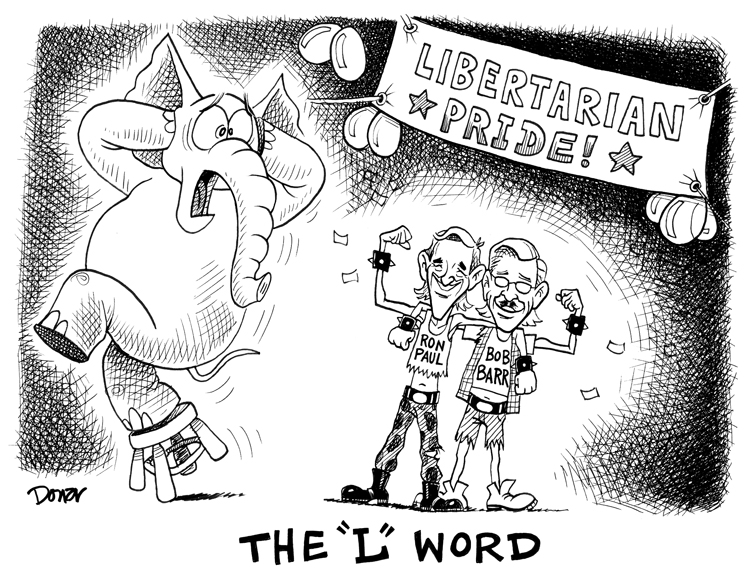
Libertarian Pride
A cartoon from Political Graffiti, coincidentally apt the day after the gay marriage bill was passed here in New York:
Toward a Libertarian-Progressive Alliance
An article by Ted Becker at The Last, Lost Empire argues that the basis for a "real" third party can be found in the convergence of libertarian-leaning Republicans and progressive-leaning Democrats, in other words, the libertarian-progressive alliance. Excerpt:
The Real Third Party, whatever it finally calls itself, will be a previously implausible coalition that will span the political continuum from Libertarianism to Social Democracy. The major themes that their president and Congressional candidates will run on will include most of the following:The piece goes on to detail the convergence of opinion between the likes of Ron Paul and Ralph Nader, Rand Paul and Dennis Kucinich, and so on. It concludes:
Do most Americans trust either President George W. Obama or the Congress run by either the Democrats or Republicans to do any of these things? Public opinion polls repeatedly show a big majority would say “No way.” More than 80% think that the United States is headed in “the wrong direction.” So, if not the Dems and the GOP, then who?
- Ending the wars in Afghanistan and Iraq—all troops and security guys out
- Ending the war in Libya—no military or covert action funds spent there
- No more “Imperial Presidency” wars; Return the war power to Congress
- Radical restructuring of The Fed—investigate lack of transparency and clear conflicts of interests between Wall Street and Main Street
- Rebuilding the American capitalist infrastructure and manufacturing base;
- Balancing the budget immediately;
- Start to deal seriously with climate change as a major national security issue..
Our point is that many very prominent, articulate Americans—who are politically visible and who hail from widely variant ideological positions are now deeply contemplating their mutual antagonism towards the Democratic-Republican regime that controls all three branches of the federal government What is crucial is that they are doing this, not by arguing, but by exploring innovative solutions, from their divergent points of view. They are emphasizing similarities, not differences. This has been at the heart of all successful third parties in the U.S. Such a Third Party can either win or change the game, put in play major solutions, policies and/or constitutional amendments that the established parties ignore. Anyone who thinks this is impossible or even improbable does not know his or her American history . . .Update: Via email a reader asks if Politea has discussed this general topic in the past. Indeed, we've discussed the progressive-libertarian alliance strategy at some length before. Long time readers might recall my PLEA for political independence with the Progressive Libertarian Electoral Alliance, or the libertarian-progressive populist front against the two-party state. See also past posts on the Green-Libertarian alliance strategy.
The Case for a Third Party Infiltration Strategy
When the professional partisans of the Republican and Democratic parties are confronted with the deep political discontent of the American public, it is their primary responsibility to channel that rage and put it back into the service of the ruling parties and reigning status quo. In such situations, these ideological prison guards of the two-party state might even go so far as to concede the criticism and critique leveled against the Democrats and Republicans, and even the duopoly system of government itself. But, in the next breath, they will throw up their hands and exclaim, "Well, what're you gonna do? It's a two-party system! Our only hope is to work within the party and reform it from the inside." This is the argument that was employed by Democrats to co-opt and kill off the anti-war movement. And it is the same argument that has been employed by Republican operatives to co-opt and kill off the tea party movement.
You are just as likely to hear the argument for the infiltration of the major parties from Rush Limbaugh as you are from Markos Moulitsas. The reason for this is quite simple. The likes of Markos Moulitsas and Rush Limbaugh share the self-same goal: ensuring the reproduction of the Democrat-Republican two-party state and duopoly system of government. The infiltration of the major parties by free thinking, independently-minded individuals and groups is not the means by which the major parties are reformed and resuscitated. Rather it is the means by which free-thinking, independently-minded individuals and groups are smothered and castrated by the entrenched interests represented by the ruling party establishment.
However, in an interesting post at The Daily Mush, Jim Hlavac takes the infiltration argument and puts it in the service of the political opposition to the dictatorship of the two-party state. He argues that the wide swath of Americans who are not represented by the "socialists and theocrats" in the Democratic and Republican parties should infiltrate the Libertarian party. Excerpt:
You are just as likely to hear the argument for the infiltration of the major parties from Rush Limbaugh as you are from Markos Moulitsas. The reason for this is quite simple. The likes of Markos Moulitsas and Rush Limbaugh share the self-same goal: ensuring the reproduction of the Democrat-Republican two-party state and duopoly system of government. The infiltration of the major parties by free thinking, independently-minded individuals and groups is not the means by which the major parties are reformed and resuscitated. Rather it is the means by which free-thinking, independently-minded individuals and groups are smothered and castrated by the entrenched interests represented by the ruling party establishment.
However, in an interesting post at The Daily Mush, Jim Hlavac takes the infiltration argument and puts it in the service of the political opposition to the dictatorship of the two-party state. He argues that the wide swath of Americans who are not represented by the "socialists and theocrats" in the Democratic and Republican parties should infiltrate the Libertarian party. Excerpt:
So us 65% or so in the middle are forced, by current election rules, to either vote for Republicans, which empowers the theocrats on that side, or the Democrats, which empowers the Socialists on that side. And because the two fringes have so successfully insinuated themselves into the party power structure, and because the election laws are rigged in the parties favor, then it becomes almost impossible to get any sort of reasonable practical stuff done. And instead, the two fringes work their magic on gaining more control over the government, the law, the public purse and over the lives of the people . . . .
The only other party structure that is up and running is the Libertarians. Technically even the third largest party in America. And it’s time to consider us rational people taking over the moribund thing with its lots of ballot access and make it truly about what America is about – leaving people alone to do what they want to, so long as they cause no harm, and believe as they want to, and otherwise do nothing except handle the violent criminals, and defense, and adjudication of natural disputes from the course of the people’s activities, and help the most truly unfortunate. . . .
So why not take over the Libertarian Party and stop arguing within the elitist two party power structure and start arguing with it as a third party? Now that would be audacious hope for change.
If You Support the Republican Party, You Are Not a Libertarian
At the Think 3 Institute, Sam Wilson reflects on the tension between young libertarians and the Republican party. Excerpt:
Of course, Republicans like to pretend that they stand for limited government, and their rhetoric reflects this fact. Could it be that young libertarians have simply fallen for the rhetorical ploy and been taken in by the GOP's propaganda machine? Or is it perhaps the case that they are just not libertarians, but rather garden variety Republicans who like to pretend that they stand for liberty?
The SFL [Students for Liberty] president tells Glaser, "Older generations may try to classify us by the bipartisan dichotomy through which they understand the world, but this just reflects their misunderstanding of who we are. We're more interested in advancing liberty than being restricted by the structures that others impose upon us." Admirable sentiments, but at most they can be but partly true. As long as libertarians define themselves as anti-statist, and as long as there exists a powerful party identified as statist, there will be a temptation to make common cause (or merge) with the next strongest party in order to save themselves from statism. While some libertarians now feel that "both sides, and Republicans in particular, suppressed and tried to rout the limited-government tendency," many may still believe that the GOP remains the strongest, if not the most reliable bulwark of limited government.It does indeed appear to be the case that many young, self-described libertarians believe the Republican party "remains the strongest, if not the most reliable bulwark of limited government," as Sam puts it. What remains unclear, however, is why anyone in their right mind would believe this. Aside, perhaps, from the voting record of Ron Paul, all the evidence points to the fact that the only thing the Republican party stands for is the endless expansion of the global warfare, corporate welfare, national security police state – and, by extension, the corresponding erosion of rights, liberties and the rule of law. In this regard they can hardly be distinguished from the Democratic party. The funny thing is, many young self-described libertarians appear to be intellectually aware of this fact but ignore it in practice in much the same way that young progressives like to pretend that the Democratic party stands for social justice.
Of course, Republicans like to pretend that they stand for limited government, and their rhetoric reflects this fact. Could it be that young libertarians have simply fallen for the rhetorical ploy and been taken in by the GOP's propaganda machine? Or is it perhaps the case that they are just not libertarians, but rather garden variety Republicans who like to pretend that they stand for liberty?
Re-educating the Welfare Queens of the Warfare State
Ironically, our country's massive military budget, which bankrolls the welfare queens of the warfare state, must be ranked among the greatest threats to our national security. The budgetary black hole that is the Pentagon absorbs nearly three-quarters of a trillion dollars every year. To his credit, at least one newly-elected Tea Party backed Republican lawmaker has come out in support of cuts to the warfare state. From the New York Times:
Representative Chris Gibson, a Tea Party-endorsed freshman Republican and a retired Army colonel from New York’s Hudson River Valley, made it clear that no part of the Pentagon’s $550 billion budget — some $700 billion including the wars in Iraq and Afghanistan — was immune. “This deficit that we have threatens our very way of life, and everything needs to be on the table,” Mr. Gibson told William J. Lynn III, the deputy defense secretary, who testified at the hearing along with Gen. Peter J. Chiarelli, the vice chief of staff of the Army, and other service vice chiefs.The response of those who advocate for the welfare queens of the warfare state reveals their patronizing and condescending attitude toward anyone who openly advocates removing their snouts from the public trough. It sounds like they may even sponsor a number of re-education camps. The article continues:
[Republican head of the House Armed Services Committee] Mr. McKeon, for one, is concerned, and has quietly been meeting with the new members — a number have no experience in government — to educate them on national security. One Congressional staff member who closely monitors the military said, “While McKeon would say that all members are entitled to advocate for positions they want to advocate, what he has been doing is working to educate new members on what the threats are, and why we need the defense budget close to where it is.” [Emphasis added] . . .Clearly, it is militarists such as McKeon who need to be taught a lesson. A recent New York Times poll found that 55% of Americans support cuts to military spending. Given a choice between cutting military spending, Social Security or Medicare, 55% of respondents favored cutting military spending, compared with only 21% who named Medicare and 13% who named Social Security. In fact, support for cutting military spending led the way across partisan lines, including 66% of Democrats, 55% of Independents and 42% of Republicans. Of course, it is highly unusual to find leadership on this issue from the representatives of the global warfare and corporate welfare state in the Democratic and Republican parties. Fortunately, for that we need only look to the Libertarians and the Greens. From the Libertarian Party's response to the State of the Union address:
Mr. McKeon, who represents a California district that is home to major defense contractors, was the single biggest recipient in the House of campaign contributions from military aerospace companies and their employees.
Tonight we heard from President Barack Obama and a response from Republican Congressman Paul Ryan. President Obama says he wants a freeze in non-security, discretionary spending. In the unlikely event that happens, it won't really matter, because to make a real dent in the deficit, it's necessary to cut spending on the military and entitlements. The president promised big government in the past, and he delivered. I expect more of the same.
However, Obama has truly been a hypocrite on the wars in Iraq and Afghanistan. As a candidate, he promised to end them. Tonight we heard more hollow promises. The fact is, as president, he has kept those wars going, and has greatly escalated the war in Afghanistan. As a percentage of GDP, military spending is higher now than it was during any year of the George W. Bush administration.
Unlike President Obama, Libertarians would bring our troops home from Iraq and Afghanistan, and reduce the military budget. On the Republican side, I found Congressman Paul Ryan's hypocrisy appalling . . .From the Green Party's response to the State of the Union address:
The White House and Congress can reduce the deficit drastically by ending the wars and occupations in Afghanistan and Iraq, cutting military spending and the number of US bases on foreign soil, and taxing the wealthy so that they pay their fair share. Future meltdowns can be averted by breaking up the "too big to fail" financial firms into smaller locally-based companies. The Green Party's goal of a decentralized economy, based on Main Street rather the Wall Street, will restore economic stability and security to the US.
It is Time to Evict the Corporatist Squatters from the People's House
In an op-ed for the New York Times on Sunday, Dalton Conley and Jacqueline Stevens argued that Americans today are the "worst-represented group of citizens in the country's history." Tell us something we don't know! Refreshingly, however, the two professors do not make this claim on qualitative or ideological grounds, but rather purely quantitatively. Excerpt via Ballot Access News:
It’s been far too long since the House expanded to keep up with population growth and, as a result, it has lost touch with the public and been overtaken by special interests. Indeed, the lower chamber of Congress has had the same number of members for so long that many Americans assume that its 435 seats are constitutionally mandated. But that’s wrong: while the founders wanted to limit the size of the Senate, they intended the House to expand based on population growth. . . .The article goes on to outline the cons of the current regime and the advantages of expanding the size of the People's House, effectively arguing that increasing the quantity of representatives and decreasing the size of districts would increase the quality of political representation:
For well over a century, after each census Congress would pass a law increasing the size of the House. But after the 1910 census, when the House grew from 391 members to 433 (two more were added later when Arizona and New Mexico became states), the growth stopped. By the time the next decade rolled around, members found themselves reluctant to dilute their votes, and the issue was never seriously considered again.
The result is that Americans today are numerically the worst-represented group of citizens in the country’s history. The average House member speaks for about 700,000 Americans. In contrast, in 1913 he represented roughly 200,000, a ratio that today would mean a House with 1,500 members — or 5,000 if we match the ratio the founders awarded themselves.
This disparity increases the influence of lobbyists and special interests: the more constituents one has, the easier it is for money to outshine individual voices. And it means that representatives have a harder time connecting with the people back in their districts.Too bad Septimus of the Whig blog has been offline, this was one of his signature issues.
What’s needed, then, is a significant increase in the size of the House by expanding the number, and shrinking the size, of districts. Doing so would make campaigns cheaper, the political value of donations lower and the importance of local mobilizing much greater.
Smaller districts would also end the two-party deadlock. Orange County, Calif., might elect a Libertarian, while Cambridge, Mass., might pick a candidate from the Green Party. Moreover, with additional House members we’d likely see more citizen-legislators and fewer lifers. [Emphasis added.]
Ralph Nader and Ron Paul Call for Libertarian-Progressive Alliance
From Raw Story:
on Wednesday's broadcast of Freedom Watch on the Fox Business channel, Judge Napolitano sat down for an amiable interview with Rep. Ron Paul (R-TX) and Ralph Nader to discuss a progressive-libertarian alliance in the 112th session of respective chambers in Congress.
Nader, who has recently called this coalition "the most exciting new political dynamic" in the US today, explained that it works well because both groups stand against corporatists who believe government should be run in the interests of corporations.
"I believe in coalitions," Rep. Paul echoed. "They talk about we need more bipartisanship, and I say we have too much bipartisanship because the bipartisanship we have here in Washington endorses corporatism."
Paul added that he agreed with Nader on a host of issues, such as cutting the US military's budget, ending undeclared US wars overseas, restoring civil liberties and civil rights by dumping from the Patriot Act, and withdrawing from the NAFTA and World Trade Organization agreements. . . .
Third Party Petition Circulator Harrassed, Pepper Sprayed and Arrested Outside Maryland Public Library
From this week's column at CAIVN:
A little-noticed incident in Ellicott City, Maryland highlights the institutional hurdles and biases against minor political parties, the harassment of citizens engaged in constitutionally protected activities by public employees, the hostility on the part of the police toward those who record their interactions with the public, and the inaccuracies common in mainstream media reporting.
On December 18th, a professional petition circulator by the name of Andy Jacobs was collecting signatures for the ballot access drives of the state’s Libertarian and Green parties outside a public library in Ellicott City, Maryland . . .
Style vs. Substance
While Democrats and Republicans continue to babble on about the pros and cons of violent rhetoric and incivility in political discourse, the Green and Libertarian parties have decided to focus on substance instead, and reaffirmed their commitment to actual non-violence in the wake of the Arizona shootings. From the Arizona Green Party, via On the Wilder Side:
The Arizona Green Party is both saddened and outraged in response to the acts of domestic terrorism that plagued not only the City of Tucson this weekend, but our whole nation. Our hearts go out to Congresswoman Gabrielle Giffords as well as all the victims and their families, friends, and communities affected by this senseless tragedy. Our sincerest condolences to those lives that were lost devastatingly on Saturday and we hope for a speedy recovery to those beginning their healing process.From the Libertarian Party national headquarters, via IPR:
Nonviolence is one of The Ten Key Values of the Green Party. We promote non-violent methods to oppose practices and policies with which we disagree, and will guide our actions toward lasting personal, community and global peace. Peace is not just the absence of violence; it is a willingness to resolve conflict in a constructive manner with a spirit of good will and respect.
Violence is never an answer. We, the Arizona Green Party, will continue to advocate for peace and non-violence in the wake of this tragedy in Tucson and everyday; that bloodshed and brutality are not replacements for compassionate dialogue and diplomatic action.
Mark Hinkle, Chair of the Libertarian Party, issued a statement condemning the shooting of Congressional Representative Gabrielle Giffords, and others in Tucson, Arizona. According to reports, federal Judge John Roll and five others were killed in the shooting, and several others were seriously wounded.
“The Libertarian Party condemns the shooting of Representative Gabrielle Giffords and others today. We are saddened by the loss of life, the suffering of those who survived the shooting, and the grief and sorrow of their family and friends.
“This shooting was wrong, and is the kind of abhorrent political violence that threatens our freedoms.
“The Libertarian Party opposes the initiation of force and violence whether it is politically motivated or for other reasons. To become a member of the Libertarian Party, people are required to sign a statement certifying that they oppose the initiation of force to achieve political or social goals.
“Regardless of the motives and other circumstances surrounding the killing, the Libertarian Party maintains its steadfast defense of the Second Amendment and the uncompromising right to gun ownership. In a free society, citizens should be free to arm and protect themselves, their families, and their property. Sadly, because of restrictions placed on responsible gun owners by all levels of government, many people avoid carrying weapons that could be used to stop mass shootings.
“Our condolences go out to the victims and their families. We wish them a speedy and full recovery.”
Third Party Ballot Access and California's Top Two Primary System
At CAIVN, Bob Morris of Polizeros takes a look at the latest third party registration numbers in California. He writes:
Let's look at the numbers and see what they tell us. All data is the most recent from the California Secretary of State. Percentage of registered voters in California as of Oct 18, 2010. (Third parties also have number of registered voters.)
To qualify as a third party, either an affidavit of registration must be completed by 1% of the votes cast in the most recent governor's race or a petition signed by 10%. Currently, 1% is equal to 103, 024.
- Democrat 44.08%
- Republican 31.02%
- Decline to State 20.25%
- American Independent 2.39% (413,032)
- Green 0.66% (113,835)
- Libertarian 0.53% (91,111)
- Peace and Freedom 0.33% (57,776)
- Other 0.74%
To maintain ballot status, a party must keep registration at all times equal to one-fifteenth of one percent of total registration, and either: 1) Maintain a registration level equal to at least one percent of the entire vote of the state at the most recent gubernatorial election or 2) poll at least 2% in any of the most recent elections for Governor, Lieutenant Governor, Secretary of State, Controller, Treasurer, Attorney General, Insurance Commissioner, or United States Senator.
Based on these criteria, all four third parties retained ballot status in the 2010 election. . . . all four third parties retained ballot status in the 2010 election . . .With the introduction of the "top two" primary system in California, it will likely be much more difficult for third parties to retain ballot access in the state. If no third party candidates are among the top-two vote-getters in the primary races for the eight offices listed above, they will be excluded from the general election, and if you are excluded from the general election, you cannot maintain ballot access by polling 2% in those races. Only the American Independent Party and the Green Party have high enough registration numbers to maintain their ballot access by the first criterion, though the Libertarian Party is quite close to the cut-off – if I'm reading the numbers correctly, that is. Bob continues:
with the exception of Peace and Freedom in L.A. County, and contrary to what might be expected, the highest registrations for third parties are in northern, rural, agricultural counties. These counties tend to be conservative, and have very low registration for Peace and Freedom, the only socialist party with ballot status. The three counties where the Green Party is highest could perhaps also be safely described as marijuana-friendly.It would be interesting to see where decline-to-state voters are clustered in California, since that is where the most movement among the electorate is. Over the last ten years, decline-to-state voters have gone from being 13% of the electorate to 20% of the state's electorate, while all explicit affiliations have either noticeably sunk or remained flat.
Subscribe to:
Posts (Atom)


