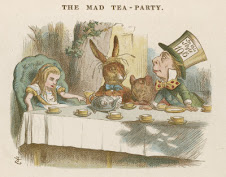
On the Contradictory and Reactionary Character of Lesser-Evilism, Primary Ideological Support for the Reproduction of the Failed Two-Party State

Via Memeorandum, Allahpundit at Hotair relays poll findings from Gallup and Rasmussen showing that the GOP is leading the Democratic Party on the so-called "generic ballot" by historic margins. Rasmussen reports:
Republican candidates have jumped out to a record-setting 12-point lead over Democrats on the Generic Congressional Ballot . . . A new Rasmussen Reports national telephone survey finds that 48% of Likely Voters would vote for their district's Republican congressional candidate, while 36% would opt for his or her Democratic opponent.
Allahpundit notes, however, that the most astonishing facet of this disparity is that Republicans are actually less popular than Democrats. He writes:
When Democrats tell people that voters hate the GOP as much as they hate them, they’re not blowing smoke. That’s basically true. In fact, in many polls, the Republican Party’s favorables are still lower than the Democrats’. And even so: Biggest generic ballot lead … in history. That’s how popular Hopenchange is.
This contradiction has left numerous Democratic Party ideologues, such as Ezra Klein, "bemused and confused," and unable to account for the apparent mixed messages emanating from the electorate. Republican Party ideologues, on the other hand, are of course less interested in accounting for the contradiction than they are in capitalizing upon it. Arguably, however, Republicans and Democrats are simply incapable of understanding the problem because they are the problem; and their inability to understand the problem is symptomatic of the problem. Democrats and Republicans cannot relate to the two-party system and state in a critical register because it is the primary condition for the reproduction of their joint misrule.

The contradiction at work here is a function of duopoly ideology. How can it be that a majority of the electorate prefer the less favorable option between the Democrats and Republicans? In other words, how can the less popular faction of the two-party state be the more popular faction of the two-party state? The WSJ/NBC poll released last week may provide at least a partial answer. When asked if they would prefer a Democrat-controlled Congress or a Republican-controlled Congress to result from this year's elections, 42% of respondents opted in favor of the Republicans while 43% favored Democrats and 15% were unsure. But the follow-up question is key in the current context. The survey then asked those who favored a Democrat-controlled Congress if they did so because they actually support the policies of the president and his party or because they oppose the policies of the GOP and its candidates. Similarly, those who favored a Republican-controlled Congress were asked if they did so because they support the policies and candidates of the Republican Party or because they oppose the policies of the Democratic Party and its candidates. Significantly, the poll did not ask whether respondents supported the idea of a Congress which was not controlled by either of the major parties, say, if enough third party and independent candidates were elected to ensure that neither Democrats nor Republicans could hijack the legislative process.

Nevertheless, of those who favored a Democrat-controlled Congress, 48% stated that they actually support Democratic candidates and policies, while 47% said they really just oppose the Republican Party and its candidates. On the other hand, of those who preferred a Republican-controlled Congress, only 35% said they support the Republican Party and its candidates, while a whopping 59% said they actually only oppose Democratic policies and candidates.

In other words, a majority of those who support a Democrat or Republican controlled Congress do not actually support a Democrat or Republican controlled Congress, rather they oppose a Republican or Democrat controlled Congress. Simply put, the two-party system produces a literally reactionary majority, which is willing to support the major party it favors less because it opposes the other major party more. This is the contradictory and paradoxical ideology of lesser evilism as articulated via public opinion polling.

As I've written before on the reactionary character of Democrat-Republican party politics, political independence begins with the recognition that we are not free insofar as we are subjugated by the politics of the two-party state and the duopoly system of government. Political autonomy requires affirmation of a tertium quid.

Update: Sam responds at The Think 3 Institute, asking: "Fear Drives the Two-Party System. Does Complacency Threaten the Republic?"

Are African Americans Abandoning the Major Parties in Favor of Superior Third Party and Independent Alternatives? Shouldn't We All?

Earlier this month, I relayed a report stating that African Americans in Illinois were supporting third party or independent candidates in relatively high numbers, with over 20% favoring an alternative to the corporatist shills of the Democratic and Republican parties. Unfortunately, it was impossible to determine just who those individuals were supporting because the polling outfit, Rasmussen, did not inquire as to which third party and independent candidates respondents favored, but rather subsumed everyone aside from the Democrat and Republican under the category "some other candidate." A similar situation may well be developing in Georgia. Jack Wagner writes at the Free Independent Sun:
I noticed something quite disturbing when studying recent polling for elections around the country. Rasmussen Reports will include upwards of 6 or 7 candidates in the Democrat and Republican Primaries, sometimes with candidates that only receive 1% of the vote, yet when it comes to the General Election they will only include the two Democrat-Republican candidates despite there being sometime upwards of 3 or 4 other candidates from Third Party Nominations or Independent Nominations. This case is most present and most dangerous in a particular Governor’s election in Georgia, where the African-American Libertarian Candidate John Monds is left out of General Election polls despite having won 33.4% in a statewide election in 2008, and apparently the most likely winner of the 15- 20% of unaccounted votes in Rasmussen Polls.
Though it likely stakes out familiar territory to Poli-Tea readers, the piece is well worth a read, and goes on to document the pollster's bias against third party candidates in Georgia, South Carolina and Illinois. Nonetheless, there seems to be significant movement afoot within the African American community away from the Democrats and in the direction of rational alternatives to Democrat-Republican party government. A column by Frederick Alexander Meade published at Akiit.com over the weekend argues that African Americans should support third party candidates for office:

In the face of a two party political system, in which neither entity holds any significant measure of deference for a socially ailing African-American body, the construction of a party in which the group may call its own, may serve as the only reasonable approach, by which this population may be afforded any degree of leverage.

The function of a third party, in its greatest capacity, would serve to conceivably eclipse the position of the Democratic Party in its perceived station, as institution of choice, for the socially dispossessed and of those seemingly concerned with the welfare of the masses.

A less speculative and perhaps more pragmatic conception of such a party, would maintain it function – in the short term – to erode a segment of the black Democratic voting base. An evolvement the Democrats can ill afford to experience, as the black vote often serves as the critical force this band relies upon, in securing electoral triumphs over political rivals in highly contested races.

A viable third party would not have to siphon twenty to thirty percent of the black Democratic voting base. Rather a ten to fifteen percent decline in this group’s support of the party would function to compromise its political strength in numerous municipalities as well as on the national level.

In politically disarming the Democratic Party, in regard to its African-American voting arsenal, a direct message would then be sent to this institution. The message delivered to this purported liberal body would boldly declare: black Americans have evolved into an electoral entity determined to observe its agenda honored and subsequently pursued by any political institution claiming to represent the interests of the group . . .

In pursuing this course of action, enough members of the African-American public must overcome the fear of perceived social loss the group may sustain in the short run, as the Republican Party would manifestly assume power within some domains presently controlled by its prime opposition.

In overcoming this fear, the African-American public must remain assured, its collective plight essentially experiences little nuance irrespective of the party that assumes office, as the masses have invariably suffered under the rule of all governing bodies.

This line of argument may be reasonably generalized, and would likely hold for the large majority of the American populace. Who is served by the tyranny of the two-party state, by Democrat-Republican party government as such, aside from the self-serving and self-entitled elites in the ruling criminal political class?

A Vote of No Confidence in the American Political Class

From Ron Brownstein at the National Journal:

The severity of these swings testifies to the distance separating many voters from either party. When asked to rate the performance of congressional leaders in a SHRM/National Journal Congressional Connection poll last month, only about one-third of adults gave positive marks to either Republicans or Democrats. Strikingly, nearly three-tenths said they disapproved of the job performance of both Republican and Democratic leaders. That number rose to 41 percent among independents.

In that survey, conducted by the Pew Research Center, nearly half of independents gave both Republican and Democratic leaders poor marks on placing the national interest ahead of their own political interests. Similarly, in a recent Washington Post/ABC News poll, a comparable 43 percent of independents (and 36 percent of all voters) said they lacked confidence that President Obama, congressional Republicans, or congressional Democrats can make the right decisions for the country's future. All of these findings represent a striking no-confidence vote in the nation's political class.

Brownstein believes this collapse in confidence could create an opening for a third party or independent presidential candidate in 2012:

Although the practical barriers to a third-party candidate remain substantial, these findings document a substantial audience that might consider a non-politician with a problem-solver pedigree, especially if the economy remains weak.
It is worth noting, however, where the emphasis is placed in this article. The piece is entitled "A Corrosive Collapse in Confidence." Taking this at face value, one would have to conclude that it is entirely backwards insofar as it suggests the public's lack of confidence in institutions both public and private is the "corrosive" agent at work in the body politic. Placing the horse back in front of the cart, we would have to say that the undeniable degeneracy and bankruptcy of those institutions is eroding the public's confidence in them.

The Democratic-Republican Conspiracy of Dunces

From this week's column at CAIVN:

If a group of people told you that elected officials, influential civic groups, the mainstream media, and independent polling organizations were all engaged in a systematic effort to effectively silence them by ensuring that the wider public was not exposed to their views and opinions, you might conclude that this was nothing but an elaborate conspiracy theory. Yet, this is the reality faced by third party and independent candidates for elected office all across the United States.
The piece goes on to document legal challenges filed against third party and independent candidates in Pennsylvania, the exclusion of Green and Independent candidates from a debate being held by a taxpayer funded group in Arkansas, the failure of mainstream media outlets to cover the Green Party candidate for governor of Massachusetts, and one Libertarian's struggle to overcome the duopolist bias of pollsters in Florida. It concludes:

The apparent nonchalance with which media and pollsters dismiss third party and Independent candidates stands in stark contrast to the seriousness of the Democratic and Republican parties in their efforts to keep them off the ballot. Any candidate who is not beholden to the Democratic and Republican party machines is a threat to the Democratic-Republican monopoly on elected office.

Given that there are already more Independents than there are Democrats and Republicans in over ten states, they are right to be afraid.

Read the whole thing.

Poll: Independent Plurality Nears Majority, 24% Support a Third Party Tea Party

Via Free From Editors, this month's WSJ/NBC poll finds that independents increasingly outnumber Democrats and Republicans. 42% of those polled identified themselves as independents, while only 30% were willing to call themselves Democrats and a paltry 21% identified with the Republican Party. Of those who identified as independents, 16% called themselves "strict independents," while 14% admitted to leaning Republican and 12% confessed to leaning toward the Democrats. Among partisans of the legacy parties, only 20% called themselves "strong Democrats" and 13% called themselves "strong Republicans."

The poll also surveyed opinion on everything from protecting the environment, to dealing with global warming and energy policy, oversight of Wall Street and banks, dealing with natural disasters, health care, social security, dealing with the economy, taxes, moral values, etc. The survey inquired whether respondents thought Democrats or Republicans would do a better job dealing with the given issue, whether they thought both parties would do about the same, or whether neither of the ruling parties is up to the task. Roughly 20% of those polled are essentially convinced that neither Democrats nor Republicans are capable of dealing with any of the most pressing political issues facing the United States.

In other findings, 24% of respondents voiced support for a third party Tea Party; only 33% have a positive view of the Democratic Party; and 24% have a positive view of the Republican Party.

The Democratic-Republican Bipartisan Front Against Voter Choice and Rational Alternatives to the Tyranny of the Two-Party State

From the Philadelphia Enquirer:
It's one thing for an independent or third-party candidate to get on the ballot in Pennsylvania. It's another for the candidate to stay there. Powers that be in the Republican and Democratic Parties were behind legal challenges in Commonwealth Court on Monday against the ballot eligibility of several candidates for governor and Congress.

The Republican State Committee said it had done "research" for a trio of citizens who challenged the election petitions of three Libertarian Party contenders - Marakay Rogers, running for governor; Douglas M. Jamison, for the Senate; and Kat Valleley, for lieutenant governor.

Democratic U.S. Senate nominee Joe Sestak challenged a Green Party candidate who has attempted to join the race with Republican Pat Toomey. Challenges also were filed against minor candidates in two area races for the House.

Approval Voting in the News: Libertarian Candidate for Governor of Colorado, "We All Win by Implementing Approval Voting"

In recent weeks there seems to have been an uptick in discussion and advocacy of approval voting in both mainstream news sources and the political blogosphere:
• Late last month, Anthony Gottlieb profiled a number of alternative voting methods in an article for The New Yorker, comparing and contrasting them with plurality voting, and devoting a significant portion of the piece to a discussion of approval voting. The article sparked a number of interesting discussions in the blogosphere.

• Just a few days ago, in Vermont's Rutland Herald, reader Ed Weissman argued that the people of the United States would be better served by the major parties if approval voting were used in the primary election process.

• And, finally, the Libertarian candidate for governor of Colorado, Jaimes Brown, recently garnered positive coverage in a number of mainstream press outlets for his advocacy of approval voting.
Brown is the first candidate for any elected office whom I've heard advocate the implementation of approval voting in the United States. I contacted him via email last week to ask a few questions about approval voting and he kindly obliged. The entire interview can be read at Third Party and Independent Daily. An excerpt:
TPID: Do you have plans to continue this advocacy beyond the gubernatorial campaign? What is your advice to others who would like to see the implementation of approval voting?
Brown: Absolutely, it's not about me, it's about liberty. I find it offensive that the two parties have spoiled the whole system and they have the audacity to label anyone with a fresh approach as "spoilers"! My advice would be to continue to point out to all political parties, independents, and citizens that we all win by implementing approval voting. Democrats would have been better off with it in 2000, Republicans would be better off with it in the 2010 Colorado Governor election. The people are better off with it because we will get better representation. Isn't that what a Republic is all about?
For more information on approval voting, head over to Citizens for Approval Voting and the Center for Range Voting, and be sure to check out Least of All Evils, a highly informative blog devoted to approval and range voting.

The United Police States of America: the Criminalization of Everyday Life in the USA

For Democrats and Republicans there is no problem that can't be solved by empowering agents of government – whether they be police, prosecutors, politicians, inspectors, garden variety bureaucrats etc. – to wield disproportionate force against the people of the United States under the color of law. If war is politics carried out by other means, and politics is war carried out by other means, then the Democratic and Republican parties are undoubtedly engaged in an asymmetrical war against the people of the United States, and they have been for some time. No matter which of the ruling parties finds itself in the majority, constitutional rights, liberties and the rule of law are trampled and eroded with equal zeal and without compunction.

In a series of reports entitled "Rough Justice in America," those anti-government extremists at The Economist detail the effects the Democratic-Republican police state has had on the people of the United States over the last thirty years, noting that "never before in the civilized world have so many people been locked up for so little," and bluntly stating that "America locks up too many people, some for acts that should not even be criminal." The Heritage Foundation has come up with a clever euphemism for this state of affairs: they call it "overcriminalization." From Overcriminalized:

“Overcriminalization” describes the trend in America – and particularly in Congress – to use the criminal law to “solve” every problem, punish every mistake (instead of making proper use of civil penalties), and coerce Americans into conforming their behavior to satisfy social engineering objectives. Criminal law is supposed to be used to redress only that conduct which society thinks deserving of the greatest punishment and moral sanction.

But as a result of rampant overcriminalization, trivial conduct is now often punished as a crime. Many criminal laws make it possible for the government to convict a person even if he acted without criminal intent (i.e., mens rea). Sentences have skyrocketed, particularly at the federal level.

Like most Americans you probably commit at least three felonies a day in the course of your everyday life, not to mention infractions of the myriad local and state laws to be found in every corner of the union. The Democratic and Republican parties, with the help of their deluded supporters, are literally turning this country into a police state and prison colony. Of course, not all Americans are subject to the laws of crime and punishment. Few, however, are lucky enough to be accorded the deference shown to members of the ruling criminal class.

Act Against ACTA

Everyone who uses the internet should be concerned about ACTA, the so-called Anti-Counterfeiting Trade Agreement, currently being negotiated in secret by the United States, Japan, Canada, the European Union, Switzerland, Australia, Mexico, Morocco, New Zealand, the Republic of Korea and Singapore. In a lengthy report at the Mises Institute, Gennady Stolyarov explains some of the reasons why:

A clandestine international treaty is currently being negotiated among parties including the United States, Canada, New Zealand, the European Union, Japan, Singapore, and Morocco. It can justly be called the greatest threat of our time to the advancement of human civilization. Considering the magnitude of the other abuses of power pervading the world today, this might seem an exaggeration, but the Anti-Counterfeiting Trade Agreement (ACTA) contravenes every principle of civilized society, both in its content and in the nature of the proceedings leading to its creation.

It threatens to undo the accomplishments of the great Internet revolution and to thrust humankind back to a time when individuals had no public voice and no countervailing power against politically privileged mercantilist institutions. ACTA tramples on essential rights that have achieved even mainstream recognition: innocence until one is proven guilty, due process, personal privacy, and fair use of published content. Moreover, because of its designation as a trade agreement, ACTA could be imposed on the people of the United States by the president, without even a vote of Congress. [Emphasis added.]

Read the whole thing. Though ACTA could be "fast-tracked" by the president, there should be little doubt whether a secret international agreement which blatantly curtails fundamental rights, liberties and freedoms would easily gain the support of a majority of Democrats and Republicans in the Congress.

IL: Poll Finds 11% Support for Third Party Candidate, Fails to Ask who that Candidate Is

If I told you that, in a certain gubernatorial race, 11% of voters were planning on voting for someone other than the corporatist shills representing the Democratic and Republican parties, and, if I added that this voting bloc was composed of 23% of African Americans, 19% of moderates, and 14% of Democrats, you'd probably wonder just who that candidate is. If your curiosity got the best of you, you might ask me; you might even do your own research on the matter; indeed, you could go so far as to ask those very people themselves. If you did, you probably don't work for Rasmussen Reports. Rasmussen's most recent poll gauging opinion on Illinois' gubernatorial race finds that 11% of voters prefer a third party or independent candidate over Republican Bill Brady and incumbent Democrat Pat Quinn:
The latest Rasmussen Reports statewide telephone survey of Likely Voters shows Brady picking up 44% of the vote, while Quinn earns support from 37%. Eleven percent (11%) prefer a different candidate, and nine percent (9%) are undecided.
As is usual for Rasmussen, however, the polling outfit chose not to query those independent thinkers as to which candidate they do indeed support, apparently satisfied that "some other candidate" suffices. At the Examiner, Dennis Brennan reports on the raw numbers:
While 88 percent of Republicans are supporting Brady, only sixty one percent of Democrats are supporting Quinn at this time. More troubling according to the poll is that 23 percent of African American voters say that they will vote for a third party candidate. An amazing 23 percent of African-Americans, 19 percent of moderates, 14 percent of Democrats and women and 10 percent of liberals chose "Some other candidate" in the poll.
Brennan reports that the Quinn campaign is worried about the impact Democrat-turned-independent Scott Lee Cohen could have on their chances of success. Yet, from Rasmussen's numbers, there is no way of telling whether Cohen is indeed garnering any amount of support from the people of Illinois. One might just as well postulate that Green Party candidate Rich Whitney has effectively broken through the 10% barrier. In June, Public Policy Polling (.pdf) found that Whitney was garnering about 9% support in the race. Or Cohen and Whitney could be competing for the votes of one 1 out of 5 African Americans and moderates and 1 out of 10 liberals. Or maybe these folks have come to support Libertarian Lex Green or Constitution Party candidate Michael White, or some combination of all of them. With Rasmussen as our guide we'll never know.

One wonders just how much support "some other candidate" would have to poll for Rasmussen to consider asking its respondents who exactly this other candidate is. 20%? 30%? 50%?

Study: 2010 Elections Likely to Result in Strongest Showing Among Third Party and Independent Candidates in over 75 Years

A lengthy article at Smart Politics reports that this year we are likely to witness the strongest showing by third party and independent candidates for office since the 1930's. Some excerpts:
A Smart Politics analysis of nearly 1,800 gubernatorial elections since 1900 finds that third party candidates in 2010 will rival those of 1994 for the strongest showing over the past 75 years since the Great Depression. . . .

If these third party candidates sustain their support through the November 2010 election, it will mark only the second time since the Great Depression that six gubernatorial candidates will have won at least 10 percent of the vote in an election cycle (the other being 1994). . . .

The 1990s in particular brought a resurgence to third parties in gubernatorial campaigns that had not been seen since before World War II. From 1990 to 1999, five third party candidates won gubernatorial contests - the second largest number per decade since the beginning of the 20th century. . . .

From 1910 to 1919, nearly one quarter of gubernatorial elections had at least one third party candidate garner 10 percent or more of the vote.
Read the whole thing. The article provides an overview of the strongest third party and independent gubernatorial candidates this year, a comparison of the 2010 election outlook with that of 1994, and a short historical sketch of successful or prominent third party candidates from the first half of the twentieth century.

CA: Top Two Primary Faces First Legal Challenge

From my most recent column at the California Independent Voter Network:

The first lawsuit challenging the legality of California’s newly-approved “top two” open primary system was brought forward last week in San Francisco Superior Court. The suit seeks to block implementation of Proposition 14 on the grounds that it disenfranchises voters and discriminates against minor party candidates.

The top two open primary system was passed into law in June when voters approved Prop 14. The measure was backed by Governor Schwarzenegger and Lt. Governor Abel Maldonado, and opposed by Democratic and Republican party leaders as well as a large coalition of third party groups, including the Green and Libertarian parties. In the end, Prop 14 was supported by 54% of voters, though only 33% of eligible voters cast a ballot in the election, according to the Office of the Secretary of State.

The Top Two Act effectively does away with the traditional party primary. Instead, all candidates for a given office, except that of President, would be listed on the same primary ballot and the top two vote-getters in each primary race, irrespective of party, would go on to compete in the general election.

The lawsuit, however, does not challenge Proposition 14 as such, but rather provisions within Senate Bill 6. SB6 was passed by the state legislature in early 2009 as part of the compromise that resulted in the passage of the state’s budget. SB6 was authored by Lt. Governor Abel Maldonado who cast the decisive vote in the budget impasse. The bill provides the legal scaffolding for the implementation of the top two open primary.

The lawsuit argues that SB6 is unconstitutional because, if implemented, candidates who “identify with a ‘minor’ party will be censored and discriminated against on the ballot,” and because votes cast for any “write-in candidate in the general election will not be counted.”

Read the whole thing.

Approval Voting and Proportional Representation

At Independent Political Report, Ross Levin relays a lengthy and informative article from The New Yorker by Anthony Gottlieb that provides a short history of voting methods and systems in the modern world. The piece compares and contrasts plurality, winner-take-all voting with proportional representation, instant-runoff voting and approval voting. An excerpt dealing with approval and range voting from the end of the article:

Range and approval voting deal neatly with the problem of vote-splitting: if a voter likes Nader best, and would rather have Gore than Bush, he or she can approve Nader and Gore but not Bush. Above all, their advocates say, both schemes give voters more options, and would elect the candidate with the most over-all support, rather than the one preferred by the largest minority. Both can be modified to deliver forms of proportional representation.

The fact that they escape Arrow’s proof, though, doesn’t mean that approval and range voting have no hidden kinks or paradoxes. Whether such ideas can work depends on how people use them. If enough people are carelessly generous with their approval votes, for example, there could be some nasty surprises. In an unlikely set of circumstances, the candidate who is the favorite of more than half the voters could lose. Parties in an approval election might spend less time attacking their opponents, in order to pick up positive ratings from rivals’ supporters, and critics worry that it would favor bland politicians who don’t stand for anything much. Defenders insist that such a strategy would backfire in subsequent elections, if not before, and the case of Ronald Reagan suggests that broad appeal and strong views aren’t mutually exclusive . . .

Mathematics can suggest what approaches are worth trying, but it can’t reveal what will suit a particular place, and best deliver what we want from a democratic voting system: to create a government that feels legitimate to people—to reconcile people to being governed, and give them reason to feel that, win or lose (especially lose), the game is fair. The novelty of range and approval voting in modern politics is so great that we can’t know how they’ll work out without running experiments.

While instant-runoff voting is likely the most well known alternative voting method, polities that have implemented it have already begun struggling with its limitations, thus underscoring the need for voting system experimentation at the state and local level. Dale Sheldon-Hess writes at Least of All Evils:

Dr. David Schultz . . . has posted his report for the Minneapolis Elections Department on the use of ranked choice voting [PDF] (more commonly known as instant runoff voting or IRV), as it was used in that city's recent elections. Schultz was (and apparently still is) a strong supporter of the use of IRV, having previously served as a board member for FairVote Minnesota, a fact he plainly states in his paper's Conflict of Interest heading. And this refreshing honesty continues throughout the document... which probably isn't good news for FairVote's or Dr. Schultz's objectives.

First on the chopping block is the claim that IRV increases turnout . . . We also find that the well-advertised claim of decreased election costs turned out to not be true . . . But my "favorite" part of the report is the section on Spoiled Ballots and Voter Error. Schultz begins by assuring us that "[T]he worst fears were not realized." By which he means IRV only quadrupled the ballot-spoilage rate, from 1.0% to 4.1%. . . . The true measure of an electoral system's quality is how well it can handle highly-contested and close-to-call elections. The predominant examples suggests that IRV would handle such elections poorly; but the Minneapolis data provides no real information for or against that proposition.
Read the whole thing. Dale is, of course, a strong supporter of approval voting and range voting; he's also has recently been involved in an on-going debate with David L. Wetzell, an advocate of strategic election reform and "American Proportional Representation." David sums up his position in the debate at A New Kind of Third Party. I don't know if David is acquainted with
Pete Healey of the Proportional Representation Party, but if not, they should consider getting in contact. In comments to the above-mentioned post at IPR, Pete wrote:
“One size fits all” [voting systems] is a poor guide. Our concept for New York isn’t a complete abolition of single-member districts and isn’t fully proportional (at least at first). It’s a transitional system that would have the state legislature elected half from single-member districts and half by party-line proportional vote. Each voter enters the booth with two votes, one for his/her local rep and the other for the party he/she wishes to represent him/her in the legislature.

CT: "Shocked but not Surprised" – On the Sec. of State's Major Party Propaganda Campaign and Recruitment Drive

In a letter to the editor of the Hartford Courant, Pete Healey of the Proportional Representation Party weighs in on "affiliate and participate," the Connecticut Secretary of State's ongoing major party propaganda campaign and recruitment drive. Under the headline "Party Promotion is Wrong," Pete writes:
The campaign being conducted by Connecticut Secretary of the State Susan Bysiewicz to encourage independent voters to affiliate with one or the other of the two major parties has become a topic of discussion outside Connecticut as well [courant.com, July 13, "Conn. Voters Urged To Register For Primaries"].

I'm shocked, but not surprised, that a statewide officeholder would shamelessly prop up the two major parties in this way to hype upcoming party primaries.

In New York, my county has a registration pattern similar to Connecticut's: Almost 40 percent of voters are not affiliated with either major party, with the Democrats and Republicans roughly equal at about 30 percent each. No statewide official here has ever, to my knowledge, attempted to do what Bysiewicz has done. To the contrary, in Democratic circles this year especially, an effort has been made to force Democrats to accept that party's endorsed candidates and suppress any primary campaigns.

I'm neither Democrat nor Republican and have little interest in their internal party affairs. And I would expect that statewide elected officials would, at least outwardly, express the same kind of disinterest. Isn't it a mistake for Ms. Bysiewicz to coax people toward one party or another, even when we know (nudge-nudge, wink-wink) that this two-party system is closed to all others?

Pete Healey, New Paltz, N.Y.
"Affiliate and Participate" might be more appropriately titled "Bait and Berate."

Unprecedented? What can contemporary America learn from ancient Athens?

Though the ongoing economic crisis and the response to it are often described as "unprecedented" by commentators, politicians and economists alike, many of these very same individuals can be found drawing conclusions on the best way forward based on analyses of its historical precedents such as the Great Depression or the Panic of 1873. Enlarging the scope of one's historical frame of reference, however, reveals precedents that reach back to ancient times. Consider, for instance, J.B. Bury's History of Ancient Greece to the Death of Alexander the Great, published in 1900. The Irish historian describes the state of Athenian and Attic society in the midst of the crises that precipitated the Solonic reforms and the eventual foundation of ancient Athenian democracy:
Every year the oppressiveness of the rich few and the impoverishment of the small farmer were increasing. Without capital, and obliged to borrow money, the small proprietors mortgaged their lands, which fell into the hands of capitalists, who lent money at ruinous interest. . . . Even in Attica the small peasant could not cope with the larger proprietor. Thus the little farms of Attica were covered with stones, on which the mortgage bonds were written; the large estates grew apace; the black earth, as Solon said, was enslaved.

The condition of the free laborers was even more deplorable. The sixth part of the produce, which was their wage, no longer sufficed, under the new economical conditions, to support life, and they were forced into borrowing from their masters. The interest was high, the laws of debt were ruthless, and the person of the borrower was the pledge of repayment and forfeited to the lender in the case of inability to pay. The result was that the class of free laborers was being gradually transformed into a class of slaves, whom their lords could sell when they chose.

Thus while the wealthy few were becoming wealthier and greedier, the small proprietors were becoming landless and the landless freemen were becoming slaves. And the evil was aggravated by unjust judgments, and the perversion of law in favor of the rich and powerful. The social disease seemed likely to culminate in a political revolution. (Emphasis added, Chapter 4, Section 4, ca. pp. 180-181.)
Sound familiar? Effectively, this is the basic template for so many reports and analyses of our current economic and financial crisis. In the Financial Times, Edward Luce describes the "Crisis of Middle-Class America":

The slow economic strangulation of . . . middle-class Americans started long before the Great Recession, which merely exacerbated the “personal recession” that ordinary Americans had been suffering for years. Dubbed “median wage stagnation” by economists, the annual incomes of the bottom 90 per cent of US families have been essentially flat since 1973 – having risen by only 10 per cent in real terms over the past 37 years. That means most Americans have been treading water for more than a generation. Over the same period the incomes of the top 1 per cent have tripled. In 1973, chief executives were on average paid 26 times the median income. Now the ­multiple is above 300.

The trend has only been getting stronger. Most economists see the Great Stagnation as a structural problem – meaning it is immune to the business cycle. In the last expansion, which started in January 2002 and ended in December 2007, the median US household income dropped by $2,000 – the first ever instance where most Americans were worse off at the end of a cycle than at the start. Worse is that the long era of stagnating incomes has been accompanied by something profoundly un-American: declining income mobility.

At the Business Insider, Michael Snyder argues in a similar vein that the American middle class is being "systematically wiped out," and provides numerous statistics to back up his argument. Some excerpts:

The 22 statistics detailed here prove beyond a shadow of a doubt that the middle class is being systematically wiped out of existence in America. The rich are getting richer and the poor are getting poorer at a staggering rate. Once upon a time, the United States had the largest and most prosperous middle class in the history of the world, but now that is changing at a blinding pace . . .

• 83 percent of all U.S. stocks are in the hands of 1 percent of the people.
• 66 percent of the income growth between 2001 and 2007 went to the top 1% of all Americans.
• Over 1.4 million Americans filed for personal bankruptcy in 2009, which represented a 32 percent increase over 2008.
• Only the top 5 percent of U.S. households have earned enough additional income to match the rise in housing costs since 1975.
• For the first time in U.S. history, banks own a greater share of residential housing net worth in the United States than all individual Americans put together.
• As of 2007, the bottom 80 percent of American households held about 7% of the liquid financial assets.
• The bottom 50 percent of income earners in the United States now collectively own less than 1 percent of the nation’s wealth.
Even the partisans of the Democratic and Republican parties and the ruling political class have begun to call for a radical response to this social, political and economic crisis. Commentators Christian and Robbins at Investors Business Daily wonder if "Washington's failures will lead to a second American revolution":

People are asking, "Is the government doing us more harm than good? Should we change what it does and the way it does it?" Pruning the power of government begins with the imperial presidency. Too many overreaching laws give the president too much discretion to make too many open-ended rules controlling too many aspects of our lives. There's no end to the harm an out-of-control president can do.
As is typical of mainstream corporate media commentators such as Christian and Robbins, they fail to properly diagnose the problem because they are incapable of liberating themselves from the ideology of the imperial presidency they claim to oppose:

Bill Clinton lowered the culture, moral tone and strength of the nation — and left America vulnerable to attack. When it came, George W. Bush stood up for America, albeit sometimes clumsily. Barack Obama, however, has pulled off the ultimate switcheroo: He's diminishing America from within — so far, successfully. . . .

Opinion polls suggest that in the November mid-term elections, voters will replace the present Democratic majority in Congress with opposition Republicans — but that will not necessarily stop Obama.

This is the precise mentality that sustains the imperial presidency. It fails to account for the most pernicious effects of the global warfare and corporate welfare state, which is beloved by Democrats and Republicans alike; and it turns a blind eye to the irresponsibility of American voters who continue to place their trust in an ethically degenerate, morally and intellectually bankrupt ruling political class. Laughably, these commentators even seem to believe that the Republican Party is part of the solution rather than one-half of the problem that is the tyranny of an oligarchical two-party state and duopoly system of government.

Faced with a similar crisis, the great statesmen of ancient Athens devoted themselves to constitutional reforms that would empower the people over and against a parasitic ruling class and political oligarchy whose power was built on the destruction and enslavement of their social and political "inferiors." The eventual result, of course, was the invention of Athenian democracy, a founding pillar of western civilization. And us? What shall we do? Freedom and independence today begins with freedom and independence from the tyranny of the Democratic and Republican parties, from the ruling political class, the two-party state and duopoly system of government.

 
http://www.wikio.com