 Via RSS
 Via Twitter

A new coalition of moderate, centrist third parties called the Centrist Alliance is aiming to fill the void that separates Republicans and Democrats. Following on the heels of organizations such as No Labels and GOOH, the Centrist Alliance is the most recent in a series of newly formed political groups emphasizing moderatism, centrism and a pragmatic approach to politics.
With the official launch of the organization’s website on Independence Day, the Centrist Alliance is working to organize the moderate center by coordinating the efforts of the numerous centrist parties that are active in the country. Currently, there are two member parties in the organization: America’s Third Party and the National Centrist Party . . .
On the issues, the Centrist Alliance is currently maintaining a relatively open platform emphasizing a strong national defense, immigration reform, a sensible and pragmatic foreign policy, energy independence and electoral reforms that would encourage civic participation and provide an equal place at the table for alternative parties and Independent voters. The influence of other relatively new moderate, centrist political groups is apparent in the Centrist Alliance’s statement of principles, which echoes the motto of the No Labels organization – i.e. “Not left. Not right. Forward.” – in its concluding lines.
“We support a pragmatic approach that looks forward. Not to the left or to the right of the political spectrum. We support independent political thinking and independent political action,” states the group on its website. “We have kept some of our principles purposely open so that individual parties can expand on them as they like,” said Hyman, who personally emphasizes the importance of ballot access reform. “Simply passing a federal law that says the state [ballot access] laws must be the same for any candidate for the same office would be a huge step in the right direction,” he said.
The parties in the Alliance are currently working together to obtain ballot access in the 2012 elections and cross-endorsing one another’s candidates . . .
Centrist Alliance Looks to Unify the Political Center
This week's column for CAIVN takes a look at the newly formed Centrist Alliance, an emerging coalition of third party groups which currently includes America's Third Party and the National Centrist Party. Excerpt:

The Two-Party System is the Greatest Political Evil under our Constitution
In his Independence Day article at CNN, John Avlon relays some choice quotes on party from the founding fathers. Excerpt:
Our first president, George Washington said, "I was no party man myself, and the first wish of my heart was, if parties did exist, to reconcile them." His vice president, John Adams, once wrote, "There is nothing which I dread so much as a division of the republic into two great parties, each arranged under its leader, and concerting measures in opposition to each other. This, in my humble apprehension, is to be dreaded as the greatest political evil under our Constitution." [Emphasis added.]Toward the end of the piece, Avlon notes that younger Americans are more likely to identify as Independents than the rest of the population:
And the third president -- and author of the Declaration of Independence, Thomas Jefferson, observed: "I never submitted the whole system of my opinions to the creed of any party of men whatever in religion, in philosophy, in politics, or in anything else where I was capable of thinking for myself. Such addiction is the last degradation of a free and moral agent. If I could not go to heaven but with a party, I would not go there at all."
Today, that independent spirit is alive and well, if under-represented in our political debates . . .
45% of voters under the age of 35 identify as independent. They have grown up with a multiplicity of choice in every area of their lives -- partisan politics is the last place they are expected to be content with a choice between Brand A and Brand B.

Let It Go
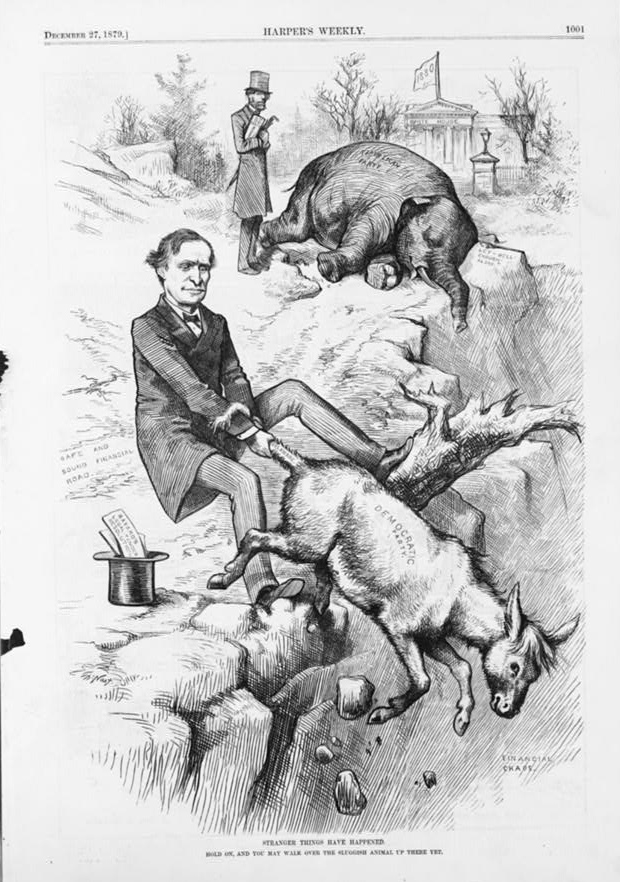
It is time to let go of the Democratic and Republican parties. A classic cartoon from Thomas Nast:

Communist Party Endorses Obama and the Democrats for 2012
In an article for People's World, the chair of the Communist Party USA, Sam Webb, asks if it matters "which party wins." Webb argues that while the Communists "have always advocated the formation of an independent people's party," Democratic Party victories create "space to struggle for a people's agenda." Excerpt:
In our view, the differences between the two parties of capitalism are of consequence to class and democratic struggles. Neither party is anti-capitalist, but they aren't identical either. Differences exist at the levels of policy and social composition. And despite the many frustrations of the past two years, the election of Barack Obama was historic and gave space to struggle for a people's agenda.Though Webb says Communists "would have been on the defensive from day one" had the Republicans won the presidency in 2008, the point is undermined by the fact that their support for the Democrats is part and parcel of a defensive and reactionary political strategy, the primary aim of which is purely negative in character: ensuring that Republicans are defeated by Democrats. In other words, it is nothing more than lesser evilism in the guise of progressive reformism. He concludes:
If, on the other hand, the Republicans had been victorious in 2008 the character of class and democratic struggles would have unfolded very differently. Our movement would have been on the defensive from Day One, the Democrats would be running for cover, and the Republicans would have an unfettered hand in their efforts to liquidate the welfare state, roll back the rights revolution of the 1930s and 1960s, and crush the people's movement - labor in the first place. [Emphasis added.]
We are keenly aware of the fact that the agenda of the far right is to bring this administration and country to its knees, with a heavy dose of racism, lies and economic sabotage, setting the stage for a full blown return to power of the most reactionary, racist, anti-labor, anti-women, homophobic and militarist grouping in U.S. politics . . . no other party besides the Democratic Party stands a chance of beating the GOP next year.Needless to say, liberal and progressive Democrats are not touting the endorsement in their commentaries and fundraising letters, while the more militant elements in the Communist party rank and file have been vocal opponents of Webb's political strategy. On the other hand, ironically, tea party groups that have been co-opted and infiltrated by Republican party hacks are among the most passionate supporters of the negative and reactionary lesser-evilist political strategy favored by Webb, but from the other direction, of course.
PA: Movement Builds to Reform Ballot Access Law and the Primary System
Since the state's primary elections in May, in which 80% of voters opted not to exercise the franchise, calls to open the primary process continue to mount in Pennsylvania. One state rep, Democrat Eugene DePasquale, has proposed a package of reforms aimed at increasing voter turnout and leveling the political playing field for Independent and third party candidates. From Politics PA:
The Pennsylvania Ballot Access Coalition – which includes the Libertarian Party, the Green Party, the Constitution Party, the America First Party, the Reform Party, the Prohibition Party, the Unified Independent Party, the New American Independent Party and the 2004 Ralph Nader campaign – is a strong supporter of the measures introduced by DePasquale, as is Independent Pennsylvanians.
Though Depasquale stated he has not yet faced opposition from any single group,“the current two-party structure is against the reforms." The big message that DePasquale wanted to express is that regardless of party or affiliation “the ‘minor candidates’ should be part of the debate.”In the press release, DePasquale notes the discriminatory character of Pennsylvania's ballot access regime:
Independents are joining third parties in pressing Pennsylvania’s closed primary system. On the forefront of this growing movement is State Rep. Eugene DePasquale’s introduction of of a four-bill reform package, known as the Voter’s Choice Act (VCA).
According to the news release the first bill would allow voters registered as independents to cast ballots in Pennsylvania’s primary elections. The second bill would require corporations to obtain shareholder approval before contributing an annual aggregate sum exceeding $10,000.
The third piece of legislation allows all voters to cast ballots up to 15 days in advance of Election Day in both the primary and general elections. The fourth and final bill in the package would make general election competition among all parties a reality by equalizing the ability of Independent and third-party candidates to run for public office in Pennsylvania.
"The Voters' Choice Act would give greater freedom of choice to our voters by making it much less difficult for independent and third-party candidates to get on the November ballot," DePasquale said. "The VCA would change the way a third party is legally defined and remove the too-high barrier of third parties, giving general election voters more choice and strengthening competition."Independents need to gather ten times more signatures than their Republican and Democratic counterparts to obtain ballot access. In 2010, Democratic and Republican party activists succeeded in purging every single third party and independent candidate for statewide office from the ballot by vowing to challenge their ballot access petitions in court, and threatening them with hefty legal fees.
The Pennsylvania Ballot Access Coalition – which includes the Libertarian Party, the Green Party, the Constitution Party, the America First Party, the Reform Party, the Prohibition Party, the Unified Independent Party, the New American Independent Party and the 2004 Ralph Nader campaign – is a strong supporter of the measures introduced by DePasquale, as is Independent Pennsylvanians.
Hidden in Plain Sight: Partisan Bias and Independent Voters
Via The Hankster comes word of a new national campaign by Independent Voting (CUIP) to push for Congress to hold hearings on systemic discrimination against independent voters. From IndependentVoting:
IndependentVoting.org has launched a national campaign to lobby Congress to hold hearings on the structural discrimination in our electoral system against independent voters. Independents are 40% of the population, yet the barriers to full democratic participation are so hardwired into the system as to be almost unnoticed.This is a great idea. CUIP is strongly opposed to partisan redistricting and closed primaries, so it is very likely those points will be emphasized in their materials. The point that partisan duopolist biases are so hardwired into the system that they basically go unnoticed is an important one, since they affect the way we act and the way we think. Ballot access issues are an obvious example. What other barriers and biases against third party and independent voters are hidden in plain sight?
The purpose of our campaign is two-fold: 1) To educate Congress and shine a light on the effect of partisan control of the election process, namely that 40% of Americans have a second class status; and 2) to urge Congress to investigate these biases by holding hearings.
Two committees were formed to launch the campaign: The Bill of Particulars Committee developed a document that lays out the various ways independents are disadvantaged. Some of these infractions are gigantic and some are minute. But they are all a part of the machinery of government and politics which places the privileges of the party above the voter.
The second committee is the Strategy and Organizing Committee which is developing the materials for independents to use at the grassroots such as a sample letter and postcard, as well as material to help independents set up and conduct meetings with their members of Congress.
Partisan Hypocrisy, Partisan Immunity, and the Necessity of Divided Government
Like the Democrats and Republicans themselves, partisan hypocrisy and partisan immunity are two sides of the same worthless coin. The concept of partisan hypocrisy is well known: Democrats and Republicans are each quick to excuse themselves for acts which they denounce when committed by the other side. The notion of partisan immunity is closely related: when confronted with even justified criticism from the other side of the duopoly divide, Democrats and Republicans claim the critique has no merit because it is leveled by a partisan hypocrite. At The Think 3 Institute, Sam Wilson has been developing the two ideas together for some time. From October 2009:
As in the past, I will see the Dividist's call for divided government and raise him one. Government divided between Democrats and Republicans is not divided government at all: the ruling parties work in concert to subvert our Constitution and the Bill of Rights. If Democrats and Republicans refuse to hold a president accountable for his crimes when he is a member of their own party, then the only way to ensure full accountability in the executive branch is to elect a third party or Independent president.
"Partisan immunity" is my term for the practice within the American two-party system of politicians evading or attempting to avoid accountability for questionable conduct by claiming that any demand for accountability is politically motivated for partisan advantage.From September 2009:
Partisan hypocrisy is a key component of the more pernicious concept of partisan immunity. Partisan immunity is claimed by those who claim that their actions are being prosecuted for political or partisan reasons alone. An inevitable element of that argument is the claim, implicit or not, that the partisan prosecutors are hypocrites who would have done the same things had they been in power. Once these claims are made, the objective injustice of the act in question becomes irrelevant.Last week, while speaking about Republican opposition to the Obama administration's illegal war in Libya, Senate Minority Leader Mitch McConnell admitted outright that partisan hypocrisy is in fact an integral facet of Republican-Democrat party politics. Althouse has McConnell's quote in full:
McConnell: I’m not sure that these kind of differences might not have been there in a more latent form when you had a Republican president. But I do think there is more of a tendency to pull together when the guy in the White House is on your side. So I think some of these views were probably held by some of my members even in the previous administration, but party loyalty tended to mute them. So yeah, I think there are clearly differences and I think a lot of our members, not having a Republican in the White House, feel more free to express their reservations which might have been somewhat muted during the previous administration.At Divided We Stand, the Dividist puts McConnell's statement in its proper duopolist context:
[McConnell's] comment is being trumpeted on the left as prima facie evidence of the venal, party-first, hypocritical nature of many congressional Republicans. This is, of course, completely true, as that is indeed their nature. The irony is that the Democrats making that point fail to note that many congressional Democrats are behaving exactly as McConnell notes on exactly the same issue.So, when a Republican president commits high crimes and misdemeanors, party loyalty prevents Republicans from holding that president accountable; and when a Democratic president commits high crimes and misdemeanors, party loyalty prevents Democrats from holding that president accountable. Is it any wonder that presidents are so rarely held accountable for their crimes? The Dividist concludes, appropriately, with a call for divided government:
The need for a check on the President and to ensure that our constitutional checks and balances function as intended justifies a divided government voting heuristic - always voting to maintain a divided government state at the federal level. Always.Unfortunately, however, government divided between the Democrats and Republicans does not ensure constitutional checks and balances. On the contrary, government divided between the Democrats and Republicans is the primary means by which the ruling political class systematically avoids political accountability. Indeed, it provides them with an ideological shield behind which they wage their outright war on constitutional, democratic-republican government. Divided government between Democrats and Republicans means never having to take responsibility, for they will always claim partisan hypocrisy and partisan immunity.
As in the past, I will see the Dividist's call for divided government and raise him one. Government divided between Democrats and Republicans is not divided government at all: the ruling parties work in concert to subvert our Constitution and the Bill of Rights. If Democrats and Republicans refuse to hold a president accountable for his crimes when he is a member of their own party, then the only way to ensure full accountability in the executive branch is to elect a third party or Independent president.
The War on the Fourth Amendment and the War on Logic Cont'd.
An opinion piece last week in the New York Times took note of the ongoing war against the Fourth Amendment that is being waged by the Republican-Democrat ruling political class in the name of "security". Excerpt:
THIS spring was a rough season for the Fourth Amendment. The Obama administration petitioned the Supreme Court to allow GPS tracking of vehicles without judicial permission. The Supreme Court ruled that the police could break into a house without a search warrant if, after knocking and announcing themselves, they heard what sounded like evidence being destroyed. Then it refused to see a Fourth Amendment violation where a citizen was jailed for 16 days on the false pretext that he was being held as a material witness to a crime.The Senate Intelligence Committee met last week, in secret, to consider the Justice Department's extremely broad interpretation of the powers granted to investigators by the Patriot Act. From Time Magazine:
In addition, Congress renewed Patriot Act provisions on enhanced surveillance powers until 2015, and the F.B.I. expanded agents’ authority to comb databases, follow people and rummage through their trash even if they are not suspected of a crime . . .
Last Tuesday the committee met to consider the worries of some members, mostly Democrats, who say the Justice Department has drafted a breathtakingly broad interpretation of Section 215 of the Patriot Act . . . That section allows the FBI to seize without a warrant "any tangible things," like documents . . . as long as the bureau can convince a special national-security court, the Foreign Intelligence Surveillance Court, that the information is "relevant" to antiterrorism work . . . Privacy advocates, however, consider it little more than a rubber stamp.
Senator Tom Udall, a New Mexico Democrat, went further, saying the government was using that opinion to conduct some sort of dragnet surveillance. "Innocent Americans are being swept up in this," was about all Udall could say to TIME.
That sounds a lot like something a certain junior Senator from Illinois might have said back in December 2005, when he joined eight other Senators in penning a dear-colleague letter that argued, among other things, that Section 215 was too broad. "We believe the government should be required to convince a judge that the records they are seeking have some connection to a suspected terrorist or spy," wrote Obama and the other Senators.Of course, President Obama is now singing a different tune. And it's one with which we're already familiar. For example, the Obama administration claims that the war in Libya is neither illegal nor unconstitutional because it is not a war. In the case of the Patriot Act, the administration's position is that illegal search and seizure is not illegal because it's not a search or seizure. From Time again:
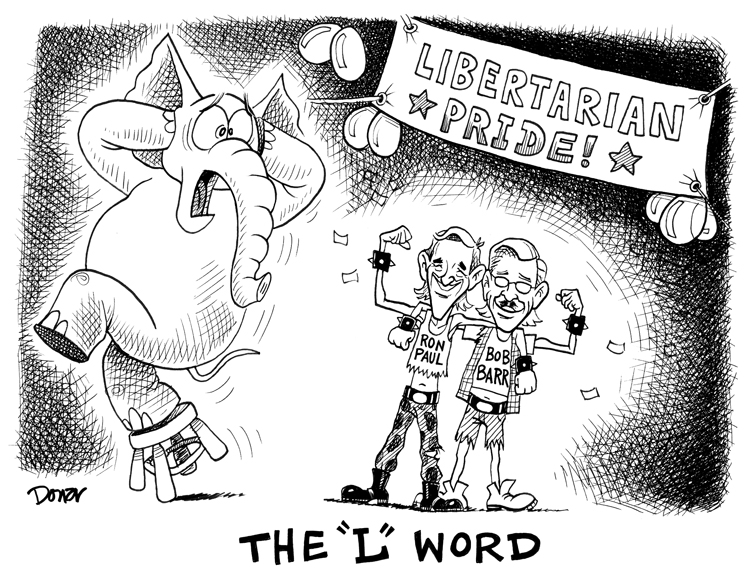
Libertarian Pride
A cartoon from Political Graffiti, coincidentally apt the day after the gay marriage bill was passed here in New York:

AZ: Independent Rights Party Seizes Properties from Fannie Mae and Freddie Mac
While reading up on the Tucson mayoral election yesterday, I happened to come across a most curious story about a would-be third party candidate in the race, Marshall Home. Home attempted to file for the office as a Democrat, but withdrew after he was challenged on the basis of residency requirements. As the Arizona Daily Star reported, "He conceded he has been living at a county address for months and voted from that address last year." Though Home changed his registration from Independent to Democrat before filing to run for mayor, he is also the chairman of a small third party group called the Independent Rights Party. You might be surprised to learn that you are already a member. From the Independent Rights Party:
The IRP is a registered political party, beginning March 3, 2004. We support the individual in their right to freely choose for themselves, subscribing to Thomas Jefferson's statement: "Never trust the government. Be ever Vigilant" Marshall E. Home is the Chairman . . . everyone is a member of the Independent Rights Party. There is not now, nor will there ever be a membership fee.The IRP's primary focus appears to be on foreclosure recovery and Home is quite active in this regard. He has already seized over twenty foreclosed properties from Fannie Mae! From AZ Central:
Marshall Home, who claims many foreclosures are illegal, has filed documents in the past two weeks with the Maricopa County Recorder's Office showing he has supposedly taken ownership of at least 21 homes belonging to government-owned mortgage giant Fannie Mae. But none of the documents shows any money has changed hands, and Fannie Mae says it has not sold the houses. Real-estate agents and experts say Home's documents, a type of real-estate form called a special-warranty deed, aren't valid . . .
"Fannie Mae has not authorized the transfer of the properties in question to the organization," spokesman Andrew Wilson said. "We will pursue appropriate legal action and involve law enforcement as necessary."
But for now, Home's Independent Rights Political Party Trust is claiming to own the houses. Several of the homes have people living in them.
"Lenders are gangsters, and they can't prove they own these homes. So they have no right to foreclose," said the 80-year-old self-professed billionaire from his real-estate and political office in Tucson on Tuesday. "I plan to continue to take homes from Fannie Mae and Freddie Mac. I would buy them, but those groups can't produce the notes showing they are the rightful owners to sell or foreclose on them."
AZ: Democratic Party's Ballot Purge Provides Opening for Tucson Greens
When Democrats and Republicans seek to dissuade others from engaging in third party and independent political activism, one of their primary arguments is that third party and independent campaigns for office are a fool's errand because it is so difficult for them to achieve ballot access. Let's put aside the fact that such ballot access hurdles are erected by Democratic and Republican lawmakers themselves in order to cement their hold on power at all levels of government. Even despite the fact that third party and independent candidates face biased and discriminatory rules and regulations when they seek to run for office – for example, having to collect anywhere from two to ten times more petition signatures than their Democratic and Republican counterparts –, these candidates often still fight their way onto the ballot, and they do so by gathering many more signatures than are required by law. Why? Because their petitions are challenged by professional partisans in the major parties, often on the basis of the most absurd technicalities. Taken to its logical extreme, the ideal outcome of such a process is an election in which there is only one candidate on the ballot or perhaps even none at all. However, sometimes it can also inadvertently provide a strategic opening for opponents of the two-party state.
The Tucson mayoral race provides us with an interesting case in point. As it now stands, only two candidates are assured ballot access: a Green and a Democrat. There would have been at least four, but in recent weeks the Democratic party successfully purged an Independent and a Republican party candidate from the ballot by petition signature challenges. From the Arizona Daily Star:
The Tucson mayoral race provides us with an interesting case in point. As it now stands, only two candidates are assured ballot access: a Green and a Democrat. There would have been at least four, but in recent weeks the Democratic party successfully purged an Independent and a Republican party candidate from the ballot by petition signature challenges. From the Arizona Daily Star:
Democratic attorney Jonathan Rothschild may be the only major-party candidate left standing in the mayoral race after today. Superior Court Judge Paul Tang bounced independent Pat Darcy from the ballot Monday after the Pima County Recorder's Office found he came up 106 signatures short on nominating petitions.
A short time later, Republican Shaun McClusky attempted to withdraw his nominating petitions before facing his own court challenge this afternoon, where Democrats will argue he didn't obtain a sufficient number of signatures to get on the ballot . . .
Darcy offered no court defense of his petitions, beyond noting there is a built-in disadvantage for independent candidates, who need far more signatures than party candidates. As an independent, Darcy needed 2,596 valid signatures. Republicans, meanwhile, needed 1,060 and Democrats needed 1,642. [Emphasis added.]
He said he was dismayed the Democratic Party challenged him at all. "What are they afraid of?" he asked, saying that if the tables were reversed, he would have welcomed a contest rather than try to kick all of the challengers out of the race. "You want to compete. You don't want it just given to you," he said, adding it is a drain on the courts, as well as the city and county staffs.
City Clerk Roger Randolph acknowledged in court that the number of challenges this year is unprecedented, saying the last challenge in a city race came in 1999.
That Green will either be Mary DeCamp, a City Council candidate in the past, or Dave Croteau, a past mayoral candidate. There will be a primary to determine who will be on the ballot for the general election. Another candidate who was running for the Green nomination dropped out of the race in order to support and work on sustainability issues with the now-former Republican candidate.Though the Republicans could still nominate a write-in candidate, the Green party has an excellent opportunity to gain attention from the media and wider recognition in the state, especially given the fact that they will be holding a contested primary. If they can successfully capitalize on the marginalization of the GOP, the Greens may even be able to score a major upset. Greens across the country should be paying close attention to this race, and lend their support in whatever way possible.
Toward a Libertarian-Progressive Alliance
An article by Ted Becker at The Last, Lost Empire argues that the basis for a "real" third party can be found in the convergence of libertarian-leaning Republicans and progressive-leaning Democrats, in other words, the libertarian-progressive alliance. Excerpt:
The Real Third Party, whatever it finally calls itself, will be a previously implausible coalition that will span the political continuum from Libertarianism to Social Democracy. The major themes that their president and Congressional candidates will run on will include most of the following:The piece goes on to detail the convergence of opinion between the likes of Ron Paul and Ralph Nader, Rand Paul and Dennis Kucinich, and so on. It concludes:
Do most Americans trust either President George W. Obama or the Congress run by either the Democrats or Republicans to do any of these things? Public opinion polls repeatedly show a big majority would say “No way.” More than 80% think that the United States is headed in “the wrong direction.” So, if not the Dems and the GOP, then who?
- Ending the wars in Afghanistan and Iraq—all troops and security guys out
- Ending the war in Libya—no military or covert action funds spent there
- No more “Imperial Presidency” wars; Return the war power to Congress
- Radical restructuring of The Fed—investigate lack of transparency and clear conflicts of interests between Wall Street and Main Street
- Rebuilding the American capitalist infrastructure and manufacturing base;
- Balancing the budget immediately;
- Start to deal seriously with climate change as a major national security issue..
Our point is that many very prominent, articulate Americans—who are politically visible and who hail from widely variant ideological positions are now deeply contemplating their mutual antagonism towards the Democratic-Republican regime that controls all three branches of the federal government What is crucial is that they are doing this, not by arguing, but by exploring innovative solutions, from their divergent points of view. They are emphasizing similarities, not differences. This has been at the heart of all successful third parties in the U.S. Such a Third Party can either win or change the game, put in play major solutions, policies and/or constitutional amendments that the established parties ignore. Anyone who thinks this is impossible or even improbable does not know his or her American history . . .Update: Via email a reader asks if Politea has discussed this general topic in the past. Indeed, we've discussed the progressive-libertarian alliance strategy at some length before. Long time readers might recall my PLEA for political independence with the Progressive Libertarian Electoral Alliance, or the libertarian-progressive populist front against the two-party state. See also past posts on the Green-Libertarian alliance strategy.
Reformism and the Politics of Infinite Deferral
Tirade Faction forwards a link to an article by Jon Walker at FireDogLake which argues that "if you want more bipartisanship, promote more political parties." Comparing the Republican-Democrat two-party state with the UK's current government, which has three major parties, Walker points out that if no party has an outright majority in government, compromise becomes a necessity. Excerpt:
The Conservative Party and the Liberal Democrats have been working together extremely closely. What is the cause of this outbreak of bipartisanship? The answer is simple, the UK has three big political parties and two of them were needed to form a coalition with a governing majority. This gave the Lib Dem-Conservative coalition a huge incentive to embrace their bipartisan relationship and do everything they could to make bipartisan compromise work . . . If they fail to work together to produce good results, both stand to lose seats, mainly to Labour. . . . The reason you see little sustained, genuine bipartisanship in America, despite most beltway pundits acting like the mere hint of it sends them into ecstasy, is that there is no incentive for doing it . . . If you really want more bipartisanship, the only real solution is to promote more viable political parties.Walker then goes on to list some of the ways to promote a multiparty system:
To have more viable parties requires systematic changes to our political system. You need to switch to a voting system like proportional representation and, to a lesser degree, instant runoff voting that promotes more than just two parties.While such reforms would be a boon for third party and independent activism, we should disagree that they are "required" or "necessary" to elect third party and independent candidates to elected offices. To elect third party and independent candidates to office, the only thing that is required or necessary is that voters cast their ballots for them. To maintain that the government must pass a series of systemic reforms before it would become feasible for the people to support third party and independent candidates is just an indirect way of saying that opposition to the two-party state is futile, thereby deferring any active opposition until some unspecified date in the future. Arguably, implementing systemic reforms to the political system should be secondary to inducing a change in the way Americans think about politics as such. The two-party state is, first and foremost, a state of mind.
Subscribe to:
Posts (Atom)


