 Via RSS
 Via Twitter


Showing posts with label cartoons. Show all posts
Showing posts with label cartoons. Show all posts
Run For Your Lives!
Goaded by the professional hysterics in the corporate media, New York City is in full crisis mode ahead of hurricane Irene. But if there is any group of people who are less reliable than political prognosticators, it is weather forecasters.


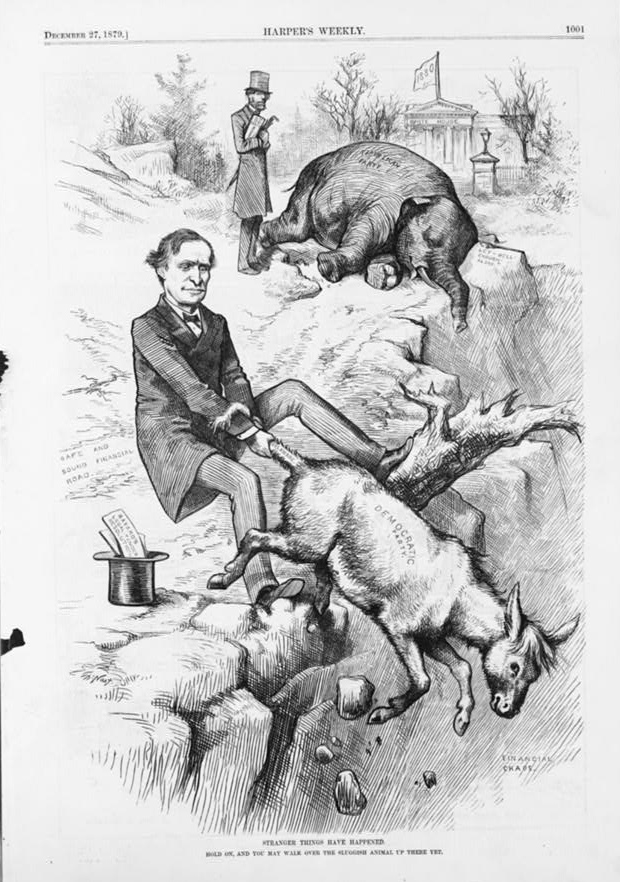
Let It Go
It is time to let go of the Democratic and Republican parties. A classic cartoon from Thomas Nast:

Libertarian Pride
A cartoon from Political Graffiti, coincidentally apt the day after the gay marriage bill was passed here in New York:



The Two-Party Two Step and the March of Tyranny
A great cartoon from Ben Garrison, entitled "The March of Tyranny":

Garrison originally posted the cartoon about a year ago with this explanation:

Garrison originally posted the cartoon about a year ago with this explanation:
My cartoon (click to enlarge) shows how the banking and corporate masters (crony capitalist fascists) control both major parties behind the scenes. They keep us distracted with left vs. right while giving us the illusion that voting for one of the other parties will solve things. It won't.The cartoonist recently returned to a discussion of this particular work after it was revealed to him that a neo-Nazi propagandist had appropriated it for his own ends. From Garrison:
There's an entity or unknown cretin out there changing my cartoons--adding in offensive Jewish stereotypes--and then spreading them throughout the internet. While leaving MY name on them. . . . Please help me report these creeps and if you see them on blogs, demand their removal.Via Reddit.
Where do Independents come from?
A cartoon via About, the making of an Independent:

And here's another, entitled "College Call Home," from Randy Miller at the Utah League of Independent Voters:


And here's another, entitled "College Call Home," from Randy Miller at the Utah League of Independent Voters:


Two-Party Tandem
Another cartoon from Randy Miller at the Utah League of Independent Voters: "on a bicycle built for two . . . parties" . . . .

The Political Slaughterhouse
If someone were to write the definitive political fable of our time, it would likely tell the story of how farm animals formed alliances amongst themselves in support of the two competing factions from the management at the local slaughterhouse. An apt cartoon from lilwonders at Mylot:

Lilwonders adds in explanation: "This is the reality of the two party system. The sooner we do something about it...the better off we will be."

Lilwonders adds in explanation: "This is the reality of the two party system. The sooner we do something about it...the better off we will be."

The American Political Zoo
Not too long after Randy Miller, founder of the Utah League of Independent Voters, began publishing a series of original independent political cartoons at the ULIV blog, I contacted him to ask if he takes requests and he was happy to oblige:

Thanks Randy! If anyone else out there is independently-minded and artistically inclined, I'd gladly relay any of your political cartoons at Poli-Tea and TPID.
Thanks Randy! If anyone else out there is independently-minded and artistically inclined, I'd gladly relay any of your political cartoons at Poli-Tea and TPID.
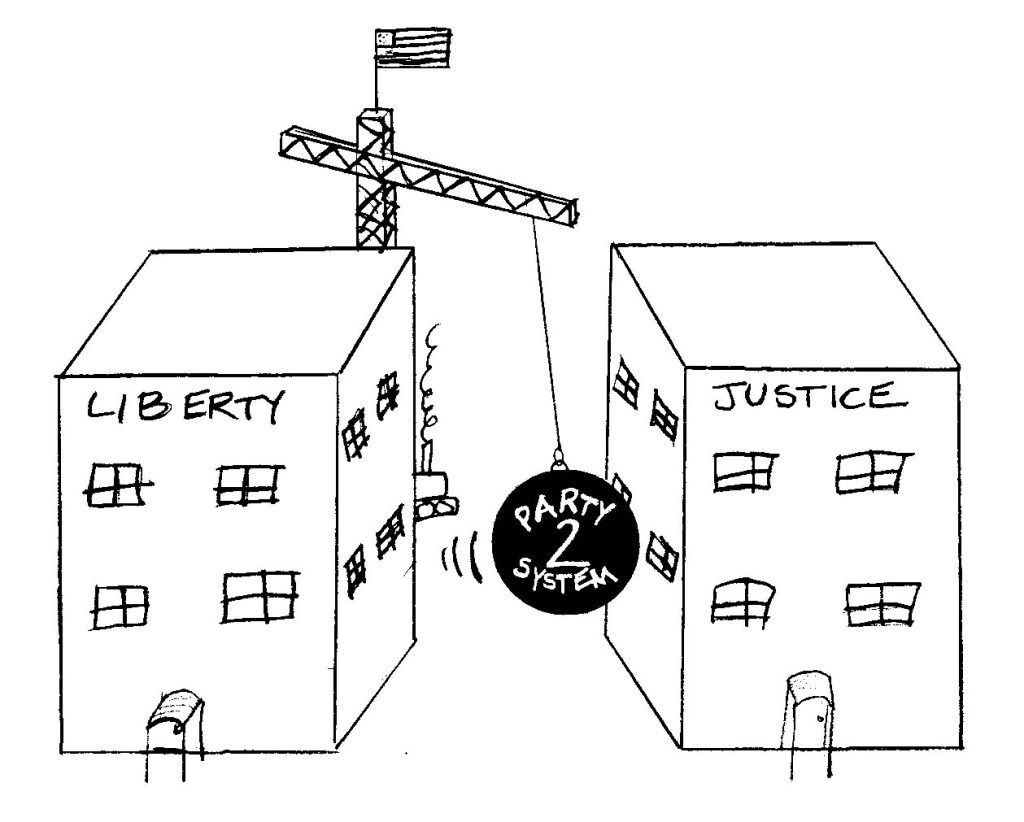
The Two-Party Wrecking Crew
Randy Miller, founder of the Utah League of Independent Voters, has begun publishing a series of original independent political cartoons at the ULIV blog and The Hankster. This one is spot-on:

Two New Third Party and Independent Blogs
Poli-Tea readers may enjoy two relatively new blogs that have come online in recent weeks, at least so far as I can tell. Start a Third Party Now relays choice quotes, editorial cartoons and article excerpts, and effectively calls for a third party revolution. In its "about" section, Jay Edward writes:
The masses of people walk around hypnotized. Hypnotized defined as believed falsehoods as true. While the country is still salvageable, the public somehow must wake up to the fact that neither party serves them, only their constituents [i.e. corporations? -d.]. The present path leads to ruin for the republic.The second blog is entitled My Third Party and is a sister site to the Daily Puma. The inaugural post at My Third Party reads in part:
It seems nowadays that neither the democrats or republicans have been able to retain the kind of integrity that most would expect. There is such a constant parrying for position that the whole point of becoming a politician has been lost. . . . So lets use this blog for two equally important purposes. Lets support third party candidates all over the country by listing their blogs on this page, and lets also reward any political candidate willing to publicly renounce the sneaky internal 2008 democratic tactics that has splintered the democratic party.
Already Dead: the Democratic-Republican Partisan Paradigm in the Age of the Independent Voter
For those of us who recognize the utter bankruptcy of Democratic-Republican party government, who do not suffer the bipolar mentality characteristic of the political class, who no longer subscribe to the ideology of the two-party state, the Democrat and the Republican are the very definition of political anachronism. Partisans of the Democratic and Republican Parties are the cartoon characters who continue to live because no one has informed them that they are already dead. At North Jersey, Murray Sabrin writes:
For decades both Democrats and Republicans have failed miserably at the national and state levels in being good stewards of the public’s money. If independents conclude that neither party is competent to govern, will independents rally around a new political party in the near future?Who are these people for whom it is still an open question whether the Democrats or Republicans are "competent to govern"? If the definition of insanity is doing the same thing over and over again and expecting different results, then voting Democrat or Republican under the conditions of the two-party state in the expectation of good – or rather, more precisely, less evil – government is certifiable, whatever your registration may be. A letter to the editor at Jacksonville.com calls for a centrist third party alternative to the Democrats and Republicans. Via The Hankster:
The time is right for the emergence of a third political party in this country. . . . Members of both parties seem far more concerned about winning elections and holding on to power than in doing the country's business. A significant plurality of the American electorate does not identify with either of the major political parties. Those independents who have not given up totally all too often hold their nose and cynically vote for the candidate they believe will do the least damage to the country.
The country needs a new centrist party that rejects polarizing ideologies of the far right and the far left and that focuses solely on doing what is fair and right for all of the American people. Such a party composed of independent voters and a small percentage of the more moderate members of the two major parties would constitute a dominant political force highly capable of winning local and national elections.
Each Tree Shall Be Known By Its Fruit: By the Time the Machines are Ready, It will Already be Too Late.
 Given the contemporary political climate, an apparent uptick in popular references and allusions to Richard Hofstadter's 1964 essay "The Paranoid Style in American Politics" on both sides of the duopoly divide was likely inevitable. One of the constitutive mechanisms of the paranoid style is, of course, psychological projection and so we should not be surprised to find that projection is a constitutive element of US politics under the conditions of the two-party state. The ubiquity of projection in Democratic-Republican politics may go some way toward accounting for the universality of hypocrisy among the partisans of the Democratic and Republican Parties. We can be almost certain that when a Democrat accuses a Republican of corruption, dishonesty or hypocrisy, and vice versa, the charge will hold just as much for the one who levels it as it does for the one against whom it is leveled. It is no coincidence that the greater part of Democratic-Republican politics amounts to little more than the revelation of such inconsistencies and has thus deteriorated from ad rem argumentation to ad hominem, if not ad personam, attack.
Nonetheless, when arguing with supporters of the two-party state, advocates of third party and independent politics can, in many if not most cases, safely assume that any charge against third party and independent activism holds just as well for the politics of the duopoly system of government. For instance, duopolists are fond of claiming that third parties are little more than personality cults, which is highly ironic coming from supporters of the Republican church of Ronald Reagan and the Democratic idolization of Barack Obama. But perhaps a more concrete example is in order. Since "Palin posts" are now obligatory, let's consider the former governor's recent interview with Rush Limbaugh.
LIMBAUGH: What are your thoughts now on the viability of a third party if the Republican Party can't be brought around?So, according to Palin, third party and independent activism is naive and idealistic given the two-party system, and so pragmatism is required, pragmatism being defined as deference to the parties that control the state. For the moment, let's recall the maxim which states that pragmatism sounds good in theory but doesn't work in practice. Limbaugh continues:
PALIN: You know, to be brutally honest, I think that it's a bit naive when you talk about the pragmatism that has to be applied in America's political system. And we are a two-party system. Ideally, sure, a third party or an independent party would be able to soar and thrive and put candidates forth and have them elected, but I don't think America is ready for that. I think that it is... Granted it's quite conventional and traditional, but in a good way that we have our two parties, and I think that that's what will remain. [Emphasis added.]
LIMBUAGH: But these magical, whatever it is, 20% of people that are not identified or do not self-identify themselves with either party, what's the way to get them?Palin would do well to observe with the evangelist: "Each tree is recognized by its own fruit." With the appropriate substitutions, the very same argument could have been put forward by any given Democratic demagogue. The only people who are so naive as to be convinced by such arguments today are Republicans and Democrats, the dead-enders of the duopoly parties, whose utopian idealism serves nothing more than the ruling establishment and political status quo, when it dictates that a third party or independent candidate for office could never win an election but that the Democratic and Republican Parties will be reformed over the course of the next election cycle. Those who are attracted to the Democratic or Republican Party on the basis of their stated platforms and agendas are like the ill-fated cartoon creatures who never fail to take the bait and always live to regret it.
PALIN: I think just naturally independents are going to gravitate towards that Republican agenda and Republican platform because the planks in our platform are the strongest to build a healthy America. We're all about cutting taxes and shrinking government and respecting the inherent rights of the individual and strengthening families and respecting life and equality. You have to shake your head and say, "Who wouldn't embrace that? Who wouldn't want to come on over?"
It is not "America" or the people of the United States who are "not ready" for an independent politics, for a politics independent of the Democratic and Republican graft and patronage machines, rather it is the graft and patronage machines of the Democratic-Republican Party and their enablers in the mainstream media and political establishment that are "not ready" for an independent politics. And they will remain "not ready" until they can be assured that any "new" politics will ensure the smooth functioning of the machines that (re)produce the political status quo. By the time the machines are ready, it will already be too late.
Why take back the party? There's nothing worth salvaging.
Many conservatives and libertarians today continue to labor under the false assumption that the election of Republicans will result in a representative government that is more representative of conservative and libertarian interests. Clearly, they have not studied the failure of the liberal and progressive strategy of electing more Democrats. Or they believe, for some reason, and against all the evidence, that this time their infiltrationist effort to "take back the party" will succeed in suspending the logic of the duopoly system of government.
Perhaps the greatest paradox of the two-party system is that it continues to exist though it has been dead for quite some time. The Washington Post, for instance, recently bemoaned "Virginia's Electoral Farce," writing:
Because the representatives of the Democratic and Republican Parties do not and cannot adequately represent the diversity of interests constitutive of the US electorate, Democratic and Republican Party shills have been forced to develop the purely reactionary ideology of lesser-evilism, which aims first and foremost not at electing the best representatives of one's own interests, but rather at defeating the perceived representatives of an imaginary ideological opponent's best interests. In reality, the Republican Party is the greatest hindrance to the representation of conservative and libertarian interests, just as the Democratic Party is where liberal and progressive politics goes to die.
The response of the Democratic-Republican establishment to criticism of the ideological order that maintains the hegemony of the duopoly system of government is highly instructive. As Jane Hamsher pointed out yesterday at FDL, the "White House contempt for bloggers and the 'left of the left' is a pattern." On the other side of the duopoly divide, angry conservative and libertarian activists confronted Republican Senator Lindsey Graham at a town hall meeting. The establishmentarian responded: "I'm not going to leave the Republican Party . . . If you don't like it, you can leave." They should take his advice. Many already are. At Your Destiny Now, Miguel Diocuore writes: "A few minutes ago, just before writing this, I joined the Constitution Party." Moderate Republicans are confronted with the same choice. At Republicans United, Dennis Sanders writes: "For those of us who are frustrated moderates in the GOP, the same argument applies. If we don’t think either party is a good fit, then maybe we need to create another party. The Whigs seem to be doing well."
Perhaps the greatest paradox of the two-party system is that it continues to exist though it has been dead for quite some time. The Washington Post, for instance, recently bemoaned "Virginia's Electoral Farce," writing:
Competitive elections are a hallmark of democracy. If only Virginia had them. Most Virginians are under the quaint impression that their state has a competitive two-party system. If only. The sad fact is that for the vast majority of legislative races in the state, real competition is a thing of the past. For that, Virginians can thank state lawmakers of both parties, who for decades have drawn lines on the voting maps for no higher purpose than to preserve their own grip on power.Apparently, the editors of the Washington Post are under the quaint assumption that Virginia is in this way somehow any different from the great majority of polities in the United States. In April, Nate Silver and Andrew Gelman of 538 noted in an oped for the NYT that:
in the past decade, there were 2,175 elections to the United States House of Representatives held on Election Days 2000, 2002, 2004, 2006 and 2008. Among these, there were 41 instances — about 1.9 percent — in which the Democratic and Republican candidates each received 49 percent to 51 percent of the vote (our calculations exclude votes cast for minor parties). In the 1990s, by contrast, there were 65 such close elections. And their number increases the further one goes back in time: 88 examples in the 1950s, 108 in the 1930s, 129 in the 1910s.The two-party system is like the classic cartoon character that has not yet fallen to its death because it has not yet realized it has run right off the cliff. It's time we looked down to ensure a hard fall. Just what groups are adequately represented by the Democratic-Republican duopoly system of government? Ideologically speaking, "none" is probably the right answer. For progressives and liberals the Democratic Party is too moderate or conservative. For moderates it is too liberal or progressive. On the other side of the divide, for conservatives and libertarians, the Republican Party is too liberal or statist, while for moderates it is too conservative. In other words, the reigning two-party system does not adequately represent conservatives, libertarians, progressives, liberals or moderates. Indeed, it cannot. How could a binary system possibly satisfy the demands and represent the interests of such a wide array of ideological constituencies? To put this in terms comprehensible to partisans of the duopoly parties: the Democratic Party is Democratic-in-name-only and the Republican Party is Republican-in-name-only.
Because the representatives of the Democratic and Republican Parties do not and cannot adequately represent the diversity of interests constitutive of the US electorate, Democratic and Republican Party shills have been forced to develop the purely reactionary ideology of lesser-evilism, which aims first and foremost not at electing the best representatives of one's own interests, but rather at defeating the perceived representatives of an imaginary ideological opponent's best interests. In reality, the Republican Party is the greatest hindrance to the representation of conservative and libertarian interests, just as the Democratic Party is where liberal and progressive politics goes to die.
The response of the Democratic-Republican establishment to criticism of the ideological order that maintains the hegemony of the duopoly system of government is highly instructive. As Jane Hamsher pointed out yesterday at FDL, the "White House contempt for bloggers and the 'left of the left' is a pattern." On the other side of the duopoly divide, angry conservative and libertarian activists confronted Republican Senator Lindsey Graham at a town hall meeting. The establishmentarian responded: "I'm not going to leave the Republican Party . . . If you don't like it, you can leave." They should take his advice. Many already are. At Your Destiny Now, Miguel Diocuore writes: "A few minutes ago, just before writing this, I joined the Constitution Party." Moderate Republicans are confronted with the same choice. At Republicans United, Dennis Sanders writes: "For those of us who are frustrated moderates in the GOP, the same argument applies. If we don’t think either party is a good fit, then maybe we need to create another party. The Whigs seem to be doing well."
Third Party Tea Party
With the next national tea party mobilization planned for July 4th, Sean Haugh at Re-Tea Party calls on activists and organizers of the events to "reach out across the aisle" to liberals and progressives, while urging the latter to join in the demonstrations, on the basis of common interests. Haugh identifi es a number of points of convergence between the left and right on various issues (opposition to the bailouts, anti-corporatism, social justice and individual liberty), arguing that they render the very distinction between right and left meaningless. He writes: "The dividing line is no longer between left and right. The division in our society is now between the robbers and the robbed." Of course, this division has been operative for some time, as the Thomas Nast cartoon on the left indicates, but there does indeed seem to be a new consciousness of its action and effects. Rasmussen Reports has even adopted new measures to gauge the depth of the division between what it calls the 'political class' and 'mainstream America.'
Nonetheless, it appears unlikely that many folks on the left or right will heed Haugh's call. Liberal Democrats have already constructed their own private master-narrative of the movement, according to which it is little more than a Republican astro-turfing campaign, while Republicans apparently aim to prove them right, and utilize the swell of discontent to re-consolidate the right within the confines of the GOP in the interests of short-term electoral gains. One tea party organizer marshals the usual list of duopolist arguments to discourage third party activism within the movement:
 es a number of points of convergence between the left and right on various issues (opposition to the bailouts, anti-corporatism, social justice and individual liberty), arguing that they render the very distinction between right and left meaningless. He writes: "The dividing line is no longer between left and right. The division in our society is now between the robbers and the robbed." Of course, this division has been operative for some time, as the Thomas Nast cartoon on the left indicates, but there does indeed seem to be a new consciousness of its action and effects. Rasmussen Reports has even adopted new measures to gauge the depth of the division between what it calls the 'political class' and 'mainstream America.'
Nonetheless, it appears unlikely that many folks on the left or right will heed Haugh's call. Liberal Democrats have already constructed their own private master-narrative of the movement, according to which it is little more than a Republican astro-turfing campaign, while Republicans apparently aim to prove them right, and utilize the swell of discontent to re-consolidate the right within the confines of the GOP in the interests of short-term electoral gains. One tea party organizer marshals the usual list of duopolist arguments to discourage third party activism within the movement:
As Conservatives, Libertarians and Republicans we need to be united behind a National party next year. There simply is not enough time to go through the process of getting third party people on the various state ballots and elected. We simply don't have the resources to fight the Democrats as independents without splitting the Republican Party again and guaranteeing the Democrats a victory. That is what the Democrats are counting on. Divide and Conquer.Given this scenario, it is likely already too late for many to "reach across the aisle" as Haugh would have it. And, in any case, is not such a gesture rendered moot by the recognition that the distinction between left and right is a false dichotomy? However, the fact that Republicans are still concerned about independent and third party campaigns arising out of the tea party protests is a sign that the tea partisanship debate has not yet been resolved in favor of the duopoly charade. The July 4th protests will thus be another opportunity for third party and independent activists to reach out to Republicans and the unaffiliated alike.
Subscribe to:
Posts (Atom)


