Fear and Loathing

Observing the devolution and deterioration of the health care "debate" over the course of the last few weeks, it is becoming increasingly difficult to stifle a sense of amusement at what passes for political discourse and informed comment in the United States. Aside from the spectacles offered by the numerous protests at town hall events across the country, a new low may have been reached last Friday in commentaries for the Wall Street Journal and the Washington Post, which took up opposite sides in the dispute. I am referring, of course, to the dueling pieces by Peggy Noonan and Steven Pearlstein. Noonan takes it upon herself to speak on behalf of the protesters and opponents of health care reform:
The passions of the protesters, on the other hand, are not a surprise. They hired a man to represent them in Washington. They give him a big office, a huge staff and the power to tell people what to do. They give him a car and a driver, sometimes a security detail, and a special pin showing he’s a congressman. And all they ask in return is that he see to their interests and not terrify them too much. Really, that’s all people ask. Expectations are very low. What the protesters are saying is, “You are terrifying us.”
Pearlstein, on the other hand, articulates the fears of liberal Democrats, when he writes:
The recent attacks by Republican leaders and their ideological fellow-travelers on the effort to reform the health-care system have been so misleading, so disingenuous, that they could only spring from a cynical effort to gain partisan political advantage. By poisoning the political well, they've given up any pretense of being the loyal opposition. They've become political terrorists, willing to say or do anything to prevent the country from reaching a consensus on one of its most serious domestic problems.
Given that this is what passes for elite, mainstream, political opinion and commentary in the United States, it is mystifying to me that there are still people who consider themselves Republicans or Democrats in this country. I happened to read these two pieces one after the other, and did not cease laughing for quite some time. In fact, I'm still chuckling at this very moment. This is what "terrifies" Republicans and Democrats now? The prospect of health care reform and opposition to the prospect of health care reform? What is truly terrifying is the speed and consistency with which the hysterics and alarmists among us are capable of successfully hijacking virtually every issue of political concern, from the hyper-local to the trans-national, aided and abetted by the corporate media and a political ruling class composed of opportunists and demagogues.

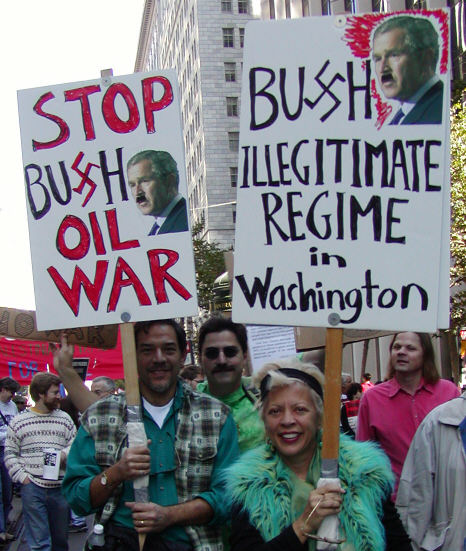
Graphic Art: Godwin's Law and the Art of Protest

One of the recurring themes here at Poli-Tea is the two-party system's inability to represent the many people whose political interests are not accounted for by the duopoly machine, with a focus on independent and third party voters. However, the limitations of the duopoly form are that much more apparent in the system's failure to adequately represent the interests of even avowed Republicans and Democrats. The result, of course, is widespread protest. However, in a kind of trickle down political economy, ideological divisions among political elites structure the partisan resentments of the politicized masses. Conservative Republicans did not rally against the massive expansion of government powers and trillion dollar expenditures under the Bush administration. Similarly, liberal Democrats ceased mass protests against the warfare state once it came under the control of their favored party. I have argued before that lesser-evilism is one of the primary practical expressions of political negativity in the US, but the reactionary character of mainstream politics under the conditions of the two-party state may be most apparent in the propaganda techniques of American protest groups. Godwin's Law supplies the principle. A more or less random sampling of protest art from around the web:


Some Other Candidate

While Republicans and Democrats enjoy bickering over whether the mainstream media and polling organizations have a liberal or a conservative bias, there is no question as to whether they actively marginalize the views and perspectives of third party activists and independents. New Jersey is in the midst of its 2009 gubernatorial campaign, for which there are a number of alternative choices to the incumbent Democrat Jon Cozine and Republican challenger Chris Christie. Among them is independent candidate Chirs Daggett, who has qualified for matching campaign funds and a place in the gubernatorial debates. But consider the findings of this Rasmussen poll on public opinion in the state:
A new Rasmussen Reports survey of voters in the Garden State finds Christie on top 50% to 37%. Five percent (5%) prefer some other candidate, and eight percent (8%) are not sure.
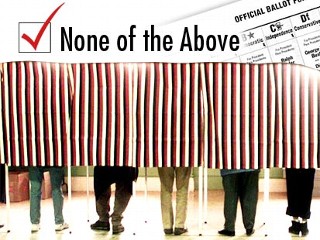
When I read this, I was surprised that Daggett had so little support, given that he has been in the news of late, and initially assumed that the 5% who "prefer some other candidate" represented the sum of those who voiced support for any of the other candidates in the race: Jason Cullen (I), Chris Daggett (I), Ken Kaplan (L), Greg Pason (S). However, it turns out that this was the literal wording used in the survey. Respondents were literally offered a choice between "Chris Christie (R)," "Jon Corzine (D)" and "Some Other Candidate"! Given that there are more unaffiliated voters in NJ than there are either registered Republicans or Democrats, and by significant margins, one has to wonder what effect the inclusion of a third candidate's name and affiliation, or lack thereof, would have on such a poll.

Third Party and Independent Candidates for Office, 2010

Frustrated by recent attempts to locate a single source listing declared or potential third party and independent candidates for office in 2010, I decided to compile one myself, focusing on candidates with active websites in races for governor, the US Senate and House. As with the Poli-Tea Guide to the Third Party and Independent Blogosphere, I will attempt to keep the list current, updating it as the opportunity arises. If there are any candidates I've missed, or just plain old mistakes, or you know some good sources compiling such information, please supply the info or correction in the comments, or send me an email. This list is not complete, but it is fairly comprehensive. To find out about all candidates for office in your state or district, consult your state's Board of Elections. In compiling this list, I have relied upon the Green Papers and Politics 1, which were indispensable resources. Updated: November 8, '09. Updated: January 10, '10. Updated: September 19, '10.


Alabama
• House: Rob John (I), Mark Layfield (I), David Marsh Walter (Constitution Party), Eddison T. Walters (I)

Alaska
• Governor: Don Wright (Alaskan Ind.), Tim Triumph (I), William S. "Billy" Toien (Libertarian)
• Senate: Fredrick D. "David" Haase (Libertarian), R. Timothy "Tim" Carter (I), Ted Gianoutsos (I)


Arizona
• Governor: John Paul Mitchell (I), Kent Couchee (I), Barry J. Hess (Libertarian), Harold F. Howard (I)
• Senate: Leonard Clark (I), Jerry Joslyn (Green), David F. "Dave" Nolan (Libertarian)
• House: Joe Cobb (L), Nick Coons (L), Richard Grayson (G), Brian Hill (I), Powell Gammill (L), William Stephen "Average Joe" Crum (G), Michael L. Shoen (L), Leonard A. Clark (G – Write-in), Rebecca DeWitt (G), George Keane (L), Harley Dean Meyer (I), Steven M. Stoltz (L)


Arkansas
• Governor: Jim Lendall (G), Tull Mayor Frank Gilbert (Constitution Party), Elvis D. "Joey Elvis" Presley (Write-in)
• Senate: Trevor Drown (I), John Laney Gray, III (G)
• House: Jerry Coon (I), Ken Adler (G), Lance Levi (I), Lewis Kennedy (G), Joshua Drake (G)

California
• Governor: Laura Wells (G), Chelene Nightengale (AIP), Dale Ogden (L), Carlos Alvarez (P&F), Derek Folley (I), Georges Marciano (I), Jacob Vangelisti (I), Rakesh Kumar Christian (American People's Party)
• Senate: Edward C. Noonan (AIP), Jerry Leon Carroll (I), Deacon Alexander (Green), Gail Lightfoot (L), Duane Roberts (G), Marsha Feinland (Peace and Freedom), Neil Brian Goldberg (I)
• House: Carol Stone Wolman (G), Mike Rodrigues (L), Jerry L. Leidecker (AIP), Michael "Mike" Roskey (P&F), Stephen Donald "Steve" Favis (I), Benjamin A. "Ben" Emery (G), Gerald Allen "Jerry" Frink (P&F), Joel R. Smolen (L), Eugene E. "Gene" Ruyle (P&F), Daniel W. "Dan" Roberts (AIP), Philip Zimt Berg(L), Gloria E. La Riva (I), Cindy Sheehan (I), Dave Heller (G), James M. "Jim" Eyer (L), Larry Allen (P&F), Jeremy Cloward (G), David Christensen (AIP), Mark Paul Williams(L), Christopher James "Chris" Pareja (TEA), Paul Lazaga (L), Eric Peterson (G), Mary Virginia Larkin (L), William Tharon Chandler (I), Darrell M. Stafford (L), John Victor Hager (I), Lance A. Aguiar (No Affiliation), Randall Weissbuch (L), David Lawrence Miller (AIP), Bruce Harry Darian (I), Carlos A. Rodriguez (L), William P. "Bill" Cushing (L), Erich D. Miller (L), Richard R. Castaldo (P&F), Herb Peters (L), Nicholas "Nick" Dibs (I), Tracy Lynn Turner (I), John Albert Smith (AIP), Mark Lambert (L), Bill Lussenheide (AIP), Cecilia Patricia "Ceci" Iglesias (I), Mike Binkley (L), Mike Paster (L), Dion Clark (AIP), Lars Grossmith (L), Miriam E. Clark (P&F), Michael Benoit (L), Paul-Michael Dekker (L),


Colorado
• Governor: Levi Hancock (Unity), Rich Hand (I), Jaimes Brown (L), Thomas G. "Tom" Tancredo (Constitution Party)
• Senate: Mac Stringer (L), Bob Kinsey (G), Jorge H. "J." Moromisato (I),
• House: Gary Swing (G), Clint Jones (L), Christopher Thomas "Chris" Styskal (American Constitution), Curtis Lee Harris (L), Jenna Goss (American Constitution), Gregory "Greg" Gilman (L), Jake Segrest (I), Doug Aden (American Constitution), Ken "Wasko" Waszkiewicz (I), Jerell B. Klaver (L), Brian "Constitution" Scott (American Constitution), Rob McNealy (L), Buckley W. "Buck" Bailey (L)

Connecticut
• Governor: Thomas E. "Tom" Marsh (Independent Party of CT)
• Senate: Vincent Forras (I), John Mertens (I)
• House: Kenneth James "Ken" Krayeske (G), Christopher "Chris" Hutchinson (I), John Pistone (I), Dan Reale (L), G. Scott Deshefy (G), Dan Reale (L), Matthew Jason Joseff (I), Rick Torres (L), Sam S.F. Caligiuri (Ind. CT)

Delaware
• Senate: James W. "Jim" Rash (L)
• Congress: Earl Lofland (Constitution), Brent A. Wangen (L)

Florida
• Governor: Farid A. Khavari (I), Peter Allen (Independence), John Wayne Smith (L)
• Senate: Bernard F. "Bernie" DeCastro (Constitution), Alexander Snitker (L), Charlie Crist (I)
• House: Paul McKain (Whig), Peg Dunmire (TEA), Randy Wilkinson (TEA), John Annarumma (Whig), Clayton Schock (Whig), Stephen Bacon (Whig), Craig Porter (Whig), Gary Koniz (I), Nicholas Ruiz (G), Thomas Snider (L), Ray Netherwood (Unaffiliated), Steve Wilkie (Green), Jim McCormick (Unaffiliated), Marc Luzietti (S)

Georgia
• Governor: John Monds (L), Neal Horsley (CRP)
• Senate: Chuck Donovan (L)
• House: Eugene Moon (C/I), Alan Weaver (I), Michael Frisbee (C)

Hawaii
• Governor: Daniel H. Cunningham (Free Energy), Paul A. Manner (Non-part), Thomas W. "Tom" Pollard (NP)
• Senate: James R. "Jim" Brewer, Jr. (G), Lloyd Jeffrey Mallan (L), Jeffrey Steven "Jeff" Jarrett (Non-partisan)

Idaho
• Governor: Jana Kemp (I), Marvin Richardson (I)
• Senate: Randy Lynn Bergquist (Constitution), Ted Dunlap (L), Marvin "Pro-Life" Richardson (I)
• House: Michael James "Mike" Washburn (L), David Edwin "Dave" Olson (I), Brian Schad (I)

Illinois
• Governor: Randy Stufflebeam (C), Rich Whitney (G), Michael White (I), Lex Green (L), Scott Lee Cohen (I)
• Senate: LeAlan Jones (G), John D. Blyth (I), Michael Labno (L), Will Boyd (I)
• House: Jeff Adams (G), Anthony W. Williams (G), Laurel Lambert Schmidt (G), Robert J. "Bob" Burns (G), Matthew "Matt" Reichel (G), William Curt "Bill" Scheurer (G), Simon Ribeiro (G), Rodger W. Jennings (G), Daniel J. "Dan" Kairis (G), Terry G. Campbell (G), Roger K. Davis (G), Sheldon Schafer (G),

Indiana
• Senate: Rebecca Sink-Burris (L), Donnie H. "Don" Harris (I)
• House: George Holland (L), Ron Kimsey (I), Jon Morris (L), Mark Vogel (L), Scott Wise (L), John Duncan (L), Michael C. "Mike" Hight (I, L), Richard Andrew "Chard" Reid (L), Jesse C. Trueblood (I), Talmage "T.J." Thompson, Jr. (L), John Wayne Cunningham (L), Greg "No Bull" Knott (L)

Iowa
• Governor: Eric Cooper (L), Rick Phillips (Constitution), Jonathan Narcisse (I), David Rosenfeld (Socialist Workers)
• Senate: John Heiderscheit (L), Maggie Trowe (Socialist Workers, write-in)
• House: Rob J. Petsche (L), Jonathan Jay "Jon" Tack (C), Gary Joseph Sicard (L), Rebecca Williamson (SWP), Dan Lensing (I), Martin James Monroe (I),

Kansas
• Governor: Andrew P. Gray (L), Kenneth W. "Ken" Cannon (Reform)
• Senate: Michael William Dann (L), Joseph K. "Joe" Bellis, III (Reform)
• House: Susan Ducey (Reform), Jack Warner (L), Robert Garrard (L), Jasmin Talbert (L), Wayne L. Briscoe (I),


Kentucky
• Governor (2011): Gatewood Galbraith (I)
• House: Edward A. "Ed" Martin (L), Michael D. Hansen (I, C)

Louisiana
• Senate: Randall Todd Hayes (L), William R. McShan (Reform), Bob Lang (I)
• House: Arden Wells (O), Anthony Kipp Marquize (No party), Artis Cash (O), Tom" Gibbs, Jr. (NP)

Maine
• Governor: Eliot Cutler (I), Sam Bailey (I), Shawn H. Moody (I), Kevin L. Scott (I)

Maryland
• Governor: Susan Gaztanaga (L), Maria Allwine (G), Eric Delano Knowles (C)
• Senate: Richard Shawver (C), Natasha Pettigrew (G), James Guy Adams (L)
• House: Richard Davis (L), Jack N. Wilson, Sr. (U, L), Lorenzo Gaztanaga (L), Alain Emile Lareau, Jr. (C), Jerry McKinley (L), H. Gavin Shickle (L), Dan Massey (L), Michael Reed (C), Scott James Spencer (L), Fred Nordhorn (C), Mark Andrew Grannis (L)

Massachusetts
• Governor: Timothy P. "Tim" Cahill (I), Jill Stein (Green-Rainbow)
• House: Michael Engel (I), Margaret M. Keegan (I), Patrick Barron (N/A), Dale Edward Brown (I), Robert Michael "Bob" Clark (I, L), Philip L. "Phil" Dunkelbarger (I), Thomas A. "Tom" Lawler (I), Maryanne Lewis (I), James Andrew "Jim" Sheets (I), Peter A. White (I)

Michigan
• Governor: Harley G. Mikkelson (G), Kenneth "Ken" Proctor (L), Stacey Mathia (US Taxpayers')
• House: Ellis Boal (G), Keith Shelton (L), Patrick "Pat" Lambert (US Taxpayers'), Glenn A. Wilson (I), Lloyd Clarke (G), Joseph "Jay" Gillotte (L), Ronald E. Graeser (US Taxpayers'), Charlie Shick (G), James Matthew Rogers (L), Theodore Brooks "Ted" Gerrard (US Taxpayers'), Clint Foster (L), John Emerick (US Taxpayers'), J. Matthew "Matt" de Heus (G), Michael J. Moon (L), Pat Foster (G), Frederick Carl "Fred" Strand (L), Melvin Dean "Mel" Vaulkner (US Taxpayers), Richard Wunsch (G), Gregory "Greg" Merle (L), Scott Aughney (I), Danny Edward "Dan" Davis (I, TEA), Bhagwan "Bob" Dashairya (L), Douglas Campbell (G), Adam Goodman (L), Robert "Bob" Gray (I), Candace Ruth Caveny (G), Claude Beavers (L), John J. Tatar (L), Julia Williams (G), Leonard Schwartz (L), Alan Jacquemotte (Natural Law), Lester "Les" Townsend (US Taxpayers), George Corsetti (G), Heidi Soosha Peterson (L), Richard J. "Rick" Secula (L), Marc Sosnowski (US Taxpayers), Aimee Smith (G), Kerry Lee Morgan (L)

Minnesota
• Governor: Farheen Hakeem (G), Tom Horner (Independence), Linda S. Eno (I), Ken Pentel (G, I), Thomas Christopher "Chris" Wright (I)
• House: Steven John Wilson (Independence), Lars Allen Johnson (I), Stephen W. Steve Carlson (Independence), Thomas "Tom" Schrunk (Independence), Michael James CavlaEugene "Gene" Waldorfn (Independent Progressive), Lynne Torgerson (I), Bob Anderson (Independence), Abraham P. "Aubrey" Immelman (I), Glen R. Menze (Independence), Eugene "Gene" Waldorf (I), Richard "George" Burton (C), Timothy L. "Tim" Olson (Independence)

Mississippi
• House: Gail Giaramita (C), Harold M. Taylor (L), Barbara Dale Washer (Reform), A. G. Baddley (I), Lester L. "Les" Green (I), Wally Pang (I), Kenneth "Tim" Hampton (L)

Missouri
• Senate: Midge Potts (Progressive), Jerry Garth Beck (C), Jonathan Dine (L)
• House: Julie Stone (L), Steve Mosbacher (L), Nicholas J. "Nick" Ivanovich (C), Steven R. Hedrick (L), Gregory Allen "Greg" Cowan (C), Jason Michael Braun (L), Dave Lay (C), Randall David "Randy" Langkraehr (L), Kyle A. Yarber (I), Kevin Craig (L), Nicholas Ivan "NIL" Ladendorf (Progressive, Green), Dean Richard Moore, Jr. (I), Rick Vandeven (L), Lawrence David "Larry" Bill (I), Christopher Willaim Dwyer (L)

Montana
• House: Mike Fellows (L)

Nebraska
•
House: Daniel Nathan "Dan" Hill (I)

Nevada
• Governor: David Scott Curtis (G), Arthur Forest "Art" Lampitt, Jr. (L), Floyd Fitzgibbons (IAP), Eugene "Gino" DiSimone (I), Aaron Yehuda Honig (I)
• Senate: Timothy "Tim" Fasano (IAP), Jon Scott "Scott" Ashjian (TEA), Michael L. Haines (I), Jesse Holland (I), Jeffrey C. Reeves (I)
• House: Edward George "Ed" Klapproth, Jr. (L), Jonathan J. Hansen (IAP), Russell Best (IAP), Joseph P. "Joe" Silvestri (L), Scott David Narter (IAP), Barry Michaels (I)

New Hampshire
• Governor: John J. Babiarz (L)
• Senate: Ken Blevins (L), Chris Booth (I), Brian Chabot (I), Tom Peters (I)
• House: Philip Hodson (L), John Taft (I), Timothy "Tim" vanBlommesteyn (I)

New Jersey
• Congress: Mark Heacock (G), Peter Frank Boyce (C), Mark Lovett (I), Vitov Valdes-Munoz (I), Russ Conger (L), Peter M. DeStefano (I), Lawrence J. "Larry" Donahue (I), Robert Edward "Ed" Forchion, Jr. (I), Steven "Steve" Welzer (G), Joseph A. "Joe" Siano (L), David R. Meiswinkle (I), Ed Fanning (G), Mark D. Quick (I), Raymond Giangrasso (I),
Robert Louis Toussaint (I), James "Jim" Gawron (L), Kenneth J. Cody (I), Anthony Zanowic (I)

New Mexico
• House: Jerry Scott (C),

New York
• Governor:Howie Hawkins (G), Warren Redlich (L), Kristin Davis (Anti-Prohibition), Jimmy McMillan (Rent is too High)
• Senate: Cecile Ann Lawrence (G), John Clifton (L), Vivia Morgan (Anti-Prohibition), Lumies Joseph Huff, II (Rent is too High), David Robert Malpass (Taxpayers), Bruce A. Blakeman (I), Colia L. LaFayette Clark (G)
• House: Christopher N. "Chris" Cox (Taxpayers), Anthony E. Tolda (C), Elizabeth "Liz" Berney (L), Anthony "Tony" Gronowicz (G), Craig Schley (I), Douglas L. "Doug" Hoffman (Conservative), Marc Alan Romain (L), Dean J. Sandstrom (L)

North Carolina
• Senate: Mike Beitler (L)
• House: Tom Rose (L), Darryl Alan Holloman (L), Bradley "Brad" Smith (I), Thomas B. Hill (L), Lon Vernon Cecil (L), James Anthony Hardesty (I)

North Dakota
• Senate: Keith J. Hanson (L)

Ohio
• Governor: Dennis Spisak (G), Ken Matesz (L)
• Senate: Daniel H. "Dan" La Botz (Socialist Party), Eric LaMont Gregory (I), Eric Deaton (I), Steven Lahanas (I), Adam Schaffer (I), Warren P. Brown (I),
• House: Richard L. "Rich" Stevenson (G), Jim Berns (L), Marcus "Marc" Johnston (L), Donald Charles "Don" Kissick (L), Brian L. Smith (L), Richard E. Cadle (C), Martin J. "Buck" Elsass (L), Cory McCusker (I), David W. Easton (C), John David Anderson (L), Chad A. Kreemer (I), James J. "Jim" Condit, Jr. (C), David A. Harlow (L), Jason David Werner (I), Travis M. Irvine (L), Robert M. Suwinski (I), John M. Jelenic (L), Jeffrey J. "Jeff" Blevins (L), Stan J. Henry (I)

Oklahoma
• Senate: Stephen Paul "Steve" Wallace (I), Ronald F. Dwyer (I)
• House: Clark Duffe (I, L), Angelia O'Dell (I, L), Dave John White (I)

Oregon
• Governor: Gregory E. "Greg" Kord (C), Wes W. Wagner (L)
• Senate: Marc Delphine (L), Richard K. "Rick" Staggenborg (Progressive), Bruce Cronk (WFP)
• House: Donald H. LaMunyon (C), Harry Joe Tabor (L), Christopher Kenneth "Chris" Henry (Pacific Green, Progressive), Daniel Karl Seigler (N/A), Jeffrey T. "Jeff" Lawrence (L), Michael Meo (Pacific Green, Pirate), Michael Allan "Mike" Beilstein (Pacific Green), Christopher J. "Chris" Lugo (Pacific Green), Paul Aranas (N/A)

Pennsylvania
• Governor: Richard Gordon (I), Robert Allen Mansfield (I)
• Senate: Michael Yilit (IA)
• House: Jake Towne (L), Bruce Teich (I), Terry Ronzio (Unity), Jim Schneller (I), Vernon L. Etzel (L), Chad Clopper (I), Terry Ronzio (C), Demo Agoris (L), Ed Bortz (G), Dan Frank (C), Joshua A. "Josh" Monighan (I)

Rhode Island
• Governor: Lincoln Chafee (I), Todd Giroux (I), Kenneth J. "Ken" Block (Moderate Party RI),
• House: Kenneth A. "Ken" Capalbo (I), John Olaf Matson, Sr. (I)

South Carolina
• Governor: Morgan Bruce Reeves (I)
• Senate: Tom Clements (G)
• House: Robert Dobbs (G), Keith Blandford (L), Jimmy Wood (Ind.), Milton Elmer "Mac" McCullough, Jr. (Citizens United), Rob Groce (WFP), Marc Alan Beaman (C), Eddie McCain (L), John Dalen (C), David Michael "Dave" Edwards (C), C. Faye Walters (G), Richard "Rick" Mahler (L), Nammu Y. Muhammad (G)

South Dakota
• House: B. Thomas Marking (I)

Tennessee
• Governor: Bayron E. Binkley, Jr. (I), Brandon Dodds (I), Samuel David Duck (I), David Gatchell (I), Toni K. Hall (I), Boyce T. McCall, Sr. (I), James Reesor (I), Carl "Two Feathers" Whitaker (I)
• House: Stephen Collings (I, Pirate), Kermit E. Steck (I, C), H. James "Jim" Headings (I, C), Joseph R. "Joe" Leinweber, Jr. (I), William Gregory "Greg" Samples (I, L), Donald "Don" Barkman (I), Morris F. "Mo" Kiah (I,L), Savas T. Kyriakidis (I), James Anthony Gray (I), Gerald York, John P. Miglietta (G, I), William "Bill" Crook (I), Jacqueline Marie "Jackie" Miller (I), John W. "Big John" Smith (I),Thomas "Clark" Taylor (I), James Gregory Whitfield, II (I), Jim Boyd (I), Brandon Eric Gore (I), Tommy N. Hay (I), J. William "Bill" Stone (I), Perry Steele (I), Sandra Sullivan (I)

Texas
• Governor: Deb Shafto (G), Katherine Youngblood "Kathie" Glass (L),
• Senate: Jack Oslin (C), Jon Roland (L),
• House: Michael Hope (I, L), Robert Hostetler (I) Michael Barrett (Constitution), Tracy Hall (I), David McCurrach (I), Nicholas Nix (I) Don Tracey (I), David Smith (L), James Strohm (L), Mike Taylor (L), Jim Prindle (L), Drew Parks (L), Jim Stutsman (L), Ed Mishou (L), Bruce West (L), David LeBlanc (L), Mike Idrogo (L), Chip Peterson (L), John Jay Myers (L), Chris Claytor (L), Jim Howe (G), James Keith "Keith" Dyer (I)

[Note: due to the large number of Libertarian candidates running for various offices in Texas (almost 200!), it has become unwieldy to include all of them here, but the LP of Texas has already compiled a comprehensive list of their own. Be sure to check it out.]

Utah
• Governor: W. Andrew McCullough (L), Farley M. Anderson (I)
• Senate: Scott N. Bradley (C),
• House: Kirk D. Pearson (C), Jared Paul Stratton (L), Randall Hinton (C), George David "Dave" Glissmeyer (I), Douglas Sligting (C), Jake Shannon (L), Joseph L. "Joe" Puente (I)

Vermont
• Governor: Ben Mitchell (Liberty Union), Cris Ericson (Marijuana Party), Daniel "Dan" Feliciano (I), Em Peyton (I), Dennis P. Steele (I)
• Senate: Peter "Pete" Diamondstone (Liberty Union), Cris Ericson (US Marijuana Party), Daniel Freilich (I), Johenry Nunes (I)
• House: Jane Newton (Liberty Union), Sheila M. Coniff (WFP)

Virginia
• House: Glenda Gail "Gail for Rail" Parker (Independent Greens), Kenneth Eugene "Kenny" Golden (Independent Greens), Douglas Alexander "Doug" "Hutch" Hutchison (N/A), James Joseph Quigley (L), John D. Kelly (I, G), Janet Murphy (Independent Greens), Jeffrey Aaron "Jeff" Clark (I, Independent Greens), Bradley S. "Brad" Rees (I), Stuart Matthew Bain (L),
Jeffrey W. "Jeff" Vanke (I, Whig), Floyd C. Bayne (Independent Greens), Matthew "Matt" Mosley (L), J. Ron Fisher (Independent Greens), Jeremiah David Heaton (Independent Greens), William B. "Bill" Redpath (L, Independent Greens), David L. Dotson (L), David William Gillis, Jr. (Independent Greens), Christopher F. DeCarlo (I), James H. "Jim" Lemon (I)

Washington
• House: Bob Jeffers-Schroder (I)

West Virginia
• Senate: Jeff Becker (C), Jesse Johnson (Mountain)
• House: Phillip "Phil" Hudok (C)

Wisconsin
• Governor: James James (I), James Dean "Jim" Langer (I)
• Senate: Rob Taylor (Constitution)
• House: Joseph Kexel (L), Michael "Mike" Krsiean (I), Gary Kauther (I),

Wyoming
• Governor: Mike Wheeler (L)
• House: John Love (L)

On the Temptations of Pragmatic Opportunism

For third party and independent activists there is always the temptation to slide back into the duopoly frame. Confronted with the difficulty of challenging Republican and Democratic political hegemony from the outside, they are often asked: why not work within the system by mounting a primary challenge, for instance, and seek to change the parties from the inside? This has been the strategy of innumerable progressives and libertarians, who have sought, in the name of pragmatism, to gain influence within the Democratic and Republican Parties. To paraphrase the old saying, pragmatism sounds good in theory, but it doesn't work in practice. As I have argued before, opportunism of this sort, the infiltration strategy, shares many of the drawbacks of a third party or independent run and has none of the advantages. Consider the following response to Rand Paul's announcement that he will seek the Republican nomination for Senate in Kentucky. Jonathan Gaby's Capital Conservative, a Kentucky-based news blog, writes:
With Senator Jim Bunning’s announcement that he will not seek re-election to the United States Senate, many promising candidates have announced their intentions of running for office. Rand Paul, a Bowling Green Opthamologist and son of Congressman Ron Paul (R-TX), has formally announced that he will seek the Republican nomination for candidate for the US Senate . . . Paul’s nomination effectively represents a different faction within the Republican Party, that of the anti-establishment. Paul’s campaign, in essence, has taken on a more “libertarian” feel . . .

He seems at least cold to especially the democrat party but also to the Republican party. A newcomer in politics and campaigns should know to win Republicans to his cause is critical.
As a registered Republican and party official I think he complains more about what’s wrong with our party than inspiring me toward becoming a better GOP . . .

A self-professed “independent Republican,” Paul continues his theme of independence, almost to the extent of a flavor of a third party run.
If he continues with that approach towards the GOP he stands at losing voters in the primary. If he is serious about securing the GOP nomination he needs to dial back the rhetoric and flavor of a third party candidate and get with the GOP to organize all counties for effective “get-out-the-vote” strategy. Instead, I predict that his cavalier attitude will trickle down to his supporters who will only help Rand Paul, not other down ticket candidates. Politically he would be more effective if cooperating with the overall GOP towards a more effective campaign apparatus. [Emphasis added.]
Ron Paul Republicans and Campaign for Liberty activists have been among the most vocal supporters of infiltration. In June, in a post on 'Infiltration or Independence,' I questioned one libertarian hopeful's strategy for "changing the face of the Republican Party in Massachusetts." Peter Schiff, economics adviser to Ron Paul's 2008 presidential campaign, has been controversially urging "Libertarian Party members work within the Republican Party," and is considering a challenge to Senator Chris Dodd in Connecticut as a Republican. Over the course of the next election cycle, we may well find out how well pragmatic opportunism works in practice.

Independent Connecticut (Update)

Last week in 'Independent Connecticut,' I noted that the majority of voters in the state are registered as independents, and drew attention to the high number of local, independent third parties being formed to challenge the hegemony of the Republican-Democratic duopoly. In the comments, Sam Wilson wondered "whether there are particular election laws that encourage independent campaigns and voting, or whether some mix of voter sophistication and personality politics accounts for it." Uncertain where to look to find an answer to the question, I contacted Richard Winger of Ballot Access News. Mr. Winger provided two reasons in explanation of the phenomenon: 1) virtually every election in Connecticut is a partisan election, while in much of the country the majority of cities and towns use non-partisan elections; and 2) unlike most other states, in Connecticut a party can be ballot-qualified in just part of the state. Thanks to Sam for the question and Richard Winger for his speedy response.

On the Independence of Independents

What does it mean to be an independent in the context of the reigning two-party state? Who are political independents? Are they people who describe themselves as independent? Or people who vote for independents? Or people who are registered as independents? Are they a-political or anti-political non-voters, disengaged from the political process? Or are they swing voters, whose voting habits cannot be predicted, that is, who may vote Republican one election and Democratic the next? Or are they split-ticket voters? Are they non-partisan or anti-partisan, and concentrate on a given candidate's character and stance on issues without consideration of party affiliation? Or are they hyper-partisans, fed up with both major parties and the political charades characteristic of the duopoly system?

Independents span the political spectrum. They can be found among conservatives, moderates and progressives. What they all share in common, however, is an unwillingness to identify themselves with either of the major parties, and, indeed, with any political party whatsoever. This fact, of itself, reveals a number of paradoxes inherent in the duopoly system of political representation. The conservative independent might argue that the major parties offer a choice between a liberal party and a not-as-liberal party; the independent progressive may very well assert that the major parties represent a choice between a conservative and a not-as-conservative party; and the moderate independent might decry ideological extremism on both sides of the duopoly divide.

The Hankster links to a reminder that "most 'independent' voters aren't," from Mark Millan at the LA Times Top of the Ticket blog, whose post was occasioned by a piece at Miller-McCune aimed at debunking media myths surrounding the independent voter on the basis of a recent study by John Petrocik in the journal Electoral Studies entitled: "Measuring Party Support: Leaners are not Independents."

'Leaners' are, of course, people who describe themselves as independents to pollsters, but when asked whether they lean toward either of the duopoly parties over the other, they choose one over the other. (I have discussed the phenomenon of leaners before, see Independent Independents and the Duopoly Prod.) Needless to say, when respondents to polls state that they affiliate with either of the duopoly parties, they are not then asked whether they lean independent or toward a third party. In his article, Petrocik argues that leaners:
are virtually identical to those who are classified as “weak” partisans (who are almost universally viewed as party identifiers) across a wide variety of perceptions, preferences, and behaviors.
Such findings justify the inclusion of independent leaners in measurements of support for the major parties. As the Miller-McClune article puts it:
In the public imagination, independents are a relatively stable demographic made up of engaged but unaffiliated people who can be persuaded one way or another. They are thought of, essentially, as swing voters. No doubt much of the fascination with how independents are thinking is based on that premise. Which, it turns out, is false.
Gallup undoubtedly agrees with this line of reasoning. In their State of the States report on political party affiliation, the polling organization notes:
Because the proportion of independents in each state varies considerably (from a low of 25% in Pennsylvania to a high of 50% in Rhode Island and New Hampshire), it is easiest to compare relative party strength using "leaned" party identification. Thus, the Democratic total represents the percentage of state residents who identify as Democratic, or who identify as independent but when asked a follow-up question say they lean to the Democratic Party. Likewise, the Republican total is the percentage of Republican identifiers and Republican-leaning independents in a state.
However, while Petrocik argues that the number of independents appears inflated because "of the inclination of Americans to prefer to think of themselves as independent-minded and inclined to judge candidates on their individual merit," the identification of leaners as weak partisans equally inflates the level of support for the duopoly parties. Petrocik's own data show that overall:
Only 38% express a preference for continuing the current Democratic and Republican party domination; almost as many (34%) prefer to see new parties challenge the Democrats and Republicans.
It is indeed highly unlikely that very many independently minded voters conform to the mass media's preconceived notions of the independent voter as swing voter. But does this mean that they are not 'really' independent? If an independently-minded voter is confronted with a choice between a Republican and a Democrat, and they consistently vote for one side over the other, this does not imply that they are not independent, but it would seem to imply that they lean conservative or liberal, and points toward the pernicious prevalence of lesser-evilism. They could be voting for what they see as the lesser of two evils, or against the greater of two evils, and they may well do so against their inclination or their better judgment, simply because they would rather vote Republican or Democrat than not vote.

Insanity and Party Loyalty

The Truth in Black and Right argues that the two-party system is corrosive of the republic's very foundations. The post is well worth quoting at length:
Political parties serve a purpose, an important purpose of providing organizational strength and “strength in numbers” for ideological commitments. At least that’s what they should do. And none of this is supposed to interfere with the primary responsibility of Congress to represent their constituents . . . It is because of this fealty [to the Republican and Democratic Parties] that Congress has such low approval ratings and why Congressmen are increasingly avoiding meeting with their actual constituents. It is a sad and scary thing when representatives are afraid to represent. More importantly, it is a danger to the republic and an indication that what was the most glorious experiment in large scale representative democratic and republican government is rapidly on the decline . . . They do not respect and they do not fear the people they are meant to represent; rather they despise them. They pass legislation they have not read, vote for health care plans to which they themselves are not subject, vote pay raises for themselves, gerrymander legislative districts to ensure their continued dominance and write legislation effectively restricting the competition to which they are subject.
The piece goes on to argue that many aspects government in the United States resemble more an aristocracy than a democratic republic. However, responsibility for the installation of a virtually hereditary ruling class ultimately lies with the people who, like loyal peasants and despite their discontent, continue to (re)elect these politicians, their relatives and their co-conspirators to positions of power. As the old saying goes, the definition of insanity is doing the same thing over and over again and expecting different results.

The Signature Hurdle

At the Phoenix New Times, James King asks Arizonans if they are "sick and tired of Republicans and Democrats." Though clearly skeptical of third party activism, King writes:
As both Republicans and Democrats in the Arizona Legislature are failing miserably at agreeing on a state budget, three new political parties are emerging on our state's political landscape.

The American Independent Party, the Constitution Party, and the Modern Whig Party are fighting to get on the Arizona ballot in time to have candidates run in the 2010 election cycle. They each need 20,449 validated signatures from registered Arizona voters.

Like always with new parties, officials say they aim to offer a buffet-style ballot box for voters frustrated with the two-party system.

In other petitioning news, the Moderate Party of Rhode Island may become the first group to qualify as a political party via the petition method. And, unfortunately, the California Moderate Party will not seek to qualify for the 2010 ballot.

Tales of Two Protests

Memeorandum, October 5, 2005:


Memeorandum, August 3, 2009:

One Dimensional Man: Breeding the American Political Animal

If man is by nature a political animal, as Aristotle maintained, the American breed of the beast is distinctly one-dimensional, but not exactly in the way postulated by Herbert Marcuse in 1964. Because the reigning duopoly system of government has today come to be accepted as axiomatic within the political straitjacket of the two-party state, its effects on social and political phenomena are often either overlooked or considered trivial at best. At Think Progress, Matthew Yglesias asks: "Why is American politics uni-dimensional?" He writes:
Paul Krugman briefly mentions a somewhat intriguing puzzle. Most people, if you ask them about it, would say that political beliefs are “multidimensional.” We often think of a simple 2-dimensional models like the Nolan Chart in which people should be sorted along both a left-right axis about economics, and then along a second axis about social/cultural issues like gay rights. But as Krugman observes, Congress doesn’t work this way.
Yglesias quotes Krugman: "Congressional politics is left versus right — end of story. Oh, and polarization along that dimension has increased hugely: the center did not hold." Krugman bases his observations on the work of McCarty, Poole and Rosenthal, who have analyzed political polarization in relation to income inequality and immigration. They write:
We find that the average positions of Democratic and Republican legislators have diverged markedly since the mid-1970s. This increased polarization took place following a fifty-year blurring of partisan divisions. This turning point occurs almost exactly the same time that income inequality begins to grow after a long decline and the full effects of immigration policy liberalization are beginning to be felt.
On the basis of Occam's razor, however, one might propose a simple solution to Yglesias's question. American politics is uni-dimensional because, in conformity with the dictates of duopoly ideology, it only allows for the plotting of two points, represented by the positions of Republicans on the one hand and Democrats on the other. To paraphrase Dorothy Parker, American politics runs the gamut from A to B. In politics as in geometry, a second dimension would require a third point of view.

Furthermore, changes in the theory of the form and function of the major parties under the conditions of duopoly following World War II must also figure in any account of the increased polarization observed by McCarty, Poole and Rosenthal. As I have remarked before, the so-called responsible party model of government developed by the American Political Science Association in 1950 explicitly called for the creation of sharply demarcated and oppositional platforms by the ruling parties. In a detailed article from 2007 on "The Rise of Responsible Parties in American National Politics," Nicol Rae concludes:
The irony may be that having finally witnessed the development of ideologically coherent parties that make sense to external observers, political scientists have also become more aware of the potentially unhealthy side effects—partisan rancor, political polarization, policy stasis in a separated national governing system—that may attend such a development. (Rae, p. 188.)

Guest Post: The Way of the Whigs

by Septimus of The Whig


Much information about the Modern Whigs can already be found online. The Modern Whigs developed out of discussions and email chain letters among soldiers in Iraq and Afghanistan. These veterans, upon returning to the States, decided to form on organization to address some of their concerns and the issues that developed out of their discussions. This eventually evolved into the Modern Whig Party in 2007. I would like to share why I am participating in the Modern Whig Party.


I did not consider my self a third-party type. After a friend and I started our blog, we discovered the Modern Whigs. At the time, they had only three states signed up, 3,000 members, and a very crude website. But we volunteered. So why the Whigs? I was, and remain, acutely aware of the issues, disadvantages, and problems in trying to get a new political party off of the ground. But the Modern Whig party addressed these concerns, and in doing so, changed my attitude about participating in an effort to start a new political party. First, the Modern Whigs did not seem to be a typical third party. Typically, a new party is started on the ideological fringe, and not only has to overcome organizational, financial, and legal obstacles, but also struggles to answer an important question. The question: If you and I find that we are unable to win over our local county major party committees, committees which after all are the basic units from which the major party is built, then on what basis do we hope to win over an entire nation? If we are serious, then do we not feel that it would be rather easier to win over the local committees first? If not, why not?


This time, I found an answer. With Republican party activists veering right, and the Democratic party activists veering left, and the number of independents increasing, there developed a need for a political grouping in the center. Every other effort to start a new political party was on the ideological fringes. But if the two major parties mover farther out to the edges, an opportunity presents itself. The Modern Whigs are in the political center, and are moderates. How many viable attempts are there to start a new party in the ideological middle? The rest are outside of the mainstream, and have failed to convince the general electorate to follow them. The Modern Whigs started where most Americans already are. Contributing to the situation is that both major parties have entrenched and unresponsive leadership, and are compromised by corruption.


Next, the Modern Whigs are marked by a realistic approach. Exclusion from power begins to sap the motivation of even the most ardent of parties. How to avoid this problem and stay motivated? Typically, third parties make a run for President, in an effort to gain publicity. The Modern Whigs, however, planned to run for Congress and state legislatures first. This approach makes more sense. For example, the Libertarians could have taken the money they raised in 2008 and instead of spending it on their presidential run, could have launched a well financed run for Congress. In the right district, they may have had a chance. Finding a sound candidate an running for Congress or the Legislature is difficult enough, but without a real base, higher level office is not realistic.


Finally, the Modern Whigs had no central, controlling figure. I found this reassuring, as I distrust personality-based politics. Often, third parties are based on, and are dependent on, a single individual. The rise and fall of the party is therefore based on the success and failure of one individual. Instead of waiting to hear what one person thinks about an issue, I will be looking forward to internal debates over the direction and platform of the party. The party can grow organically, and develop according to the interests of its membership. I have to admit, the prospect of being able to make a real contribution to a growing organization is attractive.


Only time will tell if the Modern Whigs will continue to grow and develop. But I have hope. Through the Modern Whigs, I have met many decent, concerned, patriotic Americans. So while I may despair about our politics, I am newly reminded that the real strength of our nation is in its people, and not in our feckless major parties.


If you would like to learn more about the Modern Whig Party, go to ModernWhig.org. We are still a young party, so not every organized state has a site up yet. A full list can be found on the main site, buthere are the more developed state sites: Florida, New York, Texas, Missouri, California, and Delaware. We are still organizing states, and the states are organizing locally, so there are plenty of opportunities for those interested in taking part, so contact us. Not content to just debate issues on the internet, we are already taking action, and currently have two viable candidates running as Modern Whigs:

Gene Baldassari – New Jersey 14th District Assembly (Nov 2009)

Paul C. McKain – Florida 2nd Congressional District (Nov 2010)


Your support of our candidates would be greatly appreciated.

I’d like to thank d.eris for inviting me to guest post at Poli-Tea.

 
http://www.wikio.com