 Via RSS
 Via Twitter

When a candidate files for office as a candidate representing a recognized political party, they just submit a form and financial disclosure and they are on the primary ballot. A recognized political party is based on the percentage of votes that they received in the previous election. A candidate of a non-recognized party or NO PARTY affiliation must collect a number of signatures of registered voters in their election district. That will get them on the general election ballot but not the primary ballot. This gives candidates of recognized political parties a clear and unfair advantage over those candidates not allowed on the primary ballot. During the primary campaigns candidates are able to raise campaign contributions, gather supporters, appear in forums, participate in debates, and generally raise awareness of their candidacy. Party affiliation should have no bearing on ballot access. Neither the US Constitution nor the Alaska Constitution (haven’t researched other states) mention political parties, or primary elections for that matter. The “two party system” is only perpetuated by excluding others as much as possible from gaining equal access to ballot.
The Case for Ballot Access Reform
The Emperor's Rants and Observations makes the case for ballot access reform:

Illinios Green for Governor, 2010
To the list of states with promising third party or independent candidates running for governor, we may add Illinois, where Rich Whitney has announced that he will seek the office on the Green Party Ticket. Though Whitney is considered a long shot, if he garners more than five percent of the vote, as the state's mandatory minimum ballot access laws dictate, the Greens will remain an "established" party and have one fewer hoop to jump through in the next election cycle. Whitney ran for governor in 2006, and received more than ten percent of the vote, but was soundly defeated by the now disgraced Democrat Rod Blagojevich. Mike Riopell has some more details and context on Whitney's bid for governor:
Rich Whitney announced Wednesday he is making another bid to be Illinois governor in 2010 as a member of the Green Party. It's the Carbondale attorney's second attempt at the office. In 2006, he surprised many observers and captured more than 10 percent of the state vote, falling behind Democrat Rod Blagojevich, who won re-election, and the Republican challenger, then-state Treasurer Judy Baar Topinka. Whitney rode what was considered to be a wave a general dissatisfaction with the two candidates and state government in general. Now, with controversy swirling around the state budget and former Gov. Rod Blagojevich's arrest and removal from office, Whitney told reporters 2010 could be similar, if not better, for the Greens. "I have to think people are going to be ready for a substantial change in 2010," Whitney said. The 2010 election will be an important one for Whitney and the Illinois Greens. Whitney needs to get 5 percent of the vote for the party to remain an "established" one in Illinois, meaning Greens can get their names on ballots for other state offices more easily. His 10 percent tally in 2006 meant the Green Party was able to easily put up candidates for Congress and the Illinois General Assembly in the 2008 election. None won, but the party will work this weekend on a slate of candidates for the state's top jobs and U.S. Senate.
Declare Your Independence: Pass It On
The demoralization of the American voter is one of the most insidious effects of the reigning two-party system and the ideology which sustains and reproduces the political status quo. Given the fact that most voters are forced to choose between a candidate they dislike and a candidate they dislike more, when they a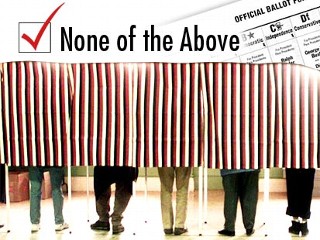 re even offered a choice at all, it is no small wonder that voter turnout is not any lower than it already is. There are, however, many ways for folks to demonstrate their discontent with the duopoly system. The simplest is to change one's party affiliation. The rise in the number of registered and self-described independents across the country is undoubtedly a cause of great concern for partisans on both sides of the duopoly divide. Perhaps the most striking aspect of this trend is that it is not the product of an organized nationwide campaign, but rather the result of autonomous action on the part of millions of individuals. There are likely ongoing efforts afoot across the country to formalize this movement. A group in New Jersey provides us with an example: MOVE Now.
re even offered a choice at all, it is no small wonder that voter turnout is not any lower than it already is. There are, however, many ways for folks to demonstrate their discontent with the duopoly system. The simplest is to change one's party affiliation. The rise in the number of registered and self-described independents across the country is undoubtedly a cause of great concern for partisans on both sides of the duopoly divide. Perhaps the most striking aspect of this trend is that it is not the product of an organized nationwide campaign, but rather the result of autonomous action on the part of millions of individuals. There are likely ongoing efforts afoot across the country to formalize this movement. A group in New Jersey provides us with an example: MOVE Now.Our silent objections have become permission slips for the candidates use in passing legislations at neck breaking speed, of which the consequences have yet to be felt. The political system no longer can operate as a two-party system. Only the people allow it to exist this way, and it is no longer useful to the people in this country. We need a political system that is just as diverse as our population, but at the same time honors the Founding Fathers Principles that made this the greatest country in the world . . . There is one thing that we can all do right now to make our voices heard in Washington. Participate in the MOVE Now Movement.(Make Your Voices Heard Now.)
It requires you to do only one thing:
Change your party affiliation to anything other than Democrat or Republican.A simple web search using "change party affiliation" and including your home state will bring up information that will help you. You can also call your County Clerk and ask. Every State may very well have a different process or application form. Some States allow you to use the Voter Registration Form. If there are no specific parties on your form other than Democratic or Republican, then just select Independent or Unaffiliated. You can send in your completed form to your local County Clerk or Board of Elections Office.
Party affiliation doesn't mean that you have to vote for that party in the election. I've been an Independent all my life and I've voted Democrat, Republican, Green Party, etc.
Want to make more of an impact? Select a party that your State recognizes, and become a paying member. Start steering the political money away from those in power in Washington, and they will have no choice but to start taking notice, and listen to the pulse of the country.
This country cannot continue to be divided by an imaginary line in the sand, asking ourselves "Which side are you on?" Behind the curtain, the vast majority of Democrat and Republican politicians conduct business with the same agenda, there is very little difference between them. They have to accept that our political views, our values and principles are more diverse than the so called two-party system that is supposed to represent us. We can make it happen together. We can find a way through peaceful resolve through demonstrations and debate.
If you feel helpless and don't know what to do, then get Involved and M.O.V.E. Now.
1. Change your Party Affiliation
2. Become a known member and donate to your new party.
3. Tell everyone you know and encourage them to make the M.O.V.E
4. Pass this message along and spread the word
The Conservative Two-Party Strategy and the Third Party Option
Sarah Palin continues to make headlines following her July 3rd announcement that she will be resigning as governor of Alaska. Needless to say, most mainstream Democratic and Republican commentators were glad to see her go, but struggled to find sense in the move, which resulted in the proliferation of speculation and prediction as to her motives and future political ambitions. Over the weekend, an "exclusive" interview with Palin in The Washington Times emphasized her intention to "stump for conservative Democrats": "I will go around the country on behalf of candidates who believe in the right things, regardless of their party label or affiliation." The news was received with glee in both conservative and liberal circles. Right wing radio talk show host Tammy Bruce called the comments "very encouraging," writing that they:
lead one to believe that she is indeed planning to do what she must: build an independent conservative movement and take this nation back from the liberals which now control both parties.Some liberal bloggers responded strategically: "Ohpleaseohpleaseohpleaseohplease...." Ironically, however, none of this is actually "news," as Palin's comments to The Washington Times do not go beyond what she explicitly stated in her resignation accouncement. As I noted in 'politics abhors a vacuum,' Palin then declared: "I will support others who seek to serve, in or out of office, for the right reasons, and I don’t care what party they’re in or no party at all." However, the reiteration of this statement has some Republicans very worried that Palin may engage in serious third party and independent activism. None other than Rush Limbaugh:
The one thing that does slightly worry me about this is this whole third party business. Yeah, it's remote but it's still a possibility out there and there are a lot of people pushing a third party and that's -- Third parties, they lose, they just lose. Third parties never end up with a congressional or Senate candidates. It's just not the way to go.Though many conservatives are clearly excited by the possibility - thus revealing the extent and depth of their frustration with the GOP -, as Limbaugh states, a serious third party or independent campaign by Palin is still unlikely. In conformity with their (un)official electoral strategy, liberal Democrats have their fingers crossed hoping that this possibility comes to fruition. Meanwhile, something entirely different may well be afoot, namely, the execution of a conservative two-party strategy. Consider the following timeline:
July 3rd: Palin announces her resignation and intention to support conservatives whatever their party affiliation may be.The Washington Times is clearly pushing the two-party strategy, perhaps in order to marginalize the voices on the right calling for third party activism. Would liberals allow conservatives to infiltrate the Democratic Party before they would support third party candidates likely to attract voters away from the GOP? Some are already behind the idea of spoiling for a fight. Reflecting on Frank Rich's column arguing that Palin "broke the GOP, now she owns it," Delaware Liberal focused on "the dangers of a two-party system":
July 5th: The Washington Times publishes a story on Newt Gingrich in which the former House Speaker suggests that conservatives build, "a center-right majority in Congress and the state legislatures — regardless of party identification — even if that means the heretical idea of Republicans actively promoting and backing conservative Democratic candidates."
July 12th: The Washington Times publishes their story on Palin, emphsizing that she may "stump for conservative Democrats."
Time for a viable third party, because this much power in the hands of a small minority is dangerous. Just by running as a Republican, Palin is launched into the political arena denied to third party candidates . . . She’ll ride the “R” brand for her own ends – reaping the benefits of “balanced reporting” from the MSM and automatically being included in every debate. Yet again, Palin will receive something she didn’t earn. And that instant elevation into the major leagues is nothing to laugh at. Palin (R) will start on an equal footing granted to a two party system.
Intellectual Honesty and the Duopoly Dialogue
It is a conceit of duopoly ideology that the adversarial nature of the two-party system functions as a check on both parties, preventing excess and overreach by necessitating compromise, thus 'keeping them honest.' This remarkable turn of phrase found its way into commentaries at both The New Clarion and CNN. In an opinion piece arguing that it is 'time to move past the Palin distraction,' John Feehery writes at CNN that: "America has done as well as it has over the last couple hundred years because it has a vibrant two-party system that keeps the party in power honest." Similarly, in a post on 'Obama's conservative critics' at The New Clarion, Myrhaf writes: "In our two-party system, when one party is in power, the other party’s job is to keep the party in power honest." It is sometimes difficult to determine whether statements such as these are meant ironically or in earnest. But whatever the case may be in this regard, saying that the two-party system keeps Republicans and Democrats honest is like saying the war on drugs keeps violent gangs and their international cartels on the right side of the law.
In a post on 'political debate and the duopoly dialogue,' I noted that one of the primary presuppositions of our anemic political discourse is that the Republican and Democratic takes on a given issue exhaust that that issue. At Bonzai, Mike Farmer bemoans the predictability of this duopolized discussion and argues for "an objective approach" to the problems facing the country. He writes:
In a post on 'political debate and the duopoly dialogue,' I noted that one of the primary presuppositions of our anemic political discourse is that the Republican and Democratic takes on a given issue exhaust that that issue. At Bonzai, Mike Farmer bemoans the predictability of this duopolized discussion and argues for "an objective approach" to the problems facing the country. He writes:
The only way people can get to political solutions is to call things as we see them after careful, objective consideration, not be defenders of a political party as if it's a game to see who wins at election time, just for the sake of winning and being part of the power prize. The country has been divided into two parties and in the meanwhile the government has grown more powerful and intrusive. An objective approach will end the game and allow grown-ups to seriously look for innovative ways to deal with the future. I'm hoping that the recent reports of independents growing in numbers means that objectivity is becoming a reality among those who care about our future. To my way of thinking, objectivity is the only means to assure intellectual honesty. [Emphasis added.]The first task of such an approach would be overcoming the pre-existing notion of objectivity embedded in duopoly ideology. Perhaps the most glaring example of the latter is so-called 'balanced' journalism, according to which objectivity consists in nothing more than taking into account both the Democratic and Republican stances on the matter at hand. What results from the latter, as I noted in Abracadabra, is "akin to an ideological vanishing act. Each side reads its spin into the scene, and the truth disappears from the political press." Here one can begin to see the limitations of objectivity itself. In the context of the present information environment, the very notion of objectivity is relativized by political antagonism: both liberals and conservatives, Democrats and Republicans, already make claims to objectivity. Paradoxically, an objective stance is already a facet of partisan perspectivalism, and objectivity becomes just one more perspective on a given issue. In some sense, though necessary, objectivity in politics may well be impossible given that a political stance is always engaged, even if only negatively. But the negative has its advantages as well, namely, independence.
A Nation of Laws: by the Corporations, for the Corporations, of the Corporations
It is often said that the United States is a nation of laws, not of men. This may be so, but the laws themselves are still made by men, and women of course, specific ones in fact, with specific loyalties, prejudices and agendas, the sum of which is equal to the disenfranchisement of the greater portion of the US public in the interest of maintaining the reigning two-party system of government and the corporate oligarchy that the duopoly parties represent. In May, Think Progress reported:
In their defense, duopolists from both parties are often quick to point out that "everyone is doing it." How many times have you read or heard a Democrat respond to some piece of criticism by stating that Republicans engage in the same behavior? How many times have you read or heard a Republican respond to some piece of criticism by stating that Democrats do it too? Of all the apologia peddled by ideologues of the duopoly parties, this is one of my favorites. For a brief moment the truth is unwittingly allowed to appear within the confines of the duopoly dialogue.
Sen. Sheldon Whitehouse (D-RI), in a Senate hearing on the EPA budget . . . decried the extraordinary amount of spending by corporate global warming polluters to lobby Congress. Reading from a report on new lobbying disclosures, Whitehouse noted that carbon polluters such as electric utilities and oil and gas companies have spent nearly $80 million on lobbying just in the first quarter of 2009. [Emphasis added.]It is further worth emphasizing that Whitehouse decried the lobbyists rather than the members of Congress who are bought and paid for with all of those lobbying dollars. Nonetheless, in his criticism of big industry polluters, Whitehouse stated:
there has been a constant battle with polluters who don’t want to pay the costs of their pollution, either preventing or cleaning it up . . . They’d like to just dump it and have it be somebody else’s problem. There’s absolutely nothing new about that. Polluters don’t want to pay. [Emphasis added.]In all fairness to the polluters, however, we must admit that this is not exactly true. They pay, and they pay handsomely . . . when they're cutting their checks to Democrats and Republicans in the Congress! $80 million in four months is no small sum, even in the age of the trillion dollar bailout. And, of course, they're not the only ones. In a report detailing campaign contributions from finance, insurance and real estate interests to the members of the House Financial Services Committee by the Public Campaign Action Fund, it was found that:
As Senator Dick Durbin recently put it, speaking of the Congress: "Frankly, the banks own the place." This, naturally, is not entirely true either. The banks do not own the Congress, the people do. The banks own the Democrats and Republicans who allow corporate lobbyists to craft legislation in the name of the people, which they then rubber stamp without reading. It is symptomatic of the contemporary duopoly form that a bill requiring bills to be voted upon only after a three day reading period has elapsed has less than ten co-sponsors (HR 554). Perhaps we can slip the so-called "Read the Bills Bill" past them while they're not reading something else.• The average committee member took $885,586 from the financial, insurance, and real estate interests over their career.
• The financial, insurance, and real estate interests already donated $2.25 million to committee members in the first quarter of 2009.
• Twenty-three members of the committee took more than a million dollars in campaign cash from the industries, including 12 Republicans and 11 Democrats. Forty-three members received at least $500,000.
• The list was topped by Rep. Spencer Bachus (R-Ala.) at $3.62 million and Rep. Paul Kanjorski (D-Pa.) at $3.12 million, both of whom represent districts outside the geographic home of the industry in New York City.
In their defense, duopolists from both parties are often quick to point out that "everyone is doing it." How many times have you read or heard a Democrat respond to some piece of criticism by stating that Republicans engage in the same behavior? How many times have you read or heard a Republican respond to some piece of criticism by stating that Democrats do it too? Of all the apologia peddled by ideologues of the duopoly parties, this is one of my favorites. For a brief moment the truth is unwittingly allowed to appear within the confines of the duopoly dialogue.
Spoiling for a Fight II
A few days ago, in 'Spoiling for a Fight,' I suggested that in response to a conservative two-party strategy like that envisioned by Newt Gingrich, Democrats might consider formulating a third-party strategy in which they would support the efforts of third party and independent candidates to the right of the GOP in order to draw votes away from Republicans. A Daily Kos Diarist, demomoke, makes this precise case in the form of a fictitious letter from Democratic National Committee Chairman Tim Kaine, arguing:
the best way to create a truly permanent Democratic majority is if there were two choices for our conservative opponents. We ought to do what we can to strengthen the Libertarian Party, to make it a viable alternative to the Republican Party, which has repeatedly broken its promises to the libertarians within it, both fiscally and socially.Of course, this is not a new idea, and has already been implemented by duopoly strategists across the country. Just last year there were numerous reports documenting Republican "infiltration" of the Green Party, for instance. In August 2008, The New York Times published a story on Green Party activist Young S. Han, whose most active supporter was Republican campaign consultant Stan Shore:
Mr. Shore's role in the state legislative race, and that of his wife in a similar situation in a county race in Seattle, are at the center of a growing political fracas featuring accusations by the Green Party that Republicans have been infiltrating their ranks and cries of shame and foul by Democrats.
In Mr. Han's case, the seat he seeks in the Seattle suburbs in a special election next month is hugely important to both major parties: with the state House split, 49 to 49, control of the chamber is at stake. There are two Democrats vying in a Sept. 18 primary to face Joe Marine, a Republican. If Mr. Marine, who was appointed to the seat last year after the incumbent stepped down, loses, the Democrats will be in the majority.
The Greens and the Democrats have accused the Republicans of hypocrisy for aiding Mr. Han and another Green candidate in the Seattle county race, Michael Jepson, 21, who had no prior involvement with the party.
This phenomenon is likely more widespread than one would think, yet not so common that it has become standard practice. But why not? The spoiler argument is virtual dogma among partisans of the duopoly parties. By their own logic, it is in both major parties' immediate interest to support candidates who would siphon votes away from their duopoly opponent. It would be absurd to assume, however, that duopolists do not support such candidates because they are hesitant to engage in hypocritical or unethical behavior: deceit and duplicity are their primary modes of operation. It is much more likely, rather, that they fear the potential unintended consequences of such a strategy, namely, the weakening of the duopoly system of government itself.
Know Your Enemy
On the news that independent Chris Daggett qualified for matching funds in his run for governor of New Jersey, Richard A. Lee decided to take a look at three studies examining how independent and third party candidacies have affected the outcomes of duopolized elections. Some excerpts from Lee's summaries with links to the articles:
"Challenges to the American Two-Party System: Evidence from the 1968, 1980, 1992, and 1996 Presidential Elections" by Paul R. Abramson, John H. Aldrich, Philip Paolino and David W Rohde (2000)
In this study, the authors found that independent candidates benefit when voters’ connections with the major political parties are weakened. Moreover, dissatisfaction with the major party candidates – as opposed to their parties – played a greater role in voters’ support for independent candidates. According to the study: “The people supporting an independent candidate are not those harboring a long-developed disaffection from the major parties, but rather are those who can be moved to express anti-party views because, and probably only because, they are disaffected from the parties’ candidates in a particular election.” . . .
"Picking Their Spots: Minor Party Candidates in Gubernatorial Elections" by Steve B. Lem and Conor M. Dowling (2006)
Lem and Dowling examined gubernatorial elections in all states between 1982 and 2000. Their research was designed to determine why minor party candidates run for office when the chances of winning are slim. The authors also suggested that independents can benefit from “ideological gaps” left by the major party candidates. Such gaps create opportunities “to offer something different than the Democrats and Republicans,” they wrote. . . .
"The Origins and Impact of Votes for Third-Party Candidates: A Case Study of the 1998 Minnesota Gubernatorial Election" by Dean Lacy and Quin Monson (2002) . . .
According to Lacy and Monson, as late as mid-October, polls were showing Ventura with just about 10 percent of the vote. But his numbers rose steadily in the latter part of October – so much in fact that on the Sunday before Election Day, the Minneapolis Star Tribune reported that he had a realistic chance of winning the election. The report had a profound and positive impact for Ventura.
“Even though he never officially led in the pre-election polls, the signal communicated to voters through the press was that Ventura was in a position possibly to win,” the authors explained. “In the close three-way race this significantly reduced the incentives to vote strategically. Third party candidates face a perpetual problem of losing their supporters to strategic voting: third party voters often defect to their second most preferred candidate in order to avoid electing their least preferred candidate. With his momentum in the polls and eventual victory, Ventura overcame the usual trend.”
Independents for Governor
Races for the 2010 gubernatorial elections are already beginning to take shape across the country (in Maine and Idaho, for instance), driven in no small part by the number of independents who have put themselves in the running early, likely in order to overcome the various hurdles to independent bids erected by the duopoly state apparatus. This past week two independent candidates made headlines in Massachusetts and New Jersey. Massachusetts State Treasurer Timothy Cahill has withdrawn from the Democratic Party and registered as an independent. At Massachusetts Conservative Feminist, Tina Hemond provides us with some context:
Timothy Cahill the current Massachusetts State Treasurer plans to leave the Democrat Party this week, according to the Boston Globe. Cahill, who is apparently fed up with the tax and spend party policy, will most likely run as an independent against Governor Duvall Patrick. Patrick, who also faces a challenge from Republican Christie Mihos, has been losing popularity as the State's financial woes continue unabated.Shortly after Cahill made his move, Republican Charlie Baker announced that he would seek the Republican nomination and oppose Mihos in the party's primary. The Sun Chronicle reports:
Republican Charlie Baker's decision to run for governor days after state Treasurer Tim Cahill made a move toward an independent bid sets up a potentially titanic three-way race with incumbent Deval Patrick, local political activists said Tuesday . . . Baker, a former state government official, is stepping down as head of Harvard Pilgrim Health Care to seek the Republican nomination for governor in next year's state election. Businessman Christy Mihos is also running as a Republican.Meanwhile, in New Jersey, independent candidate Chris Daggett has just reached the fundraising threshold to qualify for state matching funds in the 2009 gubernatorial election. The Philadelphia Inquirer reports:
Independent candidate for governor Chris Daggett announced yesterday that he has raised enough money to qualify for matching state funds, earning a spot in the two official general-election debates. At a news conference on the steps of the Statehouse, Daggett made the argument that neither Democrats nor Republicans are willing to fix the problems that face the state. "If we are going to make New Jersey an affordable place to live and work, we have to elect a governor who is free of the special interests that have created our current fiscal crisis," Daggett said. Daggett, of Bernards Township, said he expected to raise $3.6 million, which would earn him twice that in matching funds . . . He will face off in the official debates with Democratic Gov. Corzine and Republican candidate Christopher J. Christie. Daggett becomes the first independent candidate to qualify for taxpayer-funded campaign funds in time to get into the state-sanctioned debates.The rise in the number of registered and self-described independents across the country has likely changed the political calculus for potential candidates who, like many Americans, are fed up with the two-party system of favors and trade-offs, and have thus seized the opportunity to challenge entrenched duopoly powers ahead of the political curve leading up to 2010.
The Two-Party System and the Death of the Republic
Back in May, I noted that the Tax Day Tea Party protests had led to the creation of an independent slate of candidates in Toledo, Ohio: Teamwork Toledo. In the Toledo Free Press, Tim Higgins of Just Blowing Smoke provides us with something of an update on the local political scene in a piece arguing that the reigning two-party system is at odds with the continued existence of the republic: Death of the Republic?:
Government power no longer seems to derive from the great body of the people directly or indirectly, but instead from the two major political parties. The Democratic and Republican parties have made politics an all but private game no one else gets to play . . . When they are not robbing Peter to pay Paul, they are robbing Peter and Paul to pay themselves . . .Is there a light at the end of this tunnel? Certainly here in Toledo, we are seeing a plethora of qualified candidates enter the local political arena without party affiliation. Fed up with the shenanigans on both sides of the aisle, we note that two of the five candidates for mayor are running as Independents. A number of those running for the “at large” city council seats appear to be Independent as well, including the five running under the “Teamwork Toledo” banner. Perhaps this is a hopeful design for the days to come, and that we can reject those of the “party” in favor of those best able to serve.
The Democrats and Republicans were not always the parties in power in this country. Since its founding, we have seen Democratic-Republicans, Federalists, Whigs and my personal favorite, the American Party (known at the time as the “know-nothings’). There is nothing in the Constitution justifying the continued existence of these two current players. There are, however, an increasing number of laws created by these two jealous titans to insure their continued preeminence. It is my belief that some new equilibrium is not only desired, but necessary if we are to avoid the death of the republic.
To do or not to do?
At The Seminole Chronicle, Tyler Yeargain puts together a political to-do list, and makes a case for direct democracy, term limits, ballot access reform and campaign finance reform:
The Electoral College often distorts elections, hurts third party candidates and gives people the impression that their vote does not count. For example, in 2008, President Obama received 52.9 percent of the popular vote, but nearly 67 percent of the electoral vote. And we all remember in 2000 when Vice-President Gore received 500,000 more votes than then-Governor Bush, but lost the Electoral College vote. Cleaning our hands of this dreadful system would certainly add to our reputation as a democratic beacon of light.
Campaign finance reform can make our elections open to anyone, and make our politicians more honest and accountable. I think it is a reasonable thing to say that if politicians were not so much in the oil companies' pockets, then we might actually develop alternative fuels, increase fuel efficiency, combat global warming, and decrease gas prices. Why would politicians vote with an industry that does not employ people in their district and does not provide them with a steady flow of contributions?
Repealing the rule that only candidates who are polling at 15 percent nationwide or higher can participate in officially-sanctioned presidential debates would present voters with more options than the Democratic and Republican parties. The last independent candidate to appear in a presidential debate was Ross Perot in 1992. People often complain about the two-party system, and inclusion of third-party candidates (but not all third-party candidates) would present people with more options.
Implementing term limits for our representatives and senators in Congress would allow more people to serve their country and represent American citizens, thus providing the U.S. with a government that is aware of what the citizens are in support of but would be willing to make risks and stand up for what they truly believe by not having to run for re-election.
Spoiling for a Fight
A number of months ago, Newt Gingrich caused a small stir in the duopoly media-sphere when he warned Republicans that conservatives may seek out a third party alternative to the GOP in 2012, "if Republicans can't break out of being the right wing party of big government." Undoubtedly, this fear informs the electoral strategy he recently proposed in an interview with The Washington Times. Via Lev's Area:
Mimicry is a favored tactic of duopoly strategists. For instance, when the Obama campaign's slogans of 'hope' and 'change' began to resonate with the public, Republicans quickly picked up on the memes and integrated them into their stump speeches and talking points. An editorial in The Wasington Times from September 2008, entitled "Stealing Obama's Rhetoric," begins: By appropriating the rhetoric and style, the tactics and strategies, if not also the actual positions of their opponents, duopoly strategists seek to level out the competitive advantages that distinguish one campaign or candidate from the other. However, Gingrich's conservative two-party strategy cannot be co-opted or emulated by Democrats, or if so, only with great difficulty. Liberals already have enough trouble electing their own among the Democrats, let alone among Republicans. A Gallup Poll from June broke down broke down respondents' political ideology by party identification and found that "22% of Democrats consider themselves conservative, much higher than the 3% of Republicans identifying as liberal." However, liberal Democrats with a Machiavellian streak might take a more radical tack than Gingrich, and support third party and independent candidates, in competitive races, who are likely to attract voters who would otherwise vote Republican.
In his interview with The Washington Times, Mr. Gingrich sketched out a vision for conservatives and Republicans to block what he considers the Obama-Democratic march to socialism by thinking outside the party-label box. That includes building a center-right majority in Congress and the state legislatures — regardless of party identification — even if that means the heretical idea of Republicans actively promoting and backing conservative Democratic candidates in selected races where a GOP candidate would have little chance of winning.In an apology for the anti-duopoly from just last week, I suggested that Phillip Jackson's 'New Political Strategy for Conservatives,' in which he argued that conservatives should join the Democratic Party, was written tongue-in-cheek. Perhaps I misread the tone of the piece. Nonetheless, a conservative two-party strategy along these lines would certainly cause headaches for the Democrats. If effective, it could very well lead more liberals to reconsider their brand loyalty. But the very idea points toward a facet of duopoly ideology worthy of consideration in the present context.
Mimicry is a favored tactic of duopoly strategists. For instance, when the Obama campaign's slogans of 'hope' and 'change' began to resonate with the public, Republicans quickly picked up on the memes and integrated them into their stump speeches and talking points. An editorial in The Wasington Times from September 2008, entitled "Stealing Obama's Rhetoric," begins:
It may be some consolation to Barack Obama that - perhaps as the highest tribute to his eloquence - the Republican Party has appropriated many of the key words he uses. In the blink of an eye, the party of national security, limited government and family values has become the party of "reform."
Declarations of Independence
Back in April I relayed word of a split in the Republican majority of the Idaho state legislature and wondered whether it could "be exploited in the interest of actually opening up the two party system to represent a wider array of interests and views." We may well find out over the course of the state's 2010 election contests. Former Republican state legislator Jana Kemp has launched an independent gubernatorial campaign. Kevin Richert provides the commentary at The Idaho Statesman:
Jana Kemp is one of those politicians the Idaho GOP hardliners call a RINO — a "Republican In Name Only." Kemp doesn't even call herself a Republican these days. The former one-term legislator is running for governor as an independent. When a moderate such as Kemp decides she is better off as an independent, I think that says something about the direction and the orthodoxy of the Idaho Republican Party. Kemp served only two years in the Idaho House of Representatives, from 2004 to 2006, but that was enough time to demonstrate her independent streak within a generally conservative 57-member GOP caucus . . . She's a long shot . . . But Kemp's odds aren't any worse running as an independent. She avoids a GOP primary that would be unwinnabl . . . Running as an independent is an unorthodox strategy, but it isn't a foolish one . . . By running as an independent — and listing education, "entrepreneurial economic development" and sustainable energy as her priorities — Kemp at least implies that those platforms don't fit under the current GOP tent. She implies that the Republican Party is squeezing out moderates who take middle-of-the-road positions. If she can convince some independent-minded Idahoans to think likewise, this could be troubling for the GOP.
The Wretched Coin
At ~synthesis~, Shafeen Charania considers the effects a viable third party would have within the context of the reigning two-party state, and argues that a third party would have a moderating effect on the system:
Socially, culturally and politically, the United States is not bi-polar, it is multi-polar. That this fact is not reflected in our political system is reflective of the impoverishment of that system, 'big tent' circus politics not withstanding. On a whole host of issues, the positions of the US electorate are far more diverse than those of their elected representatives, and far more polarized than the duopoly parties even appear to be. One paradoxical result of this ideological formation can be observed in the polarized perception of the duopoly system itself, for instance, when both conservatives and liberals each see their preferred duopoly party as nothing more than a simulation of the other: the RINOS and DINOS and the elephants and asses. Bill Maher clearly expressed a frustration felt by many liberals and progressives when he argued that "We have a center right party, and a crazy party. Democrats have moved to the right, and the right has moved into a mental hospital . . . Democrats are the new Republicans." Conversely, independent conservatives do not see themselves as having left the Republican Party, they see the Republican Party as having left them, as they say, - if not behind then at least in the lurch, one might add. In a piece on his experience at a Tea Party in Texas on Independence Day, Howard Nemerov writes in The Examiner: "We no longer have a two party system: We have the Democrat party, and the Democrat-too party, neither of which adheres to the goals stated on their party websites." Such contradictions mark a limit of duopoly ideology, and at least partially determine our media's myopic focus on irrelevant minutia, the grandstanding of politicians and the speculations of countless "strategists" on all sides of the wretched coin.
In the end, all three parties will moderate their positions because none of the three can go it alone anymore. The more polarizing the proposition, the more likely it is to be discarded. Ideally, the three parties might also come together to pass anti-lobbying and campaign finance reforms.The assumption, however, is that two-party systems are polarizing by definition:
There is no way for one to prevail over the other if they are so similar that it's hard to tell them apart. Each of the two parties has to stake out ground that is sufficiently different from the other that the constituents have a clear choice to make.But such political polarization is not inherent to the duopolist form. It is possible for both political parties to attempt to approximate the perceived positions of the majority of voters, in which case a given voter's preference will likely be determined by other considerations, ex. personality, character, experience, image etc. Polarization is contingent. In 1950, the APSA reported in its influential paper "Toward a More Responsible Two-Party System" that: "Alternatives between the parties are defined so badly that it is often difficult to determine what the election has decided even in broadest terms" (pp. 3-4). This determination remains largely true in many cases today. Despite the appearance of polarization, the difference between the Republican and Democratic Parties is often only rhetorical or stylistic in nature, and even then they mimic one another to relativize competitive advantages. The more similar their positions on such and such a matter, the greater the need to create the appearance of difference.
Socially, culturally and politically, the United States is not bi-polar, it is multi-polar. That this fact is not reflected in our political system is reflective of the impoverishment of that system, 'big tent' circus politics not withstanding. On a whole host of issues, the positions of the US electorate are far more diverse than those of their elected
representatives, and far more polarized than the duopoly parties even appear to be. One paradoxical result of this ideological formation can be observed in the polarized perception of the duopoly system itself, for instance, when both conservatives and liberals each see their preferred duopoly party as nothing more than a simulation of the other: the RINOS and DINOS and the elephants and asses. Bill Maher clearly expressed a frustration felt by many liberals and progressives when he argued that "We have a center right party, and a crazy party. Democrats have moved to the right, and the right has moved into a mental hospital . . . Democrats are the new Republicans." Conversely, independent conservatives do not see themselves as having left the Republican Party, they see the Republican Party as having left them, as they say, - if not behind then at least in the lurch, one might add. In a piece on his experience at a Tea Party in Texas on Independence Day, Howard Nemerov writes in The Examiner: "We no longer have a two party system: We have the Democrat party, and the Democrat-too party, neither of which adheres to the goals stated on their party websites." Such contradictions mark a limit of duopoly ideology, and at least partially determine our media's myopic focus on irrelevant minutia, the grandstanding of politicians and the speculations of countless "strategists" on all sides of the wretched coin.
Grand Illusion: the Myth of Choice
Theresa Amato was Ralph Nader's campaign manager for his presidential runs in the 2000 and 2004 elections. Earlier this year she published a book on the institutionalization of the two-party state and the hurdles faced by anyone seeking office as an independent or on a third party ticket. Alternet has published an extended excerpt from the work, entitled Grand Illusion: The Myth of Voter Choice in a Two-Party Tyranny. From the preface:
In the run up to the 2004 elections article after article appeared documenting the reigning chaos in our electoral procedures, and surmising that another “Florida 2000” could happen. After the election, questions were raised in Ohio and in the gubernatorial race in Washington State, but in 2008, the infatuation with the electoral system was otherwise directed to the early primaries and the “historic” potential to elect Barack Obama or Hillary Clinton. With neither election as razor-close as the 537 vote discrepancy in Florida 2000, some of the prior attention paid to our electoral systems has waned.To the extent concern is shown, it tends to focus on the mechanics of registering to vote, keeping accurate lists, and having votes counted by machines of better-than-dubious programming or security. Less concern is directed to the far more disenfranchising systemic problems of having a “winner-take-all” system that results in uncompetitive elections in most congressional and local races. Nor is there a widespread movement toward choice maximizing voting systems, or just better competition by structuring campaign finance systems to encourage participation for more than our millionaires or those who have access to them.
In this country, we are really just at the beginning of understanding the deep flaws with our arcane electoral processes. Virtually none of the attention is on the rights of third-party or independent candidates to compete on a level playing field with the major parties so that all voters, not just two-party voters, have a chance to vote for whom they want. This book is written for third party and Independents candidates, their voters, the election law reformers and chroniclers, and all those who have tried or will try to grapple with the stunning incompetence and injustice of the broken, two-party dominated American electoral system.
-Theresa Amato, June 3, 2009
Subscribe to:
Posts (Atom)


