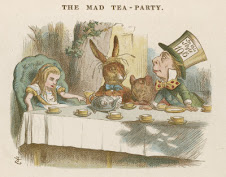
The Cold Civil War and the Fight Against the Divine Right of Party

In a guest column at The Hankster, Bryan Puertas argues that Democratic-Republican party politics has degraded into a "cold civil war".  He writes:
Congratulations America, we have our own War of the Roses, a cold civil war that has been going on for over a century. It may sound like hyperbole, but it’s helpful as a way to wrap your head around current events and decide how to move forward. This country was founded as a haven for those looking to escape the dynastic warfare of the old world, yet we have regressed to the point where we are saddled with two rival houses, alike in indignity, who tell us if only the other was out of the picture then they could finally get around to solving our problems. In the meantime, we are falling further and further behind on our economy, infrastructure, and quality of health and education. In short, the refusal of the parties to address problems unless they hold all the cards has made us broke, broken, sick, and stupid.

And mad. Definitely mad. Mad enough to renounce fealty to the parties and look to solve our problems ourselves. In less than a generation, the number of voters declaring their independence has grown to over 40%. And among the young, that number is over half. We have checked the Constitution, and there is no Divine Right of Party. Yet these two private clubs have infiltrated every branch of government, and their only interest is in keeping their position at any cost, regardless of who suffers. It is that spirit of party uber alles that holds back any progress or innovation, and if we are to move forward as a country, that is the biggest battle to be fought.

What does that battle look like? . . . 
Read the rest.  Puertas is an organizer for the Independence Party of New York and Independent Voting.

Number of States with a Ballot-Qualified Third Party at 100 Year High

In addition to the many other historic records set by the third party and independent political movements this year, the number of states with a ballot-qualified third party is at a nearly 100-year high.  From Ballot Access News:

In the aftermath of the November 2010 election, 35 states plus the District of Columbia have at least one ballot-qualified party other than the Democratic and Republican Parties.  This is the highest such number, immediately after a midterm election, for any election since 1918.
The 15 states without a ballot-qualified party (statewide), other than the Democratic and Republican Parties, are:  Alabama, Arkansas, Illinois, Iowa, Kentucky, Maryland, New Hampshire, New Jersey, North Dakota, Oklahoma, Pennsylvania, South Dakota, Tennessee, Virginia, and Washington.  New Mexico is ambiguous; it has two parties that are ballot-qualified for President in 2012 but they cannot run nominees for office other than President without submitting petitions for them.  Connecticut is also somewhat ambiguous, because qualified status is determined office-by-office, but there are four minor parties that are now qualified for at least some statewide offices.

The Democratic-Republican Party's Political Class War Against the People of the United States

From a letter to the editor of the Napa Valley Register:

This recent election has set my mind running wild in thought. Once again I personally feel we had no choice in voting for a leader, but instead voted for the person who would do the least damage. To me this is not a choice, and has not been a choice to pick a leader for the last 20 years. The debate brought this fact to the forefront of my mind. With six candidates running for the governor’s office, we got to hear the views of only two of them. It is obvious the only views worth hearing, or of any importance, are determined by both the Republicans and Democratic parties.
To me, there is no difference between the actions of the two parties, and only minor differences in philosophy between the two. They are both self-serving groups and not community-serving groups.
I do not see the purpose anymore for the two parties, because they are thinking as party members and not Americans. I think of the Constitution stating “We the People,” as a group of individuals banning together for a common good. Now I look and see the Democrats and Republicans banding together for the “party good,” not what is good for America. This is both sad and dangerous. . . .
Read the rest. 

Poll: Independent Identification Increases, Democrats Drop, Republicans Hold Steady

A new poll from the Pew Research Center gauging the public's reaction to the 2010 general elections finds a drop in the number of self-identified Democrats and a slight rise in the number of Independents.  Asked if they consider themselves Republicans, Democrats or Independents, 37% of respondents stated that they are Independents, compared with 30% who identified themselves as Democrats, and 26% who said they are Republicans.  According to Pew's polls, Republican identification has hovered in the mid-20% range for virtually the entire year, while Democratic identification has remained in the low-30% range.  Independent identification, on the other hand, has consistently remained in the high-30% range, and scored the highest percentage of any political label at the beginning of the year, when 42% of respondents stated that they were Independents. 

Among the poll's most ironic findings, it turns out that compromise is a fairly divisive issue in the United States.  Americans do not agree on the question of whether politicians should stick to their positions or seek compromise.  From the poll:

The public is divided about the value of political compromise. While 42% say that they most admire political leaders who make compromises, 45% say they most admire political leaders who stick to their positions without compromising.
There are partisan differences in views about whether political leaders should compromise. A majority of Republicans say they most admire politicians who stick to their positions, rather than make compromises (55% vs. 33%). These opinions are little changed from September.
Democrats are now evenly divided – 46% prefer political leaders who make compromises while 45% prefer leaders who stick to their positions. In September, more favored politicians who compromise over those who stick to their positions (by 54% to 39%). 
About half (49%) of independents admire political leaders who make compromises with people they disagree with, while 40% admire politicians who stick to their positions without compromising. Two months ago, a majority of independents (53%) said they preferred politicians who stick to their positions over those who compromise (40%).

Alaska's Independent Majority and the Case Against Closed Primaries

Early reports out of Alaska indicate that Lisa Murkowski has a very good chance of winning the state's US Senate election as a write-in candidate.  Via Memeorandum, the Anchorage Daily News reports:
Almost 98 percent of write-in ballots opened Wednesday went to Lisa Murkowski on the first day of a count meant to decide Alaska's U.S. Senate race. . . . Elections workers opened the write-in ballots for almost 20 percent of the precincts in Alaska on Wednesday. The count of more than 90,000 write-ins will continue today and is expected to last five days.
The New York Times reports that 231,756 votes were cast in the race:  40.1% were for a write-in candidate, 35.5% went to Republican Joe Miller, 23.4% supported Democrat Scott McAdams, and .5% were cast for Libertarian David Haase.  If Murkowski's write-in campaign proves victorious, she may well end up becoming the third Independent in the US Senate.  Why would she continue to affiliate herself with a party from which she was effectively ousted after Republican voters rejected her in the primary?

Furthermore, if she were to declare her political independence, Murkowski would not be an eccentric or an outlier.  Indeed, her affiliation or lack thereof would be a more precise reflection of Alaska's electorate, as the majority of registered voters in Alaska are themselves Independents.  This latter fact is something the ideologues in the Republican and Democratic parties would rather we all ignore. 

Democrats and Republicans together only account for 41.5% of Alaska's voters, 52% of whom are not affiliated with any party, according to a registration table at Pollster.com.  This simple fact has far-reaching political consequences.  Because Alaska has closed primaries, i.e. only party members can cast ballots in primary elections, the majority of voters are disenfranchised from the process by which candidates for public office are selected to appear on the general election ballot.  Joe Miller won the GOP primary against Murkowski with just under 50,000 votes, which comes to to roughly 37.7% of registered Republicans, and only 9.7% of registered voters!  See this post on turnout in the Alaska GOP primary.  Even the New York Times has begun to question the wisdom of maintaining the current primary system in the face of an Independent majority.  Today Matt Bai writes that "Alaska may offer a view of future elections":
Something like 230,000 Alaskans appear to have cast ballots in this month’s midterm election, compared with fewer than 146,000 who voted in the Republican and Democratic primaries combined . . . What all of this probably means is that some critical number of independent voters decided they didn’t like the options the two parties had given them, and they were willing to go to the trouble of writing in a candidate who seemed to have a real chance of winning rather than pull levers A or B. 
This was bound to happen somewhere. There was a time in America when our primary process made perfect sense, because most voters identified closely with one party or the other, and it was safe to assume that someone who wanted to participate would choose a team. In the 1950s, independents lagged behind both parties, making up less than a quarter of the electorate.
That number has risen steadily, however, especially among younger voters, to the point where independents have recently overtaken both parties, hovering around 40 percent. A recent Pew Center poll found that the number of voters who identified themselves as independents had risen five percentage points since 2002.
You have to wonder, given this trend, whether the primary process as we’ve known it can remain tenable. With each passing year, it seems, an ever smaller group of voters in either party — rallying, in a year like this one, around ever more extreme points of view — get to effectively determine the options for the rest of the electorate.
Bai concludes by wondering whether we will see more states move toward an open primary system, like that which is soon to be implemented in California.  With the rising number of Independents in the country, it will become ever more difficult to justify the continued existence of closed primary elections.  Why should taxpayers have to foot the bill for the primary elections of minority and fringe parties like the Republicans and Democrats, when the majority of taxpayers are prohibited from voting in those elections and effectively disenfranchised from the political process?

Update and Correction: In the comments, Dale corrects an error in the above regarding Alaska's primaries.  He writes:  "Primaries in Alaska are only partially closed. Parties have the option to limit who can vote in their primaries. Only the Republican party does so, and they choose only to exclude registered members of other parties; non-partisan and undeclared voters are welcome though."  It turns out I mistakenly referenced an outdated listing of states with open vs. closed primaries at Fair Vote rather than their current one, which appears correct.  Thanks Dale!

Even despite the fact that Alaska's primaries are only partially closed, there is still significant support for fully open primaries in the state.  For instance, see this article at the Juneau Empire, in which the author speculates that turnout in the state's semi-closed primaries is so low because Independents likely favor candidates from more than one party and thus "their preferred candidates in all the races were split up on the two ballots."  He argues that, "A completely open primary in a state dominated by independent voters would serve the people better" than the existing semi-closed system.

For more information about factual errors on the internet, see this article from The Onion.

Third Party Strategy and the Cult of the Executive, Part II

Democrats are among the least independently-minded voters in the United States.  Compared with self-described Republicans and Independents, Democrats are generally the most likely to believe all or most of what they hear or read from any given news source, and they are least likely to consider voting for any candidates other than those endorsed by their party.  The denunciation and denigration of third party and independent politics and activism is, of course, a favorite pastime of liberal Democratic bloggers, but few things in the mainstream media arouse their ire and incomprehension as much as incessant speculation about the possibility of a viable Independent candidate for the presidency.  Content in their ideological and political chains, they find it difficult to believe that others might desire ideological and political freedom and independence.  As you might know, NYC Mayor Michael Bloomberg recently stated that an Independent president would be superior to a Democrat or Republican.  From the Washington Post:
Mayor Michael Bloomberg, an independent who has considered running for president, declared Monday that an independent has a better chance at succeeding in the White House than a Republican or a Democrat . . . at Harvard University on Monday he endorsed the idea of an independent in the White House. "I think actually a third-party candidate could run the government easier than a partisan political president because the partisan political president - yeah he's got half the votes, but he can't get the others - whereas the guy in the middle may very well be able to get enough across the aisle," Bloomberg said. 
Matthew Yglesias thinks such talk is literally "madness."  (See also this article at the WaPo.)  Responding to the "endless discussion of a Michael Bloomberg third party presidential bid," the reliable Democratic party ideologue and proponent of the two-party state tries to "get at the core madness of this talk."  He asks: "Just what do people think a third party president would do?"  In answer he writes:
The question that needs to be asked about all these notions is what kind of legislative coalition is President Bloomberg supposed to be governing with? . . . I bet a third party president would initially impress people with his bold truth-telling and lack of need to cater to old bulls on the Hill. But it would swiftly become apparent that the constitution hasn’t been repealed, that the only bills that pass are the ones members of congress will vote for . . . 
Yglesias is right.  But the answer to his question is rather simple.  People think a third party president would have the exact same magical powers they believe every president has, because they have been indoctrinated into the Democratic-Republican party's cult of the executive.  Many Independents likely believe that, if an Independent were in the White House, he or she would be able to wave the president's imperial wand and solve the nation's problems at will.  In other words, their thoughts on this issue would be virtually indistinguishable from those of most Democrats on the eve of Obama's inauguration or those of Republicans on the eve of George W. Bush's.

As I've argued before, though, one of the greatest benefits of an Independent President might be its demonstration of the weakness of the presidency.  Imagine, if a combative Independent president were opposed by Congressional Democrats and Republicans at every turn, it might be very difficult for him to simply start a new war or expand an ongoing one at will, for instance.  Congressional Democrats and Republicans might suddenly recall that there's a document called the Constitution, which specifically gives the power to declare and fund war to the Congress rather than the president. 

Nonetheless, having argued that an Independent president would be hamstrung by a partisan legislature, Yglesias inadvertently makes the case for the election of third party and Independent candidates to the US House and Senate in his conclusion.  He writes:
members of congress all belong to parties. The only way you’d be able to get anything done would be to find a way to work within the party system somehow. The point is that most of the stuff people like to decry about American politics—the venality, the small-minded partisanship, the bickering, the corrupt deals—happens in Congress. Wishing for a different president doesn’t address any of it.

In the comments to my recent post on the necessity of an immoderate moderatism, Cranky Critter coincidentally concurs with Yglesias's diagnosis and makes the case for an Independent coalition in the House and Senate.  He writes:  
I REALLY hope that we don't see a big showy viable moderate or independent candidate for President in 2012. Such an effort is likely to use up all the available air in a way that gives one big flash, and not a sustained burn.

I'd be much happier if the idea of an independent coalition centered on congress, on forming a viable caucus that was disruptive to 2-party dominance. After all, it's in congress where most partisan behavior really manifests.
Indeed.  But the question of whether to focus attention and resources on high-profile executive and statewide offices or on local executive and legislative seats, is an important and perennial strategic issue for advocates of third party and Independent politics.  At Green Party Watch, Ron Hardy recently addressed the issue at length in an election wrap-up post on Green Party gubernatorial candidates.  He writes:
In the post election chatter, some have questioned why Greens bother to waste the resources to run for Governor when the odds are so stacked against them . . . I would argue that running a green party candidate for a high profile state-wide race has several benefits . . . First, it has the potential to influence the dialogue by putting Green Solutions out front . . . Second, it has the potential to raise awareness of the Green Party statewide . . . Third, it gives all the Greens out there someone to vote for . . . Finally, political parties run candidates. That is how they are defined. If the Green Party doesn’t run candidates, they aren’t a political party . . . 
As Independents are not a party, however, this changes the calculus here to some extent.  Ideas?  See also Third Party Strategy and the Cult of the Executive, Part I.

60 Year High: Independents Elected to State Legislature in 10 States

From Richard Winger at Ballot Access News:
Thanks very much to Morgan Daybell for helping me find instances at which independent legislators were elected or re-elected last week.  It appears that independents were elected to state legislators in 2010 in Alabama, Georgia, Kentucky, Maine, North Carolina, Rhode Island, South Dakota, Tennessee, and Vermont.  We are still waiting to see if one was elected in Colorado.  Whether this list ultimately contains 9 states or 10 states, it appears more states elected independents to state legislatures this year than in any previous year in at least sixty years. Louisiana and Virginia also have independent state legislators, but those two states didn’t have legislative elections this year.
At Independent Political Report, Paulie has put together a handy link-list to reports on those newly elected Independents:
• Rhode Island Independent State Senator Re-Elected
• Kentucky Re-Elects Independent State Senator
• Tennessee Independent Legislator Re-Elected
• Rusty Kidd, Independent Georgia Legislator, Re-Elected
• Independent Elected to South Dakota House of Representatives
• Independent Elected to Wisconsin Legislature
• Alabama Elects First Independent to State Legislature Since 1983
• North Carolina Independent Candidate Elected to State Legislature
• Colorado Hasn’t Determined a Winner in Legislative Race Involving Independent Write-in Incumbent
• Green Party Activist Elected to Maine Legislature as an Independent Candidate

The Paradoxical Necessity of an Immoderate Moderatism

In recent months there has been a fair amount of speculation among political observers regarding the possibility of an emerging moderate movement for political independence from the Democratic and Republican parties.  The evidence is difficult to ignore.  It seems like not a week goes by without any number of articles considering possible moderate, Independent candidates for president in 2012.  As perceived moderates are purged from both the Democratic and Republican parties, there is literally nowhere for them to go, except third party or Independent.  Lincoln Chafee won Rhode Island's gubernatorial race by running as a moderate Independent alternative to the stooges of the Democratic and Republican parties.  Moreover, in the very same race, the Moderate Party of Rhode Island secured enough votes to be assured ballot access in the state for the next four years.  In Maine Eliot Cutler came within two percentage points of winning the state's gubernatorial race following a very similar strategy to that of Chafee.  Earlier this year, the Centrist Party merged with the Modern Whigs with the aim of building a national moderate alternative to the Democrats and Republicans.   Jon Stewart billed his Rally to Restore Sanity as the Million Moderate March.  New groups like No Labels reject the failed politics of the Democratic-Republican two-party state.  And so on. 

Moderate and centrist bloggers have recently begun a discussion of the so-called "moderate brand," or rather, the lack thereof.  Late last month, at The Pragmatic Center, Nick Goebel asked, "Moderates: What is our brand?"  Goebel writes:
The biggest problem that voters have with moderates is that they seem to be “wishy-washy.”  Moderates never seem to have principles.  They sit on the fence playing politics instead of promoting the issues.  They lack character, decisiveness, and strength. . . . Conservatives market themselves as the small government, less taxes, free trade candidates.  Progressives market themselves as being on the side of the “average American” and utilizing government to help all people not just those at the top.  But what are we?  As moderates we are “wishy-washy.”  Not very appealing.  My opinion isn’t that we should “rebrand” ourselves; it’s that we never learned how to market ourselves in the first place.
In response, Solomon Kleinsmith at Rise of the Center notes that managing the perception of moderates "will be essential as the groundswell of moderates and centrist independents begins to coalesce into a movement in more places around the country."  It is difficult to quibble with Goebel's proposition that moderates cannot "re-brand" themselves because they never branded themselves in the first place.  Indeed, moderates have effectively allowed themselves to be defined by the dead-enders of the duopoly parties, the partisans of the Democratic and Republican political brands.  Self-described liberal Democrats and conservative Republicans each define themselves, first and foremost, in opposition to the other.  Secondarily, however, they position themselves against the moderates in their own parties, painting the latter as virtual turncoats, lacking character, decisiveness and strength. 

On this view, moderate Democrats are not "real" Democrats, they are Blue Dogs, Republicans in disguise.  Similarly, moderate Republicans are not "real" Republicans, they are RINOs, Republicans-in-name-only.  Insofar as the Democratic and Republican parties in particular, as well as Democratic-Republican party politics in general, are defined and controlled by their respective activist bases, this assessment should probably be considered correct.  If you consider yourself a moderate independent, for all intents and purposes, you cannot belong to the Democratic or Republican party.  How could things be otherwise if moderate independents are in fact marginalized by the process of Democratic-Republican party politics? 

If moderate, centrist independents want to rehabilitate their brand, as it were, they must cease to allow the advocates and supporters of the Democratic and Republican parties to define it for them.  They must take control of it for themselves, and, in addition, they must define their opposition.  The simplest and most straightforward way to accomplish both of these goals at one and the same time is to declare political independence from the Democratic and Republican parties and the politics of the two-party state. 

So long as Democratic-Republican party politics is definitive of politics as such, our politics will exclude and marginalize those who advocate moderation, centrism and independence.  Compromise between Democrats and Republicans does not equal moderation.  Their common solution to every problem is the further expansion of the global warfare and corporate welfare state.  The political center is not where the Democratic and Republican parties meet.  It cannot be, if only for the simple fact that the politics of the two-party state is radically decentered, because it is bipolar.  However, the partisans and proponents of the Democratic and Republican parties are unified in their opposition to moderation, centrism and political independence.  So long as moderates continue to provide political cover for the Democratic and Republican parties, until they offer alternatives to the reproduction of Democrat-Republican party government, they will in all likelihood be incapable of controlling their own political reputation, if not also their political destiny. 

The Democratic and Republican Parties are the Primary Obstacle to Democratic, Republican Government

In an op-ed for New York Newsday, Jacqueline Salit, the president of IndependentVoting.org, argues that the primary obstacle to representative government in the United States is the Democratic-Republican two-party state and duopoly system of government.  In the piece, entitled "Goodbye Two-Party System," she writes:

Name a problem — poverty, war, out-of-control spending. The political parties offer themselves as the solution to all of the above, and more. We respond by voting for first one party, then the other, then back again. We want to let the world know we are unhappy, but we haven’t yet developed the creative capacity to rearrange the world around us . . . This is American politics 101. The cure for whatever ails us is . . . more of the same. . . . But Americans are starting to move beyond the parties, even beyond partyism. That’s the dynamic story unfolding on the edges of the midterm battleground.
Salit goes on to make the case for open primaries, but on the model of the so-called "top-two system" like that in Washington and soon to be implemented in California.  As you probably know, on this model, all candidates for a given office participate in the same primary election, in which all voters are allowed to cast a ballot, and the top-two vote-getters proceed to the general election.  While the argument for open primary elections, as such, is quite persuasive, closed general elections are not likely to result in a more representative government or more perfect Union.  Supporters of top-two have yet to make a strong case to support the counter-intuitive notion that restricting the scope of choices on the general election ballot will lead to more political competition and more adequate representation.  That aside, Salit concludes by questioning the very existence of the reigning two-party state:
The parties are so deeply embedded in government and in the structure and design of America’s electoral process that they never have to justify their existence to voters. But at a moment when there is across-the-board dissatisfaction with partisanship, shouldn’t they have to? Shouldn’t we have the opportunity to create alternatives — nonpartisan (rather than bipartisan) governance, campaigns based on healthy debates about new ideas, unorthodox coalitions and an environment that fosters innovation?  Right now the parties stand in the way of all that.
Thanks to The Hankster for the link.

TPID: 2010 Elections Wrap-Up

The 2010 elections were a mixed bag for the third party and independent political movement.  Public discontent with the Democratic and Republican parties undoubtedly raised the profiles of third party and independent candidates for office across the country and at all levels of government.  Yet, that discontent did not translate into deep and widespread support for third party and independent alternatives to the false choice offered by the Democratic and Republican parties.  At the same time, however, there were quite a few notable successes:
• Rhode Island elected its first Independent governor, Lincoln Chafee.  
• In Maine, Eliot Cutler further demonstrated the viability of Independent politics, besting his Democratic rival for second place in a contest which the Independent ultimately lost by only a few percentage points. 
• In Colorado, Tom Tancredo's late entrance into the gubernatorial race significantly raised the national profile of the Constitution Party, and demonstrated the viability of third party politics, besting his Republican rival for second place in the race.
• Third parties gained or retained ballot access in California, Colorado, Connecticut, Massachusetts, Missouri, Nebraska, New York, Oregon, Rhode Island, Texas, and Wisconsin.  See this preliminary report at Ballot Access News.
• The Vermont Progressive Party has likely won seven seats to the state legislature.  
• Over 1,000,000 votes were cast for Libertarian candidates for US House across the country.
• Green Party candidates won a number of elections for local offices across the country. 
• Candidates of the Independent American Party of Nevada won four races for local offices.
I launched Third Party and Independent Daily at the beginning of this year in the expectation that 2010 would be an historic year for third party and independent politics in the United States.  And, as numerous studies have shown, it was.  But we still have a long way to go.

Cross-posted from TPID.  

Student-Columnists Blast the Two-Party State, Call for Third Party and Independent Alternatives (Updated)

Over the last few weeks, in opinion pieces for college and university newspapers across the country, students have stepped up their criticism of the reigning two-party state and duopoly system of government.  AJ Warne writes for the Daily Athenaeum, out of West Virginia University, and argues that the "rise of a third (or fourth) party will better the political landscape." An excerpt:
The United States is taking leaps and bounds toward a more effective and self-regulating political system even if it is going unnoticed. The bipartisan system that has constipated the political processes of this country for the greater part of its existence is beginning to change a little each year, but this year more than any other in the past.

The changes taking place in the United States are very important and should force voters in every state to look beyond the party of their parents and the normative party lines seemingly etched in stone from generations before. The abandonment of a strict left or right political system will instigate political creativity, foster better political cooperation and ultimately benefit the American people. For the past several elections, candidates who are not typical of one party or another have started popping up all over the map. . . . .

It is asinine to believe the political beliefs of an entire nation can be lumped into two aged categories.  The advent of parties that do not follow the conventional left or right of center dichotomy will lead to systemic changes and benefits that will be reaped by the entire nation. This will make policymaking more difficult, but more good will come from the increased labor to bear the same policy fruit.
In another piece, from Brittany Forell, writing at the Standard Online out of Missouri State University, the author reminds her fellow students that "voters have a third option on election day."  Excerpt:
Here it is. Election Day. What will it be, Springfield? Carnahan or Blunt? For me, I say neither. We have been told countless times to accept that we live in a two-party system. "Vote for a Democrat or a Republican - otherwise, you are throwing your vote away," my father used to say. Our country has a political history of valleys and peaks in a cyclical pattern. . . .

The cycle goes back and forth: Democrat, Republican, Democrat, Republican. Each time we decide the status quo is no longer working, we move one party out of Washington and bring the old one back in. In recent years, we decided President George W. Bush had destroyed the glory of our country with his Republican ways, and in came the Democratic savior, Barack Obama. As the current president's approval rating sinks down into the sewers, Americans are leaning back toward Republicans. In only two years, we have forgiven all of the transgressions of the Republican party. Out with the old and in with the... old. Must I repeat that exhausted description of insanity? We do the same thing over and over again and expect different results.  There is another option. Minor or "third" parties have a long history in American politics . . .
Finally, in an opinion piece for The New Hampshire, out of the University of New Hampshire, Nick Murray argues against the old cliche that voting third party is "throwing your vote away." Excerpt:
When we see two candidates, one Democrat and one Republican, we feel as though we must pick one of the two. Why? Is it because putting a vote towards any other candidate won't count for the top two vote getters? Why does it matter? Will one vote sway an entire election? Not likely. Don't be duped into thinking that voting for anybody other than the Democrat or Republican is a "waste" of a vote. Your vote is your voice in the political process. As citizens of a functioning democracy, we have the unique ability to vote, something not many in the world can say. Make sure your vote is yours. . . .

Voting may be our only way to combat the oppressive two-party system. . . . . Casting a vote for a third-party candidate and even not casting a vote at all sends a message to the establishment that we are tired with the prevailing system. It is not, as some claim, "throwing a vote away." Today, New Hampshire voters have alternative choices rather than the stale establishment candidates in contests for Governor and Senate. In Libertarian candidates John Babiarz and Ken Blevens, voters in the "Live Free or Die" state are allowed an outlet to voice their disgust with the prevailing political system. . . .

Americans will press the button for "change" for the third time in three elections today. We tried to send the message to Washington in ‘06 and ‘08, and we have yet to find leaders who will put the people before their party or themselves. It seems like we'll keep choosing "the other guy" until we get the change we're looking for. Unfortunately, this change will not come from either party as we know it today.
Update:  Today, writing at The North Wind, out of Northern Michigan University, Ryan Haskell argues that "America is not a two-party system."  Excerpt:
There is no constitutional or logical reason that we should be so restricted by the two parties. We need to break from the falsely created two party system. The solution is to get rid of the party system all together.

Why is the two-party system such a bad one? The simple answer is that it restricts our choices . . . . The major parties’ influence over our system shuts out all other choices and leaves us with a limited field of options from which to choose our representatives. If you don’t fit neatly into the Republican or Democratic camp, you are out of luck. It creates a false choice between two solutions when there is in all reality a multitude of possible solutions. We should be free to choose from a wide range of representatives and those we choose should be loyal to their constituents and their own conscience and not to an unelected party leadership looking for the best way to gain political points. So what can be done about it? . . .

The 2010 Elections and Democratic-Republican Bipolar Disorder

Following yesterday's general election, the 112th Congress will begin with a Democratic majority in the Senate and a Republican majority in the House.  This will be the second time the corporate parties have exchanged majority control of the House in the last five years.  While many Democrats were naive enough to believe, or cynical enough to pretend, that their victories in 2006 and 2008 were the result of something other than a simple rejection of undivided Republican Party government, this year the GOP is all-too-aware that their victory was ensured by voters' rejection of undivided Democratic Party government.  The Hill quoted John McCain admitting as much just yesterday:
The 2010 election results should not be interpreted as an "affirmation" of Republicans, Sen. John McCain (R-Ariz.) said Tuesday. . . . "The moral of this story is that this election is a repudiation of Obama and the Democrats," McCain said on Fox News. "It is not an affirmation of Republicans. So Republicans have got to come through and satisfy this outcry — this anger and frustration — that's been expressed."
Republican-friendly pollster Scott Rasmussen made much the same point in an op-ed for the Wall Street Journal on Monday, in which he argues that these quickly shifting majorities express a fundamental rejection of both ruling parties:
tomorrow Republicans will send more Republicans to Congress than at any time in the past 80 years . . . This isn't a wave, it's a tidal shift—and we've seen it coming for a long time. . . . But none of this means that Republicans are winning. The reality is that voters in 2010 are doing the same thing they did in 2006 and 2008: They are voting against the party in power.

This is the continuation of a trend that began nearly 20 years ago. In 1992, Bill Clinton was elected president and his party had control of Congress. Before he left office, his party lost control. Then, in 2000, George W. Bush came to power, and his party controlled Congress. But like Mr. Clinton before him, Mr. Bush saw his party lose control.

That's never happened before in back-to-back administrations. The Obama administration appears poised to make it three in a row. This reflects a fundamental rejection of both political parties.
A new poll from Rasmussen indicates that the American public does not expect to be adequately represented by the new governing majority:
Most voters expected Republicans to win control of the House of Representatives on Election Day, but nearly as many expect to be disappointed with how they perform by the time the 2012 elections roll around.

A new Rasmussen Reports national telephone survey finds, in fact, that 59% of Likely U.S. Voters think it is at least somewhat likely that most voters will be disappointed with Republicans in Congress before the next national elections. That includes 38% who say it is Very Likely.
These quickly shifting majorities indicate the fundamental inability of the Democratic and Republican parties to adequately represent the interests of the people of the United States.  Trapped by the bipolar logic of the two-party state, the only way for voters to express their discontent with the current Democratic majority was to cast their ballots for a party they favor even less.  As CNN reports today:
Democrats have a 10-point favorability gap: 43 percent of voters have a positive opinion of the party, while 53 percent aren't thrilled. The Republican Party also gets a thumbs-down from 53 percent of the nation's voters, with just 41 percent saying they're happy with the party.

Compare that with 1994 and 2006, when voters had a net positive view of the incoming party. The numbers suggest Tuesday night may signal a rejection of the Democratic Party -- but something less than an embrace of the GOP.
The American electorate clearly suffers from a form of political bipolar disorder, in which incidents of manic political enthusiasm alternate with lengthy depressive episodes.  The seriousness of the illness is all-too-clear from the fact that we have entered a lengthy stage of so-called rapid cycling, in which manic periods alternate ever more quickly with depressive episodes.  Today, Democrats are likely to enter a depressive state:
Signs and symptoms of the depressive phase of bipolar disorder include persistent feelings of sadness, anxiety, guilt, anger, isolation, or hopelessness; disturbances in sleep and appetite; fatigue and loss of interest in usually enjoyable activities; problems concentrating; loneliness, self-loathing, apathy or indifference; depersonalization; loss of interest in sexual activity; shyness or social anxiety; irritability, chronic pain (with or without a known cause); lack of motivation; and morbid suicidal ideation.
Republicans, on the other hand, will likely be found exhibiting signs and symptoms of mania:
Mania is the signature characteristic of bipolar disorder and, depending on its severity, is how the disorder is classified. Mania is generally characterized by a distinct period of an elevated, expansive, or irritable mood state. People commonly experience an increase in energy and a decreased need for sleep. A person's speech may be pressured, with thoughts experienced as racing. Attention span is low, and a person in a manic state may be easily distracted. Judgment may become impaired, and sufferers may go on spending sprees or engage in behavior that is quite abnormal for them. They may indulge in substance abuse, particularly alcohol or other depressants, cocaine or other stimulants, or sleeping pills. Their behavior may become aggressive, intolerant, or intrusive. People may feel out of control or unstoppable. People may feel they have been "chosen" and are "on a special mission" or have other grandiose or delusional ideas. Sexual drive may increase.
If someone you know exhibits any of the above symptoms, contact a political professional immediately for appropriate doses of partisan spin and propaganda.  Of course, this does nothing but mask the symptoms of the illness.  Political independence may be the only viable, long-term treatment for Democrat-Republican bipolar disorder.

Election Highlights

For now, an overview of some significant results from the 2010 elections:
• Rhode Island has elected its first Independent governor, Lincoln Chafee! 
• In Maine's gubernatorial race, Independent candidate Eliot Cutler's last minute surge was not enough to overcome the gap between himself and the Republican front-runner.  Cutler lost by under two percentage points, garnering 36.7% to Paul LePage's 38.2%. 
• In New York, the Green Party's candidate for governor, Howie Hawkins, received enough votes to ensure ballot access for the party for the next four years. On the Libertarian Party line, Warren Redlich appears to have come up about 5,000 votes short of the 50,000 vote threshold. 
• In Colorado, Tom Tancredo demonstrated that it is indeed possible to run a viable, high-profile candidacy for governor under the banner of a third party, in this case, the Constitution Party. 
• Ballot Access News reports that the elections have resulted in some parties gaining qualified status, and others losing it, in states across the country. 

Election Day: Vote Third Party and Independent

It's election day.  Declare your independence from the two-party state.  Vote third party and independent. 

Analysis: New York's General Election Ballot, 2010

On New York's general election ballot, 2010, there are at least four candidates in all of the races for statewide offices (excluding elections for the judiciary).  However, in the 241 races for US House, State Senate and State Assembly, there are only 39 contests in which there are more than two candidates on the ballot; and there are 37 in which there is only one!  These are just some of the findings from a Poli-Tea study and analysis of New York's general election ballot. 

(To check out NY's certified general election ballot for yourself, visit the web page of the New York Board of Elections and follow the appropriate links.  For links to all the ballot-qualified candidates for state-wide and congressional races in NY, see the New York State page at Politics1.)  

Introduction
New York is well known for its electoral fusion voting system.  Under this arrangement, a candidate for public office can obtain the endorsements of more than one political party.  On the ballot, the candidate's name is listed under the ballot lines of each of the parties by which he or she has been endorsed, allowing voters to cast their vote for that candidate under the party banner of their choice.  For instance, in the state's gubernatorial race, Democrat Andrew Cuomo has been endorsed by the Democratic Party, the Independence Party, and the Working Families Party, while Republican Carl Paladino will appear under the ballot lines of the Republican Party, the Conservative Party and the Tax Payers' Party.

This system is widely seen as empowering minor parties, since major party candidates seek to obtain their endorsements, which can prove decisive in a given contest.  In 2009, when Michael Bloomberg was elected mayor of New York City, it was the votes he received on the Independence Party's ballot line that provided him with his margin of victory over Democrat Bill Thompson.  However, if New York's minor parties simply endorse major party candidates in the majority of races, it becomes clear that they are not an independent force in the state's politics, but rather a rubber stamp in favor of the political status quo embodied by the Democratic-Republican party establishment.

Findings
What does the New York State ballot look like in the 2010 elections?  Excluding judicial contests, this year, at the top of the ballot there are:

• 7 candidates for Governor on 11 ballot lines
• 6 candidates for Lieutenant Governor on 10 ballot lines
• 4 candidates for Comptroller on 7 ballot lines,
• 4 candidates for Attorney General on 7 ballot lines
• 7 candidates for US Senator (Clinton vacancy seat) on 11 ballot lines
• 4 candidates for US Senate on 8 ballot lines 

• There are 29 seats in New York's delegation to the House of Representatives.  There are at least two candidates in all of these races.  There are more than 2 candidates in 9 of these 29 races (31%).  In 7 of these contests, there are 3 candidates; in the remaining 2 races there are 4 candidates.  

• New York's State Senate has 62 members.  In 8 of these races, or 13%, there are more than two candidates on the ballot.  There are 7 races with three candidates and one with 4 candidates.  In five of these races, or 8%, there is only one candidate on the ballot.

• There are 150 seats in New York's State Assembly.  There are more than two candidates in 22 of these races, which is just under 15%.  In 20 of the latter races there are three candidates, and there are four candidates in the remaining 2 contests.  However, in 32 of the races for NY State Assembly, just over 21%, there is only one candidate on the ballot.  

• The great majority of races feature only Democratic and Republican party candidates, often with the cross-endorsements of one or more minor parties.  The Working Families Party tends to endorse Democrats.  The Conservative Party tends to endorse Republicans.  The Independence Party can be found endorsing Democrats or Republicans.

• In races for US House, State Senate and State Assembly, the Conservative Party is running more independent candidates than any other minor party, with 4 candidates for US House, 4 for State Senate and 11 for State Assembly.  They are followed by the Working Families Party, which has endorsed 2 independent candidates for State Senate and 6 independent candidates for State Assembly.  (By 'independent candidate,' here, I mean an individual who has not been endorsed by the Democratic or Republican parties.)

• In the same set of races, i.e. US House, State Senate and State Assembly, the Green Party is running 6 candidates and the Libertarian Party only 1.  If the Green and Libertarian candidates for governor receive more than 50,000 votes in this election, their parties will be assured a ballot line for the next four years, thus potentially facilitating the growth of the Green-Libertarian opposition to the Democratic-Republican two-party state in New York.  

• Question: what do you make of the disparity between the multiplicity of candidates for all the statewide offices, versus the relative paucity of choice in district-based races?

• Question: what does the breakdown look like in your state?

Unfortunately, over the weekend, I did not have time to cross-reference this year's ballot with that of any previous election, and so cannot draw any conclusions on whether there are more or fewer independent, third party candidates on the New York ballot in 2010.  However, if you are in possession of such information, please relay the info or a link by email or in the comments.

If you'd like more detailed info on any of the above races, or categories of races, or about a specific party, feel free to ask in the comments.  I gathered a bit more info from the ballot than is relayed above.
 
http://www.wikio.com